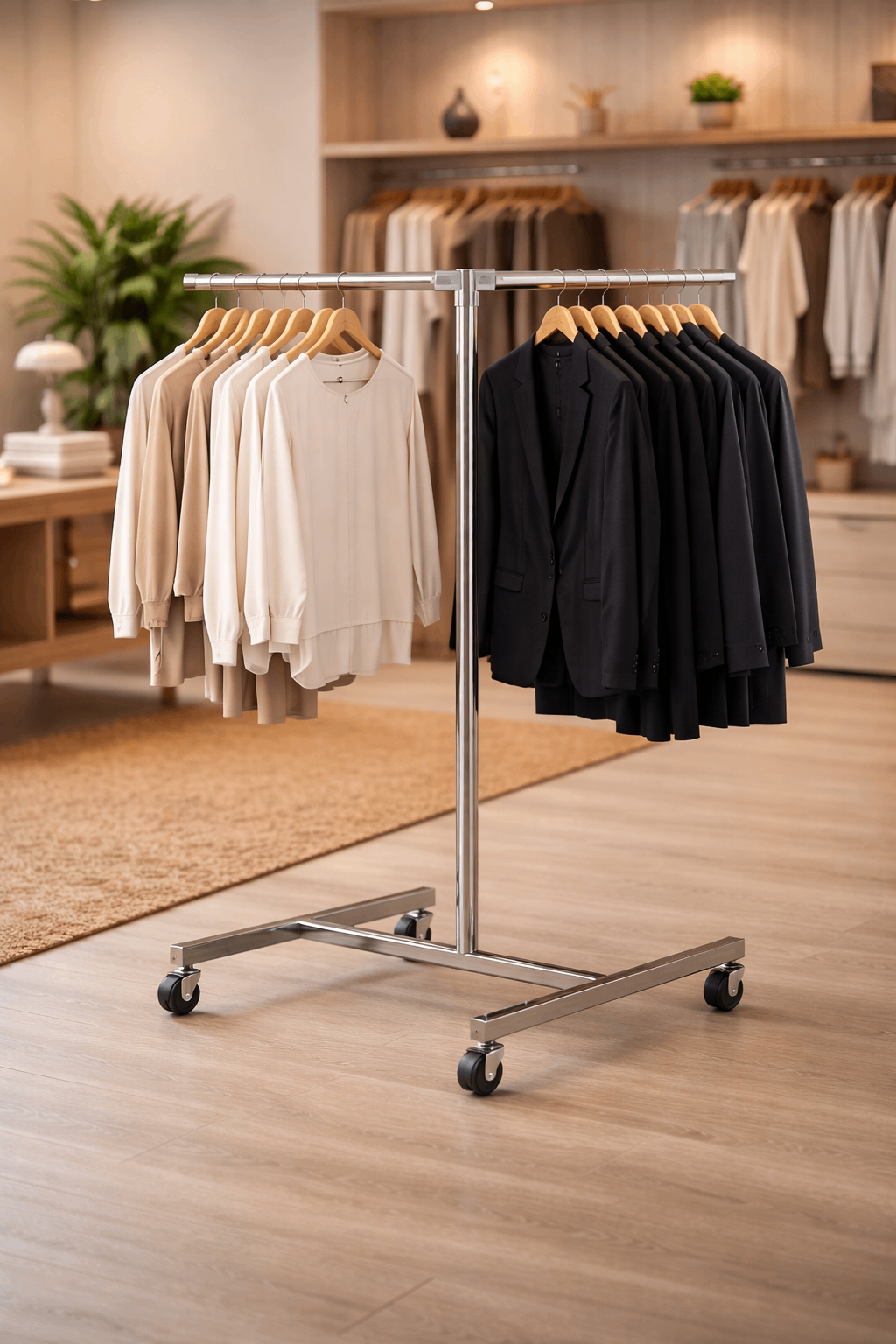
For overseas wholesale buyers, a garment display stand is judged by what happens after delivery: stability on the shop floor, consistency across repeat orders, and the cost of ownership over multiple seasons.
Boutique clothing displays change frequently—new arrivals, capsule drops, and promotional resets. A boutique store fixture metal 2-way garment display stand with casters supports fast layout updates without dismantling fixtures or adding labor cost.
Mobility also helps retailers react to sales data. When a rack can be rolled, locked, and re-zoned quickly, stores can feature high-margin collections and keep traffic flowing smoothly.
This page focuses on the product details wholesale procurement teams typically verify before placing bulk orders.
Wholesale procurement teams usually start with three checks: does it stay stable under real store loading, does it remain aligned after frequent movement, and can the structure be reproduced consistently across batches.
This fixture metal 2-way garment design is engineered for balanced load transfer. Two opposing arms distribute garment weight into a reinforced vertical column, reducing stress concentration at the weld joints and lowering long-term bending risk.
Compared with consumer-grade racks, this store fixture metal 2-way system uses commercial steel tubing selected for dimensional stability. Controlled tube thickness, welding precision, and column alignment help reduce replacement cycles and service issues for distributors.
A 2-way garment display stand increases presentation capacity without expanding the footprint. Parallel arms allow garments to face outward, improving visibility from both directions—useful for aisle placement and small boutique layouts.
The geometry is designed to manage uneven browsing behavior. When customers pull garments from one side, balanced arm layout helps maintain stability and reduces torque at the arm-to-column connection.
For wholesalers supplying chains, repeatable arm spacing supports planogram consistency. That makes store rollouts easier and helps ensure reorders match the original display standard.
The reinforced carbon steel frame is built for load-bearing durability. Precision welding improves joint integrity and reduces fatigue risk under repeated stocking and movement cycles.
The base platform uses anti-tilt geometry to stabilize the rack during uneven loading. A well-balanced base also prevents excess stress on casters and keeps the rack tracking straight when rolled.
For a garment display stand with wheels, caster mounting matters. Reinforced mounting plates distribute rolling forces through the base instead of concentrating stress at isolated fasteners.
A stand with casters should move smoothly and lock securely. Industrial lockable wheels provide controlled mobility and reliable positioning once placed.
Each caster is specified for commercial garment loads. Proper load rating supports stable rolling performance even when the rack is stocked at high density.
Wheel materials such as nylon or PU are commonly selected to reduce floor marking and improve rolling on tile, wood, vinyl, and polished concrete.
For wholesalers, higher-grade casters reduce post-installation complaints and warranty exposure—especially in multi-store deployments.
Material choice influences lifecycle cost. Carbon steel provides strong tensile performance and repeatable fabrication for large-scale wholesale procurement.
A powder-coated finish is often preferred for commercial apparel fixtures because it improves resistance to abrasion and corrosion versus conventional wet paint. Electrostatic application supports even coverage and adhesion.
Chrome plating can be specified for premium boutique aesthetics. In high-traffic zones, powder-coated surfaces typically deliver better scratch resistance and lower maintenance effort.
For chain rollouts, wholesalers often define gloss level and surface texture at quotation stage. Clear finish specification reduces batch variation and supports consistent boutique branding.
A heavy-duty garment rack must handle both static weight and dynamic stress. Static load is garment weight; dynamic stress comes from rolling, stopping, and customer interaction.
Typical guidance: each arm supports 30–40 kg under balanced loading, with total rack capacity around 60–80 kg depending on configuration.
Dual-arm load distribution protects weld joints and helps preserve vertical alignment over time. Durability planning also considers repeated rolling cycles—lower-grade racks often loosen at structural joints after frequent relocation.
For wholesale buyers, durability translates into lower total cost of ownership and fewer replacement orders driven by failure.
A well-proportioned 2-way garment display improves product visibility without making the floor feel crowded. That matters in boutique stores where curated presentation supports premium pricing.
Open-frame construction improves light penetration and multi-angle viewing, helping fabrics and colors present accurately. This is especially relevant for fashion merchandising focused on texture and shade.
A rolling garment display stand can be used as a flexible focal point: new-arrival zone, feature capsule, or seasonal drop. The ability to re-zone quickly supports fast testing of layouts and promotions.
For distributors, versatile styling across boutique, mall, and showroom formats reduces SKU complexity and increases addressable customer segments.
Boutique clothing displays often require scalable fixture solutions. A standardized garment display stand with casters can be deployed across multiple locations while maintaining consistent presentation.
Pop-up retail and short-term activations benefit from mobility. A rolling retail display rack with wheels reduces installation time and helps staff adjust layouts without tools.
Showrooms also benefit from stable but movable fixtures that can be repositioned during buyer meetings. Flexibility expands usage scenarios without sacrificing commercial stability.
Wholesale buyers sometimes compare a 2-way garment display with 4-way or fixed rail systems. A 2-way configuration is typically preferred for boutique layouts where floor space is limited and outward-facing visibility is important.
A 4-way rack may offer higher density in larger stores, but it can visually crowd smaller boutiques. Fixed racks provide maximum stability but limit layout flexibility. For stores that refresh displays frequently, a metal 2-way garment display with lockable casters often provides the best balance between capacity and mobility.
Wholesale buyers typically prefer structured options rather than unlimited customization. Modular configurations speed up quoting, sampling, and reorder cycles.
Common controlled options include arm length, finish color, and branding panels for boutique store fixture programs. These changes maintain production efficiency while enabling brand differentiation.
Flat-pack packaging improves container utilization and reduces freight cost per unit. It also helps wholesalers plan inventory and warehouse handling more efficiently.
Standardized hardware kits and clear assembly instructions reduce installation errors for overseas retail teams.
| Specification | Detail |
|---|---|
| Product Type | Metal 2-way garment display stand with casters |
| Material | Carbon Steel (stainless options by request) |
| Finish | Powder Coating / Chrome |
| Arm Type | 2-way garment display (straight or slanted by request) |
| Base | Reinforced anti-tilt platform |
| Casters | Lockable industrial wheels |
| Typical Load | 60–80 kg total (balanced) |
| MOQ | 50 Units |
| Lead Time | Approx. 30 Days |
| Certification | RoHS, ISO 9001 |
Export documentation and packaging standards can align with buyer requirements under EXW, FOB, CIF, or DDP terms.
For wholesale procurement, defined inspection points reduce risk before shipment. Typical checkpoints include verification of steel thickness, weld integrity at arm-to-column joints, surface finish consistency, and caster brake function.
Pre-shipment inspection may also review coating adhesion, color consistency, and rolling stability under simulated load. Clear QC criteria help protect distributors from post-delivery disputes and ensure batch-to-batch consistency.
| Option Category | Standard Configuration | Available Options |
|---|---|---|
| Surface Finish | Powder Coated Steel | Chrome / Custom Color |
| Arm Format | Straight 2-Way | Slanted Arms |
| Casters | Lockable Industrial Wheels | Nylon or PU Variants |
| Packaging | Flat-Pack (Knock-Down) | Customized Export Carton |
Defined configuration ranges support faster quoting and more predictable production timelines.
When sourcing a boutique store fixture metal program, buyers typically evaluate three practical areas: batch repeatability, logistics readiness, and documentation completeness.
Batch repeatability reduces the risk of mismatched reorders across store rollouts. Logistics readiness includes packaging strength, flat-pack feasibility, and labeling requirements for distribution centers.
Documentation supports faster purchasing cycles. Clear quotation scope, approved drawings, finish standards, and inspection checkpoints reduce misunderstanding and speed up approvals.
How stable is a 2-way garment display under uneven loading? Balanced arm layout and an anti-tilt base help maintain stability when customers browse one side more heavily.
Are locking casters necessary for boutiques? For layouts that change often, lockable wheels provide flexibility while keeping the rack secure during peak traffic.
Powder coat or chrome—what’s better for wholesale rollouts? Powder coating typically offers better scratch resistance and easier maintenance. Chrome can fit premium aesthetics but may require more care.
Can this ship flat-pack for export? Flat-pack options can reduce freight cost and improve container utilization, especially for volume orders.
How do we keep repeat orders consistent? Define critical dimensions, finish spec (gloss/texture), and material thickness at quotation stage so batches stay aligned.
If you are sourcing boutique clothing displays for wholesale distribution, this metal 2-way garment display with casters is designed to support repeatable store rollouts and day-to-day retail use.
Yishang Display can provide detailed specifications, controlled configuration options, and quotation support aligned with overseas procurement workflows. A short inquiry with your target quantity, finish preference, and desired dimensions is enough to start.


Yishang Display specializes in crafting bespoke display solutions. From initial concept and prototyping through to full-scale production, our in-house team manages every phase—delivering a seamless, one-stop experience for your brand.
If you have any questions or need a quote, please send us a message. One of our specialists will get back to you within 24 hours and help you select the correct valve for your needs.
All of our products are available for sampling