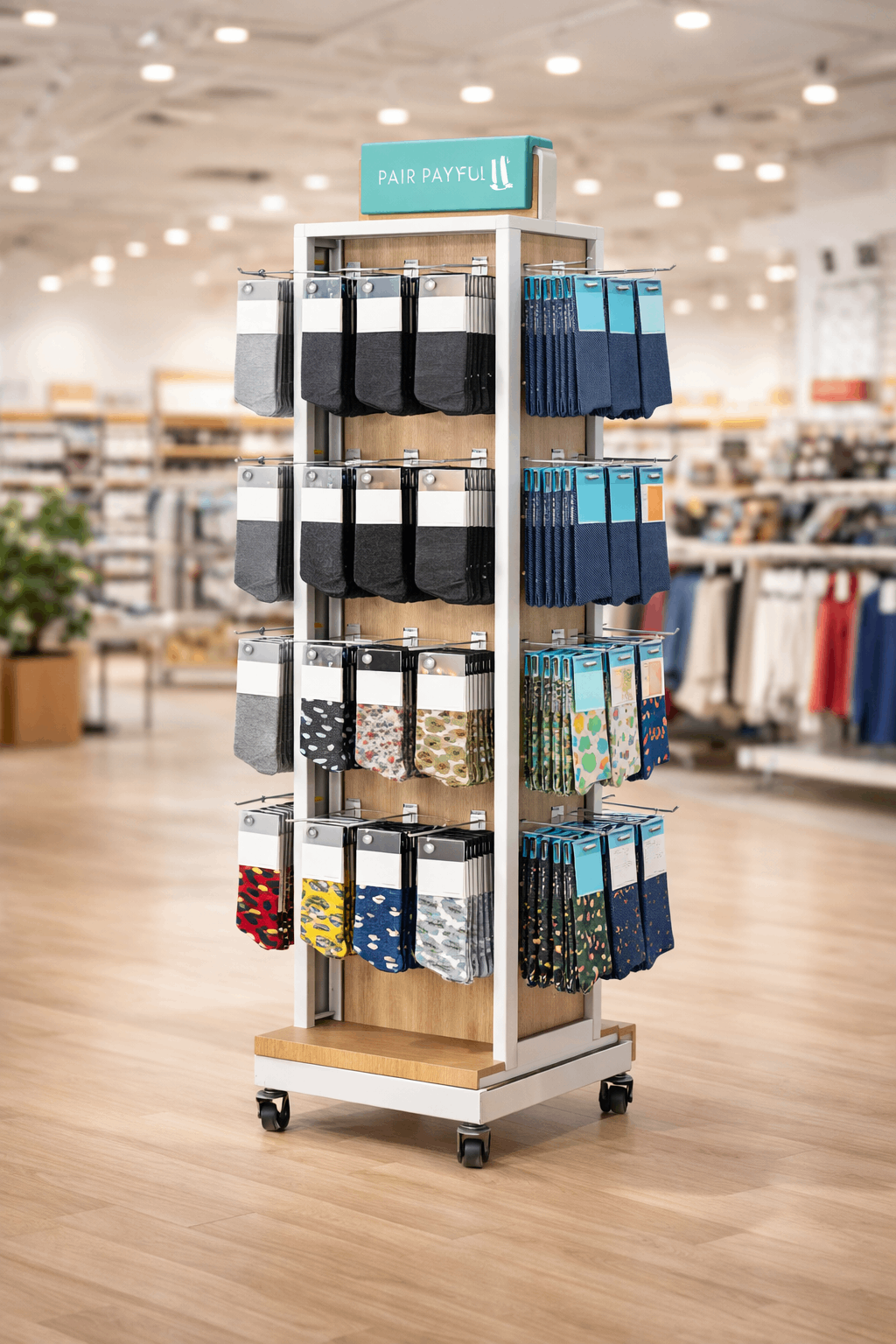
Quick specs for wholesale buyers: MOQ from 50 units • Lead time ~30 days • Trade terms EXW/FOB/CIF/DDP • Export packing for ocean freight • OEM/ODM available.
| Procurement item | Typical option |
|---|---|
| Product type | Floor sock display stand (hanging hooks) |
| Materials | Metal frame + wood base (acrylic header optional) |
| Branding | Custom logo header / interchangeable signage |
| Shipping format | Flat-pack (KD) or pre-assembled |
In overseas wholesale programs, socks and hosiery operate as a fast-turn accessory category with frequent replenishment and high SKU churn. Buyers evaluate a floor sock display not by showroom appeal alone, but by how reliably it performs after repeated customer contact, weekly refills, and seasonal resets. A well-engineered floor sock display that keeps packs front-facing and separated reduces in-store friction, protects packaging, and lowers store-level complaints. These outcomes directly influence sell-through, returns, and replenishment labor for distributors managing multi-store networks.
Retailers typically place a sock display stand for shop environments at interruption points along customer flow, such as aisle junctions, end caps, and the path between footwear and apparel. In these zones, a compact floor sock display stand concentrates SKU density without narrowing circulation. When stability holds under daily contact, store teams spend less time correcting misaligned hooks and more time replenishing inventory, an operational advantage that compounds across rollouts with tight labor budgets.
For wholesale buyers supplying multiple doors, predictability is decisive. A socks stand for shop programs must ship efficiently, assemble reliably, and present the same visual order across locations. Predictable performance enables standardized planograms, faster store onboarding, and fewer training cycles. Operational predictability often outweighs purely aesthetic differentiation when buyers assess a display stand for shop initiatives at scale.
Hanging presentation aligns with how shoppers scan small packaged goods. A socks hanging stand positions each unit at eye and hand level, supporting quick visual comparison across colors, sizes, and functional claims. This improves category clarity versus flat shelving, where overlapping packs hide product faces. Faster visual parsing shortens decision time and supports conversion in high-traffic aisles.
From a space-economics perspective, a floor sock display converts vertical volume into sellable frontage. Retailers measure revenue per square meter, and wholesalers must justify fixtures in premium zones. A hanging hosiery floor configuration presents more SKUs within a narrow footprint, helping buyers demonstrate that a display stand for shop programs increases assortment density without increasing space cost.
Merchandising teams value interruption placement for add-on categories. Socks are frequently purchased alongside footwear or apparel. A hanging hosiery floor sock display placed along natural traffic lines captures complementary demand without disrupting the primary shopping mission. Over multi-store rollouts, incremental lifts in attachment rate compound into meaningful category growth with manageable maintenance overhead.
Wholesale procurement centers on durability and repeatability. A metal wood hanging structure provides the rigidity required for daily retail contact while maintaining dimensional stability under full load. Compared with lightweight wire frames, a metal wood hanging design resists torsion and keeps hooks aligned, preserving a tidy visual grid that signals quality at shelf edge and reduces field adjustments over time.
The wood hanging hosiery floor base contributes to stability and perceived value. A solid wood base lowers the center of gravity, improving anti-tip behavior in crowded aisles. This reduces micro-movements that cause product rows to drift out of alignment and trigger store complaints. The wood surface softens the industrial look of metal, helping the fixture integrate with contemporary shopfitting schemes across fashion, sports, and lifestyle retail.
Where brand visibility is required, logo metal wood panels integrate cleanly without compromising structure. Acrylic header inserts keep print sharp under store lighting. Used selectively, these elements enhance brand presence while the metal frame and wood base carry the mechanical load needed for long service life.
Customization matters to wholesalers because packaging formats vary by market and season. A sock display stand for shop programs must accommodate slim sleeves, multi-pair bundles, and seasonal gift packs. Hook spacing and orientation can be tuned to packaging width so products hang cleanly without crowding. This protects packaging edges, reduces snagging during replenishment, and preserves category order during peak trading periods.
Brand programs often require visible identity without overwhelming product faces. A custom logo metal wood header establishes ownership at distance while keeping the focus on merchandise at browsing range. Finishes can be matched to store palettes to avoid visual conflict with surrounding fixtures, supporting retail acceptance when proposing a display stand for shop initiative.
For multi-location rollouts, repeatable customization is as important as flexibility. OEM programs benefit from controlled drawings, agreed tolerances, and stable finishes so subsequent batches match earlier deliveries. Buyers managing phased deployments prefer fixtures that can be reordered with confidence, reducing rollout risk and protecting replenishment timelines.
Lifecycle cost is shaped by operational details. Although socks are light, cumulative load across dozens of hooks can stress under-engineered frames. A floor sock display built on rigid geometry distributes load evenly and minimizes flex during customer interaction. Over time, this preserves hook alignment and reduces field corrections that slow replenishment.
Mobility supports promotional cadence. Lockable casters allow staff to reposition a floor sock display stand during campaign resets while keeping the unit stable during trading hours. Stability features protect planogram compliance, especially in busy corridors where carts and strollers pass close to fixtures.
Maintenance efficiency influences wholesale acceptance. Durable finishes resist abrasion from routine cleaning. Rounded hook profiles reduce packaging wear. When staff can replenish quickly without dismantling parts, stores maintain presentation standards with less labor, improving the economics of display stand for shop programs at scale.
Clear specifications support procurement and logistics planning. Buyers compare landed cost, container utilization, and assembly time across suppliers. The ranges below reflect typical options for a floor sock display stand using metal wood hanging construction and can be tuned for project requirements.
| Attribute | Typical Specification Range |
|---|---|
| Primary Structure | High-gauge steel or aluminum frame |
| Base | Solid wood with protective coating |
| Header | Acrylic or composite logo panel |
| Configuration | Single-, double-, or multi-sided |
| Hook Density | Tuned to packaging width and SKU mix |
| Finish | Powder coat or retail-grade paint |
| Stability | Anti-tip geometry; lockable casters optional |
| Assembly | Flat-pack or pre-assembled for export |
| MOQ | Project-defined minimums |
| Lead Time | Standardized windows for custom builds |
| Shipping | EXW, FOB, CIF, DDP supported |
| Compliance | RoHS-aligned materials; ISO-aligned QA |
For wholesale programs, shipping efficiency is a cost driver. Flat-pack options reduce cubic volume, improving container utilization and lowering freight per unit. Consistent export packing protects finishes during transit and shortens store installation time during regional rollouts.
In brand-led environments, a socks stand for shop applications anchors the category near footwear or accessories. The mixed metal wood hanging aesthetic complements contemporary interiors while maintaining robustness for high-contact areas. Clear SKU separation helps premium ranges retain visual order during peak traffic.
In supermarkets and department stores, where assortment breadth is high, a display stand for shop use consolidates hosiery into a compact vertical footprint. This improves wayfinding and reduces shelf sprawl. For chains, standardized floor sock display modules simplify central planning and ensure consistent execution across doors.
Promotional zones benefit from mobility. Seasonal themes and sports collections often need temporary emphasis. A hanging hosiery floor sock display that can be repositioned allows retailers to react to traffic patterns without permanent refits, preserving flexibility across campaign calendars.
Buyers ask how customization affects timelines and cost. When packaging dimensions, target SKU counts, and branding assets are provided early, drawings can be confirmed faster and samples aligned with production intent. This reduces iteration risk and helps wholesale schedules stay on track.
Repeatability is another priority. Buyers want assurance that subsequent orders will match earlier batches in finish and fit. Controlled processes and stable supplier ecosystems in Guangdong province China support consistency across runs, protecting phased rollouts and replenishment programs.
Lifecycle value also matters. Components that can be serviced or replaced in the field reduce downtime. A well-engineered sock display stand for shop use supports targeted maintenance rather than full replacement, improving total cost of ownership across store networks.
Sourcing decisions balance unit cost, freight efficiency, and supply reliability. Buyers compare how fixtures ship, how quickly samples are produced, and how stable quality remains across batches. A metal wood hanging solution designed for flat-pack shipment can materially lower freight per unit as ocean rates fluctuate.
Documentation quality influences supplier selection. Clear drawings, tolerance notes, and finish samples reduce ambiguity during production. When specifications are documented and repeatable, buyers spend less time on corrective actions after delivery, protecting rollout schedules and retail relationships.
Regional manufacturing ecosystems matter for scalability. Established supply clusters in Guangdong province China support tooling access, surface finishing, and logistics coordination. For buyers managing large programs, this depth translates into shorter lead times and better resilience during demand spikes.
Fixtures are evaluated by their contribution to category performance. Clear frontal presentation and vertical SKU density improve browse time for small packaged goods. For wholesalers, these signals help justify floor placement and defend space allocation during range reviews.
Operational savings compound over time. Displays that remain aligned reduce labor spent on straightening and refilling. Packaging protected by proper hook geometry experiences fewer damages. These efficiencies improve net margin across chains, strengthening the case for standardized display stand for shop programs.
Multi-store pilots often guide broader rollouts. Buyers favor fixtures that perform consistently across formats rather than peaking in a single flagship location. A hanging hosiery floor sock configuration that maintains visual order under varied traffic offers a predictable return profile for distributors.
Risk management focuses on preventing variability. Material selection, finish consistency, and assembly fit influence perceived quality at retail. A metal wood hanging build with retail-grade coatings resists chipping and corrosion, preserving appearance across seasons.
Process control reduces surprises. Documented inspection points for frame geometry, hook alignment, and header fit ensure each batch meets the same functional criteria. For buyers, this lowers the probability of store-level complaints and protects relationships with retail partners.
Export packing is part of quality assurance. Protective packaging that isolates metal surfaces and secures wood bases reduces transit damage. Fewer damaged units on arrival shorten rollout timelines and reduce replacement logistics for large deployments.
Retailers increasingly ask for material compliance and responsible sourcing. Using RoHS-aligned materials and durable finishes supports acceptance programs and reduces the risk of rejected fixtures at store intake. Durable construction extends service life, lowering replacement frequency and material waste.
Flat-pack shipping improves transport efficiency and can reduce the carbon footprint per unit. For wholesalers supplying multiple markets, these incremental gains support sustainability targets without compromising performance.
Successful implementation aligns merchandising intent with fixture capability. Buyers who map SKU count, placement zones, and replenishment frequency before finalizing a display stand for shop specification achieve smoother rollouts. Early pilot installations provide feedback on hook density and stability under real traffic.
Training store teams on replenishment best practices preserves presentation standards. Simple guidance on load distribution and caster locking reduces wear and maintains visual order. Over time, these practices protect investment in standardized fixtures.
Phased deployments benefit from reorder consistency. When subsequent batches match initial specifications, buyers can expand programs without re-training or re-tooling, accelerating time to value across networks.
If you are sourcing a wholesale sock display stand or need an OEM sock display stand built to your packaging and planogram, share your pack width, target SKU count, store placement, and logo artwork. We will propose hook density, overall dimensions, and a shipping format (flat-pack or pre-assembled) that protects landed cost and rollout speed.
Yishang Display specializes in crafting bespoke display solutions. From initial concept and prototyping through to full-scale production, our in-house team manages every phase—delivering a seamless, one-stop experience for your brand.
If you have any questions or need a quote, please send us a message. One of our specialists will get back to you within 24 hours and help you select the correct valve for your needs.
All of our products are available for sampling