If you source shoe rack supplies retail programs as an overseas wholesaler, you rarely judge a fixture by looks alone. You judge it by whether the rack ships efficiently, assembles predictably, stays stable under daily handling, and keeps presentation consistent across stores. That’s why professional buyers search phrases like slat wall shoe rack, rack for shop display, retail shop display supplies, and metal slat wall rather than consumer-style keywords.
Men’s footwear adds a special constraint: many styles share similar silhouettes, so the display must amplify material, finishing, and brand cues. When shoes are presented at consistent spacing and within ergonomic reach, shoppers compare faster and store teams spend less time re-facing product. In practice, modular island fixtures are often able to lift display density by roughly 20–40% versus single-sided runs in comparable floor plans, without increasing aisle congestion.
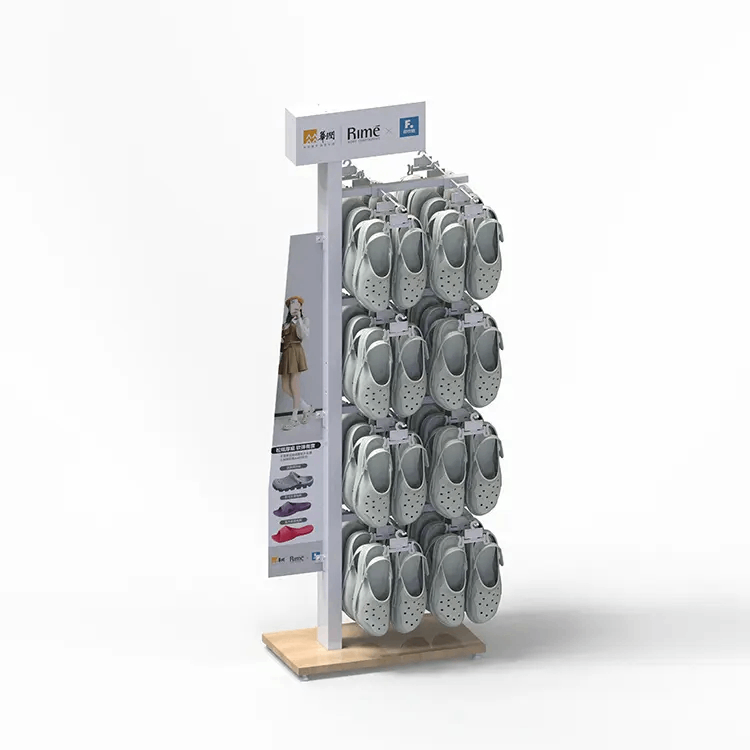
Floor productivity is a real KPI for every retail shoe store. Single-sided racks and fixed wall shoe rack layouts often underutilize the center aisle, creating a corridor rather than a merchandising zone. A double-sided 2-way slat wall shoe rack for retail shop display turns that same aisle into productive selling space while keeping sightlines open. When the surface uses a slatwall interface, the store can reset categories quickly without replacing fixtures.
Buyers often ask how many pairs a double-sided slat wall shoe rack for retail can present before clarity drops. The answer depends on holder geometry and spacing, which is why this page focuses on structure, materials, and modular interfaces rather than headline capacity claims.
This page is written for buyers who want to move fast. The next sections explain what the 2-way slatwall format is designed to do, why the wood–metal structure matters for lifecycle cost, how it compares to common alternatives, and what customization options help a wholesale rollout stay consistent.
This section helps procurement teams confirm whether a 2-way wood metal slat wall men’s shoe rack fits their assortment strategy and reset cadence.
For buyers sourcing rack supplies retail shop programs, the functional objective is simple: maximize facing density without sacrificing clarity or aisle flow. This 2-way wood metal slat wall system is engineered for shop display where modular planograms and seasonal resets are routine, not exceptions.
The fixture provides two merchandising faces, each built around a slat wall shoe interface. Slatwall grooves accept interchangeable holders—hooks, brackets, rails, or small shelves—so the display can be configured by shoe type, size range, or campaign priority. That modularity is critical for shoe store supplies planning because assortments move: dress-to-casual transitions, seasonal color drops, and new-arrival zones that need rapid change.
As a rack for shop, the double-sided format increases facing count within the same footprint. Compared with single-face options, it supports broader assortments without narrowing aisles. Compared with fixed wall systems, it enables island merchandising that encourages movement and browsing from both directions.
For wholesalers managing store supplies shoe programs, a standardized slatwall platform stabilizes procurement: you replenish holders and headers as ongoing supplies instead of replacing full frames, keeping rollout timelines cleaner and reducing fixture churn across campaigns.
Material choice directly affects claims rates, rework, and long-term presentation quality in wholesale rollouts.
Procurement decisions favor materials that hold tolerances under repetitive load and frequent handling. A metal slat wall frame is selected to maintain holder alignment and presentation stability across high-traffic retail shoe environments. For wholesale buyers, that translates into fewer claims, fewer replacements, and better consistency across batches.
Metal is also the foundation for a professional “store-fixture” feel. When frames stay square and holders stay level, shoes sit forward and rows remain uniform. Softer materials can deform over time, producing uneven lines that make the display look tired—even when the product is new.
A wood metal slat wall build is not a compromise; it is a functional pairing. Metal provides load-bearing performance and long-term dimensional stability. Wood adds warmth and can increase base mass, improving anti-tip stability in busy aisles.
In men’s footwear retailing, wood elements often match premium categories better than purely industrial fixtures. A laminated wood base can complement leather and fashion styles while the metal structure keeps the engineering intact behind the scenes.
Retail fixtures live in a harsh environment: repeated stocking, customer contact, and routine cleaning. Powder-coated steel is widely used because it resists abrasion and maintains color stability. A smoother coating also reduces dust adhesion, shortening cleaning cycles for store teams.
In humid climates, corrosion resistance becomes a lifecycle factor, not a nice-to-have. Coating quality around edges, joints, and high-touch areas influences how the fixture looks after months of trading. This matters for wholesalers because cosmetic damage at arrival or early finish wear can undermine a rollout immediately.
Experienced buyers ask practical questions: How does load distribute across each face? Are joints reinforced to prevent wobble? Does the slatwall groove keep integrity after repeated reconfiguration? These checks help avoid a common wholesale risk: batch-to-batch variation that breaks accessory compatibility.
Panel stiffness and slot alignment determine whether slat wall men’s shoe holders remain square through seasonal resets. If grooves drift or panels flex, holders tilt, shoes misalign, and the display quickly loses its professional look.
The comparison below uses procurement-relevant criteria to evaluate slat wall shoe rack formats against common alternatives.
Wholesale comparisons typically focus on capacity efficiency, reconfiguration speed, durability, and lifecycle cost. The slat wall shoe rack format is often evaluated against single-sided floor racks, wall shoe rack systems, and plastic stands.
Compared with single-sided fixtures, a 2-way design offers two selling faces within a compact footprint. That means more SKUs visible without adding more fixtures that block circulation. For wholesalers, it can also mean fewer unique fixture types to manage across a program.
Wall-mounted solutions can be effective when perimeter walls are the primary merchandising plane, but they reduce flexibility and often concentrate traffic along walls. Many stores end up with an underused center aisle that becomes a corridor instead of a selling zone.
Plastic stands may look economical on unit price, but in high-traffic retail they can increase lifecycle cost through faster wear, instability, and replacement. Over multi-store programs, even small replacement rates compound into avoidable downtime.
| Display Option | Capacity Efficiency | Reconfiguration | Durability | Lifecycle Cost |
|---|---|---|---|---|
| 2-way wood–metal slatwall rack | High in compact footprint | High via modular holders | High with metal frame | Lower over long term |
| Single-sided floor rack | Moderate | Medium | Medium | Moderate |
| Wall shoe rack system | Perimeter efficient | Low | Medium | Variable |
| Plastic stands | Low to moderate | Low | Low | Higher due to replacement |
To speed up rollout decisions, it helps to qualify store fit quickly and avoid mismatched inquiries.
Fit-for-purpose selection reduces mismatched inquiries and accelerates rollout success. This men’s shoe rack aligns with store formats that require modular merchandising, frequent seasonal resets, and predictable replenishment workflows.
If your retail shoe store carries multiple men’s categories—dress, casual, athletic—dual faces allow clean zoning. One face can carry new arrivals or premium lines at eye level while the other supports core volume styles. This improves navigation and keeps the display retail shoe standard consistent.
For wholesale programs, modular slatwall configurations enable quick resets without replacing fixtures. That lowers fixture churn across campaigns and stabilizes purchase planning for shoe rack supplies retail programs.
Very narrow stores may prefer a perimeter-first approach, including wall men’s shoe fixtures, to preserve circulation. A brief floor plan check—aisle width, traffic flow, replenishment cadence—usually clarifies whether an island-style rack improves the merchandising outcome.
Customization is most valuable when it reduces operational friction for wholesale programs. Buyers typically prioritize holder geometry, spacing control, and header visibility that can be standardized across batches for consistent multi-store deployment.
Functional customization often starts with the silhouette. Dress shoes may require holders that present toe angle consistently, while athletic shoes may need different spacing for bulkier uppers. Adjusting holder type and spacing protects clarity and reduces rework during replenishment.
Aesthetic customization supports brand coherence without sacrificing lifecycle performance. Metal frames can be finished to match store concepts while maintaining abrasion resistance. Wood bases can be specified to complement premium zones. The key is keeping the interface standard so accessories remain compatible across future production runs.
In many programs, the fixture is also a point-of-sale media surface. Header panels and side signage can carry category messaging or campaign graphics, turning supplies retail shop display infrastructure into a branded zone that stays consistent across locations.
Lifecycle performance influences total cost of ownership for rack for shop display programs. Durability, finish resilience, and replaceable components determine whether fixtures remain presentable through peak trading cycles.
In real retail conditions, fixtures face constant micro-impacts—from stocking carts, from customers lifting shoes, and from routine cleaning. Powder-coated metal surfaces resist scuffing and maintain a clean appearance. Reinforced joints reduce wobble, protecting the slatwall grooves from long-term stress.
Service life is more than “not breaking.” It includes whether holders remain aligned, whether coatings keep their appearance, and whether the rack continues to look premium after repeated resets. Wholesale buyers often evaluate this as lifecycle cost rather than purchase price, because replacement disrupts operations and erodes fixture standardization.
Maintenance efficiency matters to store teams. Smooth coated metal wipes quickly, and modular holders can be replaced individually. For wholesalers, that supports ongoing shoe store supplies programs where accessories are reordered as needed to keep displays consistent across stores.
Wholesale buyers do not need a long company story, but they do need evidence of repeatability. Batch consistency and predictable assembly are essential for synchronized store rollouts. Process control focuses on fabrication tolerances, finish adhesion, and packaging protection for export lanes.
For slatwall fixtures, tolerance control is not a minor detail. If groove spacing varies, holders sit unevenly and display rows drift. Consistent welding quality and joint reinforcement protect frame squareness so the rack remains stable when fully loaded on both faces.
Flat-packed export cartons improve freight efficiency for long-haul shipping routes, including procurement programs referencing Guangdong province China as the origin. Standardized hardware reduces assembly time at destination, and export-grade protection helps prevent cosmetic damage that can reduce perceived quality on arrival.
Yishang Display keeps the focus practical: standardized interfaces, replenishable accessories, and stable batch consistency so distributors can plan rack supplies retail programs confidently.
The indicators below are procurement-ready references for comparing suppliers and estimating ROI on rack for shop display programs.
Objective indicators help buyers compare suppliers and estimate ROI for wholesale programs. The metrics below align with common evaluation criteria used for retail store fixtures and footwear display fixtures.
| Parameter | Typical Range | Relevance |
|---|---|---|
| Frame | Powder-coated steel | Load stability for metal slatwall |
| Interface | Slatwall grooves | Modular merchandising |
| Base | Laminated wood | Anti-tip stability |
| Load per face | 40–60 kg distributed | Capacity for men’s footwear |
| Footprint | Compact floor standing | Space efficiency |
| Finish | Abrasion-resistant coating | Retail lifecycle performance |
| Packaging | Flat-packed export cartons | Freight efficiency |
If you are comparing suppliers, align these indicators with your rollout realities: expected facing density, peak-season traffic, cleaning routines, and whether you need replacement holders as ongoing retail shoe store supplies.
Wholesale buyers tend to ask questions that reflect rollout realities: capacity with clarity, seasonal reusability, logistics protection, and access to replacement holders to keep store programs consistent.
Capacity matters, but capacity alone is not the goal. The real question is how many pairs can be presented while keeping each pair visible, aligned, and easy to take down and return. Slatwall spacing supports uniform presentation across sizes and silhouettes, sustaining a clean display retail shoe standard without visual clutter.
Reusability across seasons reduces lifecycle cost. Modular holders allow reconfiguration without replacing the rack infrastructure, stabilizing procurement planning for store supplies. Many buyers also plan spare holders to avoid downtime when stores are busy.
Logistics and assembly affect rollout speed. Flat-pack cartons protect finishes, and standardized fasteners shorten installation time. If long-term continuity matters, confirm accessory compatibility and reorderability so the program remains consistent through future store refreshes.
The 2-way wood–metal slatwall men’s shoe rack is built for wholesale rollouts: durable structure, modular merchandising, and freight-efficient packing. If you are planning a multi-store program, share target silhouettes, facing density, and layout constraints for a tailored configuration and quotation.
Yishang Display specializes in crafting bespoke display solutions. From initial concept and prototyping through to full-scale production, our in-house team manages every phase—delivering a seamless, one-stop experience for your brand.
If you have any questions or need a quote, please send us a message. One of our specialists will get back to you within 24 hours and help you select the correct valve for your needs.
All of our products are available for sampling