Displaying heavy ceramic tiles and stone slabs in retail environments is an operational and commercial challenge that affects safety, space efficiency, merchandising clarity, and buyer confidence. Floor tiles carry significant weight and have fragile edges. When teams present samples on generic fixtures, instability, cluttered layouts, and inconsistent presentation often follow. Over time, under-engineered racks deform, joints loosen, and finishes wear. As a result, maintenance costs rise and display risk increases.
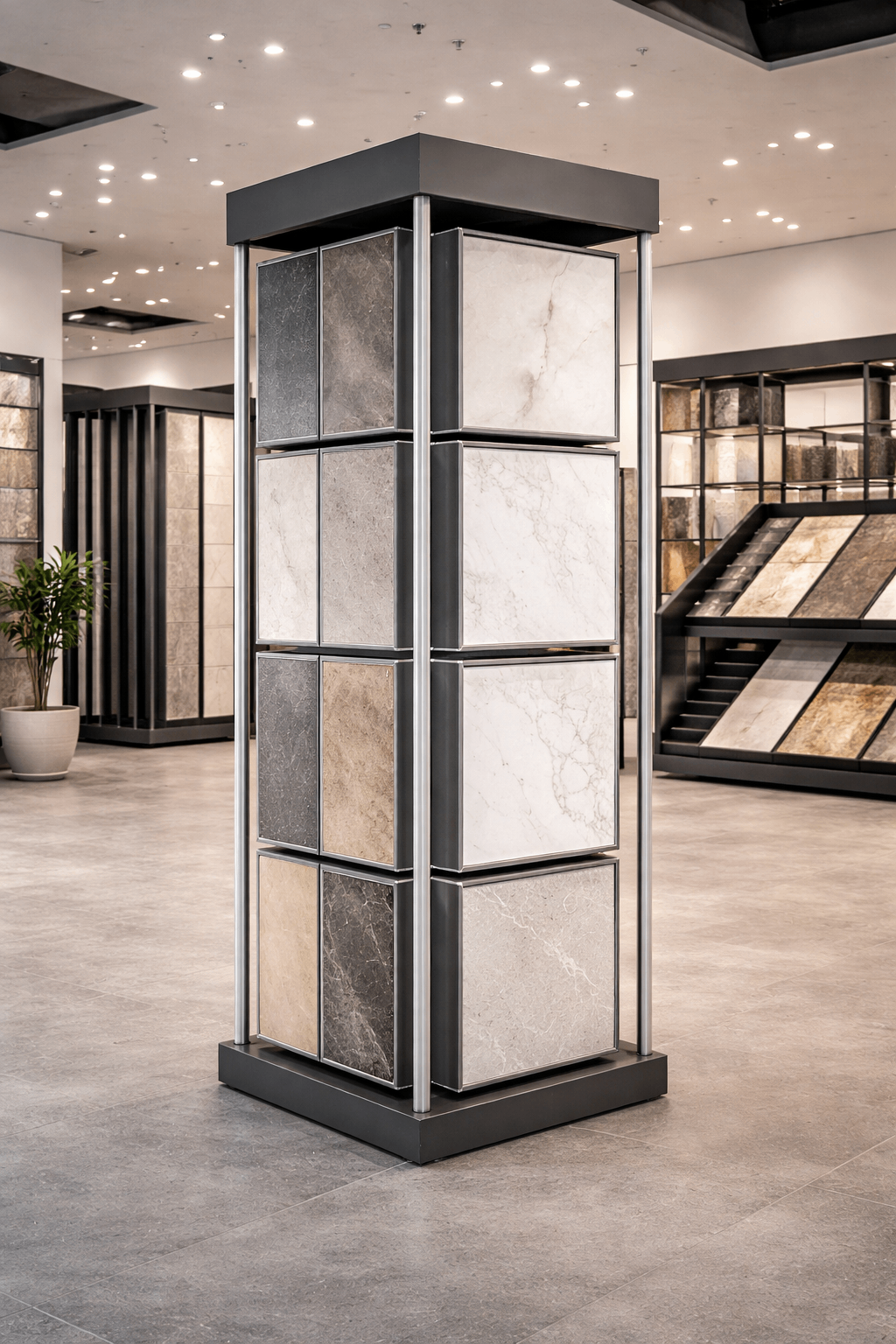
This product page presents a custom POP display solution engineered for floor tiles, ceramic samples, and stone slabs in showrooms, building material stores, and project-driven retail rollouts. For wholesale buyers planning multi-store programs, structural stability and batch-to-batch consistency directly influence rollout cost, maintenance load, and time-to-market. The focus is on structural performance, predictable load behavior, and practical usability for wholesale buyers planning repeat deployments. The floor-standing system features a heavy-duty metal frame with modular sample panels and a compact footprint, so it performs reliably in high-traffic areas. Yishang Display develops and supplies this design, which balances load-bearing stability with clear product presentation. Consequently, buyers support purchasing decisions and reduce operational friction.
MOQ: Project-based (typical bulk programs supported)
Lead Time: Project schedule aligned with production cycles
Trade Terms: EXW / FOB / CIF / DDP (as required)
Shipping Port: South China (Guangdong Province, China)
Service Scope: Customized wholesale supply for multi-store rollouts
Tile merchandising differs from lightweight POP programs. Ceramic and stone samples impose continuous static loads, and the combined mass of multiple panels can exceed what standard display fixtures are designed to carry. In showrooms where customers slide panels, compare finishes, and handle samples, the stand must remain stable under dynamic forces. When structural paths are not defined, micro-movements at joints accelerate fatigue and misalignment, increasing service needs.
Space constraints add pressure. Many tile showrooms operate within fixed footprints while needing to present broad collections. Floor tiles display solutions must use vertical space efficiently without blocking aisles or sightlines. A well-planned tile sample display system improves comparison at eye level, shortens browsing time, and protects edges from frequent handling.
Retail aesthetics matter as well. In building-material retail, fixture failure rates tend to rise in high-touch zones where samples are frequently handled; engineering for stability in these areas reduces service calls and preserves presentation standards across locations. Clean geometries and neutral finishes help the product surface stand out. Fixtures that compete visually with the samples reduce perceived quality. Purpose-built metal structures allow slim profiles with sufficient stiffness, aligning presentation with modern showroom expectations.
This metal floor tiles display solution addresses three procurement concerns for wholesale buyers: load management, stability during customer interaction, and efficient presentation across multiple formats. When these factors are overlooked, buyers typically absorb hidden costs later through higher maintenance time, fixture replacements, damaged samples, and inconsistent in-store presentation across locations. The heavy-duty frame distributes weight through defined load paths to the base; therefore, it reduces localized stress and floor impact. Display bays are configured to support ceramic and stone samples while maintaining alignment for consistent viewing.
From a POP merchandising perspective, the structure improves visibility. Instead of stacking samples, panels are separated to show textures and finishes without repeated re-handling. This reduces chipping at edges and lowers store labor needed to keep the area orderly, which matters for multi-store rollouts where maintenance time compounds.
Modularity supports assortment changes and protects procurement ROI. In chain deployments, modular tile sample display systems enable fast assortment refresh without reworking the frame, shortening refresh cycles and lowering per-store upgrade costs. Teams can reconfigure panels to accommodate new formats or seasonal collections without replacing the entire fixture. As a result, programs extend asset life and lower total cost of ownership across store refresh cycles.
In project discussions, buyers often need reference ranges to benchmark options before final drawings are issued. Typical configurations for showroom programs include support for common tile formats (e.g., 600×600 mm and 600×1200 mm), panel-based sample presentation for quick comparison, and heavy duty load performance appropriate for ceramic and stone samples. Structure options commonly include fixed modular frames, rotating towers for compact spaces, and sliding or pull-out panels for high-density sample libraries. Engineers finalize specifications to match assortment weight, aisle clearance, and traffic intensity at each location. As a result, installations meet site constraints.
The core structure uses welded steel members designed for rigidity and torsional resistance under eccentric loading. Vertical columns and cross-members form closed sections. Consequently, they control deflection when customers interact with one side. Defined load transfer to the base limits bending moments at joints and preserves long-term alignment across panels.
Mounting interfaces accommodate varying tile thicknesses and formats. This flexibility supports mixed assortments, including porcelain panels and stone samples, within one display. Optional rotating configurations suit compact spaces, while fixed modular layouts fit linear showroom plans. Both approaches prioritize clear sightlines and safe access.
We specify surface finishes for commercial wear. Moreover, the coatings protect appearance over long retail cycles. Powder-coated steel resists abrasion from frequent handling and offers corrosion protection in climate-controlled retail environments. The base geometry lowers the center of gravity to improve lateral stability in high-traffic zones.
Material choice defines service life. Lightweight fixtures may reduce upfront cost but lack fatigue resistance for stone and ceramic samples. Heavy-duty metal display stands provide predictable strength-to-weight performance, enabling slim profiles without sacrificing stiffness. This balance supports premium presentation in compact retail footprints.
Metal structures maintain dimensional stability across humidity and temperature changes common in retail spaces. Therefore, alignment remains consistent in daily use. Unlike wood-based fixtures that can creep or warp, steel frames keep alignment consistent, which is critical for large-format panels. Consistent alignment protects perceived quality and reduces service calls.
Lifecycle value matters for wholesale programs. With appropriate surface treatment and quality controls, metal fixtures remain in service through multiple assortment updates. As a result, buyers reduce replacement frequency. Fewer replacements reduce downtime and contribute to sustainability goals by extending fixture lifespan.
Effective OEM development starts with the assortment and the floor plan. Customization goes beyond size changes to include load distribution, reach ergonomics, and aisle clearance. For buyers planning multi-store rollouts, this ensures each unit performs consistently across locations.
ODM capabilities integrate brand identification into the structure. Header panels, laser-cut marks, and color-matched finishes support brand presence without overshadowing sample surfaces. Consistent visual language across stores helps buyers evaluate collections quickly.
Modular architectures simplify logistics. In addition, flat-pack packaging reduces freight volume for bulk orders and accelerates handling at destination. For cross-border projects, fixtures can be specified to align with local safety practices and floor load considerations, lowering deployment risk.
To support different showroom footprints and merchandising strategies, multiple structure variants are typically applied across projects. Common formats include rotating floor tile display racks for compact retail areas, pull-out tile sample display stands for dense assortments, wheeled tile display racks for flexible zoning, and vertical tower systems for premium collections. Referencing proven variants during planning helps buyers shorten design cycles and align fixtures with existing store layouts. Related structures can be cross-referenced across tile display racks and stone slab display systems to maintain a consistent merchandising language.
In tile showrooms, the stand curates collections within a compact footprint. Vertical presentation improves comparison at eye level and supports consultative selling without overcrowding. Clear separation between samples shortens evaluation time for trade customers and homeowners guided by sales staff.
In building material retail, heavy-duty fixtures withstand frequent interaction and maintain alignment over time. For stone slab showrooms, reinforced interfaces support heavier samples while preserving a refined presentation. This balance is important where premium materials justify higher display standards.
At trade exhibitions and project showrooms, modular designs support repeated assembly without cumulative misalignment. Configurable layouts adapt to venue constraints while keeping the same merchandising logic across events.
Wholesale programs require clarity on minimum order quantities, production windows, and coordinated delivery. For chain retailers and regional distributors, scalable replication, visual consistency across stores, and batch-to-batch consistency are key decision drivers when selecting a tile display rack supplier because even small visual or dimensional variances can disrupt brand standards and increase field adjustments. Factory-direct supply supports consistent quality and pricing for multi-site deployments. Consequently, procurement teams plan rollouts with fewer revisions. Production lead times account for material sourcing, fabrication, coating cure cycles, and inspection.
Flat-pack shipping reduces volumetric freight; furthermore, it simplifies warehousing on arrival. Coordinated deliveries aligned with store opening schedules reduce on-site congestion and storage needs. These details help procurement teams plan rollouts with fewer disruptions.
For international buyers, packaging standards and documentation support predictable clearance and handling. Moreover, clear labeling speeds receiving at destination. Where applicable, specifying heavy duty tile display stands for showroom environments and custom tile display racks for building materials helps procurement teams align technical specs with local installation practices. Responsive technical support during installation reduces project risk and protects timelines.
For wholesale programs, after-sales clarity is part of risk management. Manufacturing defects are addressed through defined replacement or parts support processes, and finish integrity is assessed against commercial-use cycles. Clear support pathways reduce downtime during rollouts and protect merchandising continuity across locations.
Quality assurance centers on load testing, stability verification, and finish durability. Technicians evaluate structural components under specified weights to prevent permanent deformation. Consequently, fixtures retain alignment over time. Stability checks simulate lateral forces from customer interaction to ensure the fixture remains secure.
Quality teams verify finish performance through abrasion and adhesion checks suitable for retail handling cycles. In turn, coatings retain appearance under frequent handling. Coating thickness and edge coverage are controlled to protect appearance over time. Dimensional checks and weld inspections ensure consistent assembly across batches; therefore, multi-store programs achieve uniform fit and finish.
Batch consistency matters for multi-store programs because visual uniformity across locations underpins brand perception and simplifies visual merchandising guidelines. Consistent tolerances reduce rework during installation and help procurement teams avoid downstream labor overruns. Uniform fit and finish across units preserve brand standards and reduce field adjustments during rollout.
Across showroom upgrades and regional rollouts, buyers consistently prioritize stability in high-touch zones and visual consistency between stores. Project teams report fewer service interventions when heavy duty metal floor tiles display systems are specified for dense assortments, and faster refresh cycles when modular tile sample display systems are adopted for seasonal updates.
| Parameter | Typical Specification |
|---|---|
| Primary Structure Material | Carbon steel with durable powder-coated finish |
| Load Performance | Engineered for ceramic tiles and stone samples |
| Display Configuration | Floor-standing, modular or rotating options |
| Finish Options | Custom colors, matte or semi-gloss |
| Branding Integration | Header panels, laser-cut marks, applied decals |
| Packaging | Flat-pack optimized for bulk shipping |
| Application Environment | Showrooms, building material retail, exhibitions |
Specifications are finalized to match tile dimensions, traffic intensity, and layout constraints for fit-for-purpose performance.
What information is needed to quote a project?
Providing tile dimensions, approximate weight per sample, target quantities, and rollout timelines helps scope the structure and production plan.
Can rotating or pull-out structures be specified?
Yes. Rotating towers, sliding panels, and mobile bases are selected based on space constraints and traffic patterns.
How is batch-to-batch consistency maintained?
Dimensional controls and finish standards are applied across production runs to support visual consistency in multi-store programs.
How are units packaged for international delivery?
Flat-pack packaging is commonly used to reduce freight volume and simplify handling at destination.
Can branding be integrated without obscuring samples?
Brand identification can be integrated via header elements or subtle markings that preserve sample visibility.
A well-engineered floor tiles display system supports safer handling, clearer comparison, and more efficient merchandising. Therefore, teams achieve higher in-store efficiency. For buyers evaluating custom POP displays metal floor solutions, predictable performance across sites and repeatable installation workflows are central to achieving lower total cost of ownership. By aligning structural performance with retail needs, the solution improves operational consistency across projects. For buyers planning repeat deployments, partnering with Yishang Display helps translate merchandising plans into reliable fixtures with predictable lifecycle value.
If you are planning a new showroom opening, a multi-city rollout, or a seasonal collection refresh, share brief requirements and target quantities. Then, teams can evaluate options faster and lock timelines with fewer revisions.
Yishang Display specializes in crafting bespoke display solutions. From initial concept and prototyping through to full-scale production, our in-house team manages every phase—delivering a seamless, one-stop experience for your brand.
If you have any questions or need a quote, please send us a message. One of our specialists will get back to you within 24 hours and help you select the correct valve for your needs.
All of our products are available for sampling