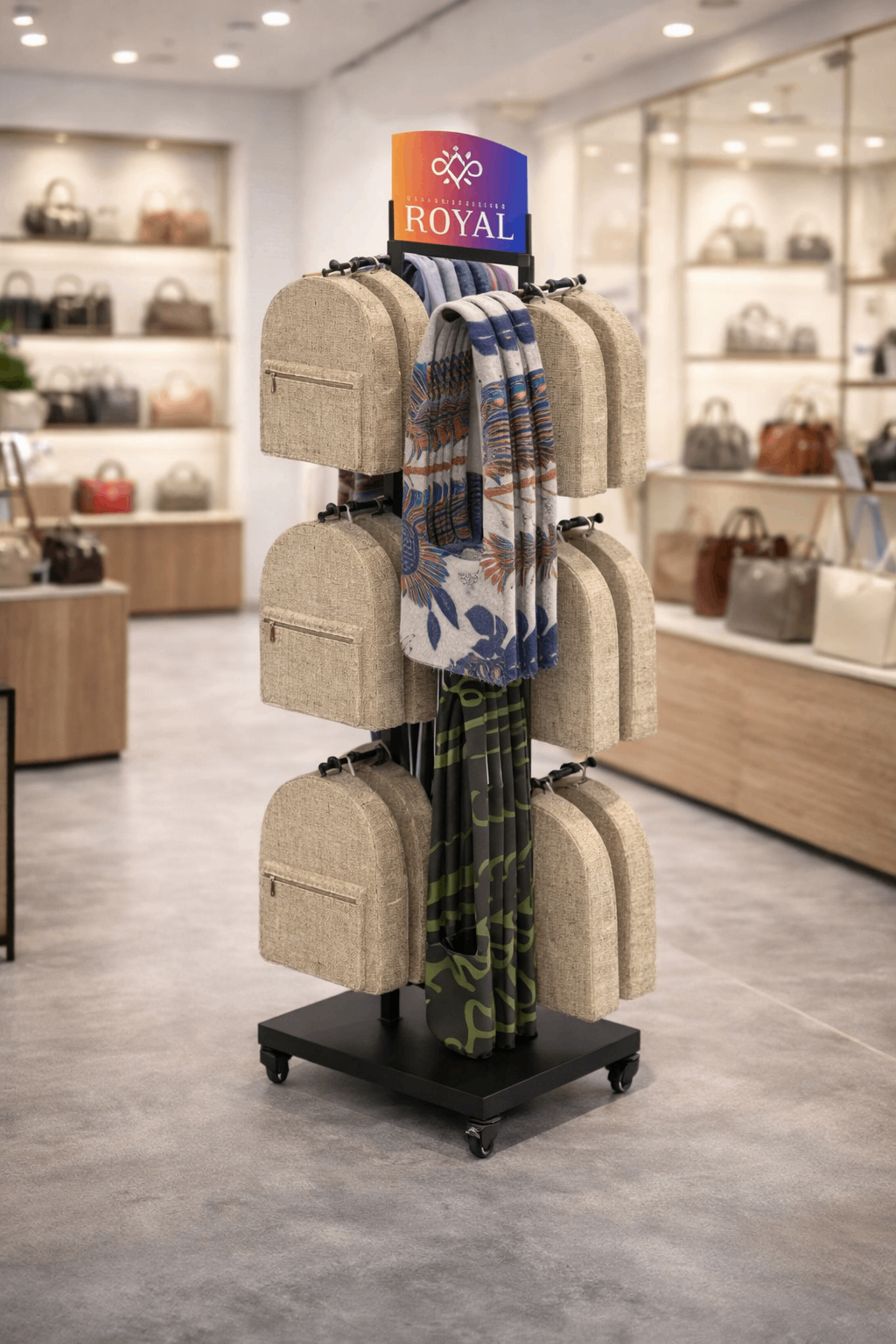
Heavy Duty Metal Bag Display Stand for Retail Stores and Wholesale Supply
This retail floor handbag display rack is a floor-standing metal structure designed specifically for hanging handbags and bags in retail environments. It uses a hook-based layout to keep products visible, organized, and easy to access on the shop floor. The rack is suitable for wholesale supply, supporting bulk orders with consistent structure, optional customization, and packaging solutions optimized for international shipping.
For overseas buyers sourcing a bag display stand for retailers selling handbags, the key concerns are repeatable quality, stable load-bearing performance, and predictable landed cost. This display rack is engineered around those priorities, making it suitable for chain stores, distributors, and project-based retail rollouts.
Handbags and bags are three-dimensional products with inconsistent shapes, strap lengths, and weights. On shelves, bags easily collapse, overlap, and hide key design details such as logos, stitching, and material texture. When retailers display bags on the retail floor, the challenge is not only capacity, but also maintaining an organized presentation after customers handle products throughout the day.
A hook-based rack keeps each bag visible and separated, which improves “face-out” exposure and makes it easier for shoppers to compare styles. This is particularly important for categories like fashion handbags and luggage accessories, where perceived value is closely linked to presentation quality. A floor standing display with hooks also avoids permanent installation, so stores can reposition the rack during seasonal resets, new-collection launches, or promotional events.
From a wholesale point of view, this format reduces after-sales risk. Retailers can restock quickly, keep aisles tidy, and avoid the clutter that often leads to damaged merchandise. When a display solution supports better in-store maintenance, it becomes a repeat-order item rather than a one-time purchase.
For wholesale supply, a display rack must be engineered for repeated use, not just for photography. On a busy retail floor, fixtures are pushed, bumped, and reloaded unevenly. A reliable bag display rack needs stable geometry, balanced load distribution, and a base that reduces tipping risk when customers remove products from one side.
This floor handbag display rack is built primarily from steel and other metal components selected for stiffness and long-term dimensional stability. Compared with lightweight plastic fixtures, metal performs better under cyclical loading and frequent handling. For overseas procurement, the ability to maintain consistent structure across large batches is crucial, because small deviations become visible when racks are deployed across many stores.
The base and upright mast are designed as a stable system. The base footprint is wide enough to support loaded conditions, yet compact enough to fit into store aisles and promotional zones. In projects where mobility is required, caster options can be integrated, typically with locking mechanisms to keep the unit secure during customer browsing.
The hook system is designed to balance capacity with accessibility. Hooks that are too dense cause overlap and reduce visibility, while hooks that are too sparse waste valuable retail space. By selecting the right hook gauge, length, and spacing, the rack supports different bag categories without damaging straps or collapsing the display.
The exact configuration is customizable, but wholesalers often want a clear, buyer-friendly view of what can be specified.
| Parameter | Typical Wholesale Options (Customizable) | Procurement value |
|---|---|---|
| Primary structure | Powder-coated steel / metal tubing & plate | High durability, stable batch output |
| Hook layout | Quantity, spacing, length configurable | Fits your SKU mix and merchandising density |
| Load approach | Balanced hanging positions | Reduces tipping and deformation risk |
| Base | Reinforced plate; optional locking casters | Stability for high-traffic areas |
| Branding | Header sign, logo plate, color matching | Retail identity without structural changes |
| Packing | Knock-down (flat pack) or semi-assembled | Lower shipping volume and damage risk |
This kind of clarity helps wholesale buyers quote faster and align the rack to downstream retailer requirements.
Procurement teams often judge a fixture by what happens after deployment. A display stand handbag program fails when racks tilt, hooks deform, coatings scratch easily, or packaging damage triggers claims. Those are not theoretical problems; they are the most common sources of friction in wholesale supply of retail fixtures.
In real stores, customers remove products unevenly, then return them in different positions. The rack must remain stable even under asymmetric loads. This floor rack is designed to maintain balance through base reinforcement and hook placement strategy. The goal is predictable performance during daily customer interaction, not just initial setup.
A second retail requirement is operational efficiency. Staff need to restock quickly, especially during promotions or high-turnover periods. With a hook-based layout, bags can be added or removed without rearranging stacked products or resetting shelves. That reduces labor time, which is a measurable operational saving for retailers and a practical selling point for wholesale buyers.
For store presentation, the vertical layout keeps merchandise off the floor and supports a clean planogram. Many retailers treat visual consistency as a brand standard. When a rack maintains a tidy display through repeated handling, it supports brand perception and reduces the chance of damaged or soiled products.
Although metal is the preferred structural material for long-term durability, retail concepts vary. A supermarket fixture may prioritize robustness and easy cleaning, while a boutique may want warmer visual language and brand storytelling. The right approach is to keep the load-bearing structure metal and selectively add other materials only where they deliver real visual value.
A fully metal rack is common for high-volume stores because it offers predictable strength and consistent appearance across batches. Powder coating is frequently chosen for surface finish because it provides abrasion resistance and color stability under frequent contact. For coastal markets or humid environments, finish selection becomes even more important for long-term corrosion protection.
Where visual differentiation is needed, acrylic can be integrated for signage holders or header elements. Acrylic components allow clear branding and price messaging without adding much weight. In premium environments, a wooden bag rack style can be created by adding wood panels or trims while preserving a metal backbone. This hybrid approach keeps performance consistent while aligning with store aesthetics.
For wholesale buyers, material choice also impacts logistics. Mixed materials require packaging that protects edges and surfaces. If the project involves frequent international shipments, it is usually more cost-effective to keep structural parts metal and use add-on panels sparingly.
Customization is valuable when it reduces project risk or improves merchandising performance. For wholesale buyers, the best customization options are those that can be specified clearly, produced consistently, and deployed with minimal complexity. This rack supports a range of OEM and ODM adjustments, with the focus on practical merchandising requirements.
One common customization area is footprint and height. Store layouts vary, and some projects require a rack for shop aisles, while others require a compact unit for promotional endcaps. Adjusting dimensions can help match planograms and improve customer flow without changing the core structural logic.
Hook configuration is another high-impact parameter. A retailer selling handbags with thicker straps may need more spacing, while a store displaying lighter bags can use a denser hook arrangement to increase SKU exposure. Hook gauge and protective ends can also be specified for heavier products or frequent handling environments. These adjustments help wholesalers provide a custom bag display that fits the product range, not just the store space.
Branding customization is usually most efficient through header signs and logo plates. A header panel creates immediate brand visibility and helps retailers communicate product categories. Color matching and surface finish selection further support brand alignment. Importantly, these branding elements can be changed without altering the load-bearing structure, keeping production stable and repeatable.
For specialized categories, the same structure can also support adjacent use cases. Some projects involve coffee bag display programs or packaged goods displayed with hooks in specialty stores. The key is to specify hook spacing and load expectations correctly so the display remains stable.
This retail handbag display rack is most often sourced by overseas wholesalers and distributors supplying retailers, shopfitting contractors, and brand programs. It fits projects where consistency matters, including multi-store rollouts and repeat seasonal deployments. Buyers typically value the rack because it can be standardized as a base design while still offering customization to meet retailer needs.
Fashion and accessory retailers use this rack to present handbags, backpacks, and related items in a clean, vertical merchandising format. Supermarkets and department stores often deploy similar racks in promotional zones where flexibility is needed and permanent wall fixtures are not practical. In showrooms or trade environments, the same rack helps present many SKUs without clutter, making buying decisions easier.
For wholesalers, the main advantage is a procurement-friendly platform design. Instead of developing a custom bag display from scratch for every client, the rack can be adapted through specification changes that are easy to confirm and scale.
For wholesale procurement, design quality must be matched by production discipline. This floor handbag display rack is developed with batch repeatability in mind, allowing the same structure and finish to be delivered consistently across large orders. Metal component thickness, hook gauge, and base plate dimensions are controlled to reduce variation between production runs, which is critical when racks are deployed side by side in multiple stores.
Surface finishing is another area where inconsistencies often appear in bulk orders. Powder coating parameters are selected to balance appearance and abrasion resistance, helping racks maintain a uniform look after repeated handling. For projects requiring documentation, material compliance such as RoHS can be provided, and quality management aligned with ISO 9001 principles supports predictable output without overpromising certifications that are not relevant to the project scope.
Packaging and logistics are treated as part of the product design rather than an afterthought. Knock-down packing reduces shipping volume and improves container utilization, which has a direct impact on landed cost. Protective packaging is designed to reduce transit damage, lowering the risk of claims and rework for wholesalers supplying overseas markets.
When overseas buyers search, they often use functional phrases rather than brand names. Queries may include variations such as display rack for shop, handbag display rack, bags display stand, or custom bag displays for a specific program. Many buyers also search by use case, such as “floor display stand with hooks for handbags” or “metal rack for retail bag merchandising.”
This page intentionally uses natural language that matches those search patterns without repeating the same phrase excessively. The goal is to help search engines understand the topic breadth through semantic coverage, while keeping readability high for human buyers who scan quickly.
A practical way to think about long-tail keywords is that they represent specific procurement scenarios. For example, a buyer searching “rack bag display for shop” is likely comparing fixtures for a particular store format. A buyer searching “custom bag display” may be preparing an RFQ for a brand program. Including these phrases naturally, within relevant contexts, improves both search relevance and conversion potential.
A floor handbag display rack with hooks often works best as part of a layered retail display strategy. Retailers may combine floor fixtures with wall-mounted racks, countertop units, or gondola accessories depending on store layout. The floor rack typically handles the “high-visibility, flexible placement” role, especially in aisles and promotional zones.
For wholesalers, offering compatible display structures can strengthen project scope and increase order value. It also reduces friction for downstream clients who prefer sourcing multiple fixtures from one supplier. The key is to keep the program consistent in materials, finishes, and branding so the store environment looks unified.
In many projects, the floor rack acts as a modular component that can be deployed repeatedly with minor adjustments. That is why platform-style designs—where core structure stays stable and customization happens through hook layouts and signage—tend to perform well in wholesale procurement.
Procurement teams can speed up quotation and sampling by clarifying a few practical points early. The more specific the requirements, the easier it is to recommend the right hook layout and finish.
Typical RFQ inputs include the bag size range, approximate weight range, preferred merchandising density, and whether the rack needs mobility. If the retailer’s brand identity is important, a reference color or finish requirement can be included, along with signage preferences for headers or logo plates. If the rack will be shipped to multiple markets, packaging preferences and labeling requirements should also be noted.
A clear RFQ reduces iteration, lowers development cost, and helps deliver a sample that matches real store requirements. For wholesale projects, this clarity is often the difference between a quick conversion and a slow procurement cycle.
A retail floor handbag display rack built with a durable metal structure and a hook-based presentation format offers a reliable solution for wholesale buyers focused on scalability and risk control. It supports hanging bags in a clean retail layout, adapts to different merchandise through configurable hook systems, and remains suitable for repeat orders thanks to production-friendly design.
For quotation and sampling, providing basic information such as bag size range, approximate weight, expected order quantity, and preferred finish will help confirm the most suitable configuration. A short inquiry with these details is usually sufficient to evaluate feasibility and move forward efficiently.
Yishang Display specializes in crafting bespoke display solutions. From initial concept and prototyping through to full-scale production, our in-house team manages every phase—delivering a seamless, one-stop experience for your brand.
If you have any questions or need a quote, please send us a message. One of our specialists will get back to you within 24 hours and help you select the correct valve for your needs.
All of our products are available for sampling