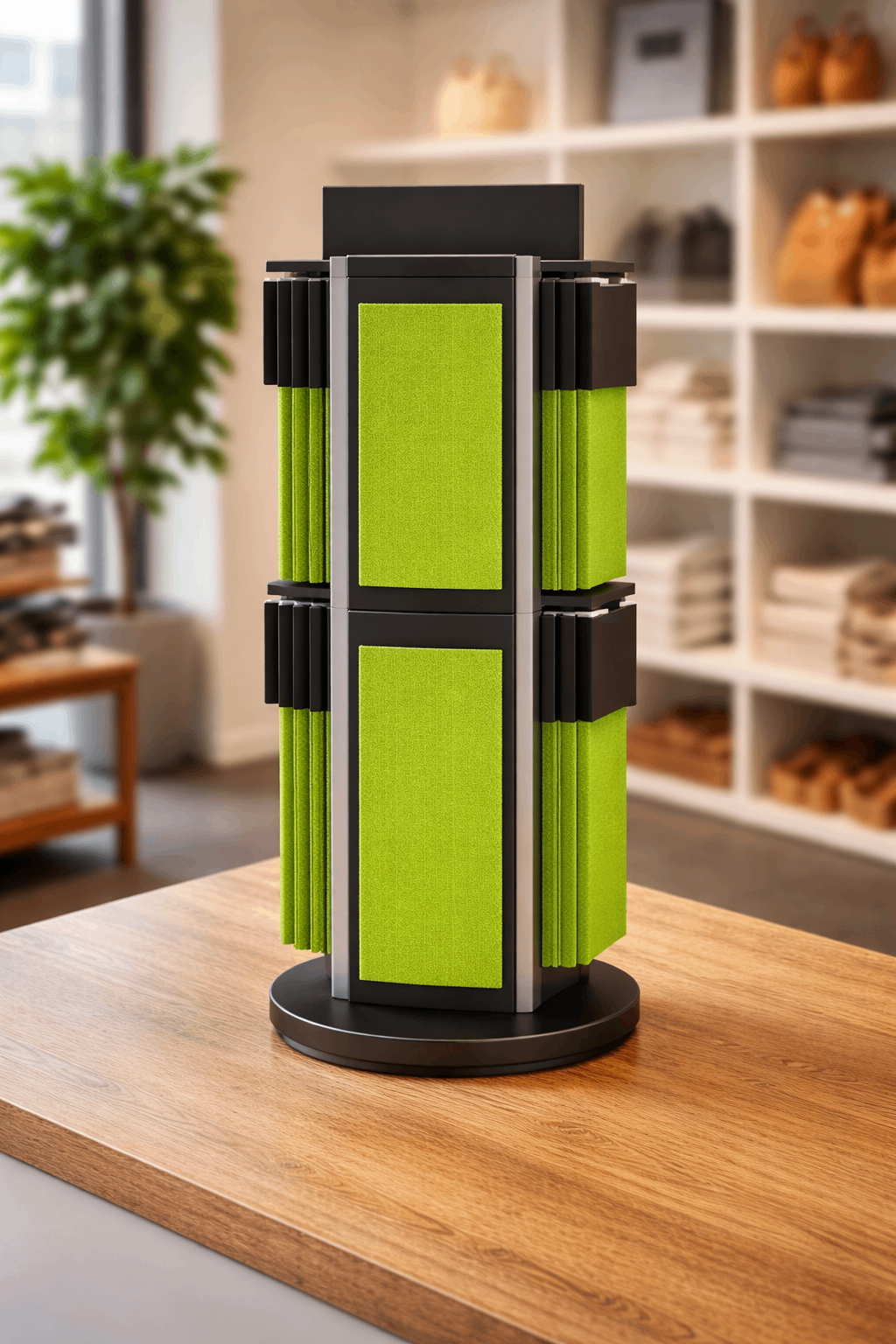
Overseas wholesale buyers, importers, and sourcing managers usually open a supplier’s product page to answer one question: can this item be purchased in volume and perform reliably for my retail accounts. The decision is rarely based on style alone. It depends on stability, repeatability, shipping predictability, and how easily retail staff can keep the display looking presentable.
This page is therefore written as a procurement-focused reference for a counter acrylic cloth retail scarf swivel towel rack display rotating. It explains what the display is, how it works, and why the structure and materials are suited to real retail programs—especially those that require consistent results across many stores.
Scarves, towels, and similar textile accessories are high-turnover items in multiple categories, from fashion and lifestyle to sports and gift retail. They are also among the easiest products to disrupt on a counter. Customers want to touch and compare, stacks collapse, and presentation quality declines quickly. Staff then spend time restoring order instead of serving customers.
A rotating counter fixture solves this in a straightforward way. It keeps a small footprint, presents multiple faces of products, and lets customers browse by turning the unit rather than digging through piles. For wholesalers, that means fewer complaints from retailers, fewer replacement requests, and better chances that the fixture will stay in service long enough to justify repeat orders.
In practice, wholesale buyers also evaluate how a fixture fits into their operational workflow. You may be listing the item as a display rack for resale, bundling it with a brand program, or supplying it as part of a rollout. That makes details like packaging method, repeatable finish, and consistent assembly quality more important than one-time aesthetics.
The terminology used here reflects how buyers typically search: scarf display rack, towel rack display, swivel towel rack, towel display stand, and display rack for shop counters. These phrases are integrated naturally for relevance, while keeping keyword density under control and the reading flow professional.
Structure is where wholesale risk is either reduced or amplified. When a display looks acceptable in a catalog but wobbles on a counter, it creates downstream cost: returns, replacements, and damaged relationships with retail accounts. This rack display rotating unit follows a simple structural hierarchy—stable base, rigid center support, and balanced loading—to avoid those issues.
A weighted metal base keeps the center of gravity low and resists tipping when customers rotate the unit or remove items from one side. Counter placement puts fixtures close to both customers and staff, so stability directly affects whether retailers accept the display for ongoing use.
A vertical load-bearing column connects the base to the rotating assembly and provides torsional stiffness. In real retail environments, customers may rotate a display hundreds of times per week. A rigid column keeps rotation smooth and prevents long-term misalignment.
Evenly spaced panels surround the column to maintain balance during rotation. This spacing distributes product weight evenly and avoids uneven torque. As a result, customers browse without pulling against stacked products, which helps preserve both structure and presentation.
Manual swivel rotation relies on a central spindle and low-friction contact surfaces. When these components align correctly, the unit turns smoothly even when loaded with scarves and towels. Smooth rotation reduces structural stress and extends service life.
From an operations perspective, rotation simplifies replenishment. Staff rotate the unit to access any face without moving the fixture. For accounts that refresh assortments frequently, this reduces daily effort and helps maintain consistent presentation.
Small structural details influence whether a fixture stays in service. Smooth edge finishing reduces snagging risk for textiles. Balanced panel spacing prevents overcrowding. Optional anti-slip pads protect counters and limit shifting. These features help the display remain a long-term fixture rather than a short trial unit.
Rotation adds value when it solves browsing and maintenance problems. For textiles, it does exactly that. A swivel towel rack or scarf swivel towel rack allows customers to compare patterns and colors quickly without unfolding stacks or rearranging folded items.
Customers rotate the display, scan options, and touch fewer products to evaluate their choices. This behavior keeps the assortment intact and reduces the time staff spend restoring order. In checkout areas where labor is limited, that reduction in daily maintenance has real operational value.
Rotation also improves assortment visibility within a limited footprint. When retail accounts want to show more SKUs at the counter without expanding space, a rotating fixture adds more faces instead of taking more area. This directly supports tighter planograms and cleaner counters.
For store layouts, this approach offers a measurable advantage. The same counter space delivers higher exposure, which supports add-on sales for scarves and towels.
Industry research often links improved product visibility with higher sell-through. Shop! Association studies, for example, have reported sales lifts in certain channels when displays are present. The exact outcome depends on category and placement, but the overall direction remains consistent.
For wholesalers and distributors, the key point is not a single percentage. A well-designed counter display helps retail accounts sell accessories without adding labor. Fixtures that support both presentation and efficiency tend to stay in service longer and generate repeat orders.
Rotation also helps consolidate fixture SKUs. One rotating design can support multiple assortments—scarves, towels, and cloth accessories—by adjusting panel configuration instead of introducing separate fixtures. This simplifies inventory planning and reduces the risk of slow-moving fixture SKUs.
Material selection is a supply-chain decision. Wholesale buyers evaluate materials through durability, shipping risk, and appearance retention. This display uses acrylic panels where visual clarity matters most.
Clear acrylic keeps attention on the merchandise. For scarves and towels, transparency allows patterns and textures to stand out under retail lighting. Acrylic also fits a wide range of retail interiors without creating a heavy visual block on the counter.
Acrylic surfaces support daily maintenance. Staff wipe them clean quickly, which helps maintain consistent presentation in high-touch counter zones and reduces the chance that a fixture looks worn mid-season.
Metal components concentrate in the load-bearing system: the base, central column, and structural joints. This is where metal manufacturing adds value. Metal provides rigidity and resists long-term deformation, which is essential for stable rotation.
In a rotating fixture, rigidity determines how well the unit performs over time. A strong metal backbone keeps the rotation axis aligned and supports long service life.
Hybrid construction also reduces transit risk. Fully acrylic structures face higher cracking risk when load-bearing points experience stress. Reinforced metal load paths improve robustness during packing, container transport, and last-mile handling.
Many buyers source from Guangdong Province China because it supports efficient manufacturing and export logistics. In that context, predictable packaging performance matters. A metal backbone protects the functional core, while acrylic supports premium presentation.
If a project has specific durability requirements, buyers can align acrylic thickness and metal surface finishes with expected service conditions. These decisions help match the fixture to real retail environments rather than theoretical use cases.
This display supports counter and small-table merchandising where space is limited and quick customer access matters. A common use is a scarf display rack near checkout counters or on promotional tables. The vertical format introduces additional SKUs without disrupting the main layout.
In fashion accessory retail, counters often carry seasonal add-ons. A rotating display allows stores to expand assortment visibility with less clutter. For wholesalers, this makes the fixture suitable for repeat seasonal orders where the assortment changes but the display rack scarf structure stays consistent.
In sports, golf, and lifestyle retail, towels and microfiber cloths often sell alongside core products. A towel rack display or towel rack display rotating unit placed at point-of-sale zones supports add-on purchases while keeping merchandise tidy.
Gift shops and boutique retailers also rely on rotating counter fixtures for textiles and soft goods. These stores frequently need to present a variety of items in a small area. A rotating unit lets customers browse without spreading products across the counter, which helps keep service areas clear.
Across these scenarios, retailers look for consistent presentation with low maintenance. Rotating counter fixtures meet that requirement better than flat stacking for textiles.
Because the same fixture design works across multiple store types, wholesalers often position it as a core counter solution rather than a one-off promotional tool. This consistency supports repeat procurement and simpler rollout planning.
Customization works best when it is repeatable. Wholesale programs rarely need unlimited modification. They need controlled options that preserve performance, allow consistent quality across batches, and keep lead times predictable.
Panel quantity and spacing can be adjusted to match scarf widths, towel thickness, and desired SKU count. Overall height can be tuned to align with typical counter height in your target market. These adjustments keep the core structure intact while improving fit for your specific assortment.
Branding is a common requirement for wholesalers serving multiple accounts. A brand logo display area can be integrated as a header panel, printed acrylic face, or signage element. This is where your brand logo can be presented clearly without interfering with rotation or load-bearing performance.
For many wholesale programs, branding follows a simple and efficient approval flow. Buyers usually confirm logo placement and artwork proofs first, then approve a pre-production sample or rendering before mass production. Keeping branding elements modular helps ensure that each repeat order remains consistent while still supporting different retail identities.
For distributors managing multiple label programs, modular branding is often the most efficient approach. The core structure remains unchanged, while signage or printed elements vary by account. This reduces tooling complexity and supports stable production across multiple SKUs.
Finish options can also be tailored. Metal parts may use powder coating or other finishes to match store fixtures, while acrylic can remain clear or lightly tinted. These options are selected to balance visual alignment with durability, rather than for decoration alone.
If you need a display solution for your program, the most productive input is usually your assortment profile, counter dimensions, and branding expectations. That information allows configuration changes that remain scalable for bulk production and consistent across deliveries.
Wholesale buyers often prefer specifications that reflect real retail use rather than abstract maximums. The values below are presented in a practical way: what is standardized, what is variable, and what matters for repeat procurement.
| Specification Item | Typical Range / Notes | Why It Matters for Wholesale Programs |
|---|---|---|
| Application | Countertop retail display | Fits checkout and compact promo zones |
| Primary Materials | Acrylic panels + metal base/column | Visibility with structural stability |
| Rotation Type | Manual swivel / spinner rotation | Low maintenance, predictable operation |
| Display Format | Multi-face panel arrangement | More facings per footprint |
| Product Fit | Scarves, towels, cloth accessories | Optimized for soft-goods browsing |
| Branding | Header/sign area optional | Supports brand logo display |
| Packaging | Protective export packaging | Reduces scratch and transit claims |
| Quality System | ISO 9001 process control; RoHS materials available | Supports QC expectations and documentation |
From a procurement standpoint, packaging and shipping notes are often as important as the fixture itself. Acrylic panels are typically protected with removable film to prevent surface scratches, while metal components are isolated to avoid friction during transport. Depending on order volume and destination, units can be supplied assembled or flat-packed to optimize carton size, CBM, and container loading efficiency.
For buyers managing landed cost, flat-pack options are often preferred for bulk programs because they reduce freight cost per unit. Assembled delivery may be more suitable for smaller rollouts where in-store labor is limited. Clarifying this early helps align production, packing, and delivery schedules.
Lead time and MOQ depend on whether the configuration is standard or includes custom branding. Standard configurations usually support lower MOQs and shorter lead times, while branded or modified versions may require additional setup time for approvals. Aligning specifications early allows production planning to remain predictable across repeat orders.
Consistent specification language also supports buyers who resell fixtures. Clear descriptions reduce the risk of mismatched expectations and simplify internal documentation for multi-account distribution.
Is the swivel towel rack display stable when fully loaded? Stability is driven by the base weight, the rigidity of the center column, and balanced panel loading. This unit uses a weighted metal base and reinforced central support to maintain stability during rotation, even when fully stocked.
Can the display be adjusted for different assortments? Yes. Panel quantity and spacing can be configured so the same structural design can carry different scarf or towel assortments. This supports standardization across stores while allowing assortment variation.
Will the display stay presentable over long programs? Acrylic surfaces are selected for visibility and easy cleaning, while metal structural elements support long-term rigidity. This combination helps the fixture maintain both appearance and performance over extended retail cycles.
What about packaging and shipping risk? Export packaging typically protects acrylic from scratches and isolates metal components to avoid contact marks. For bulk orders, a consistent packing method is an important part of controlling landed cost and reducing transit claims.
What are typical MOQ and lead time expectations? MOQ and lead time depend on whether the configuration is standard or customized. Standard versions usually support lower MOQs and shorter lead times, while branded or modified configurations may require additional setup time for approval and production.
How does branding approval usually work for wholesale orders? Most buyers confirm logo placement and artwork proofs before bulk production, particularly when supplying multiple retail accounts. Clear branding zones on the fixture help streamline approval and keep repeat orders consistent.
Can the same fixture support a variety of textile items? Yes. The rotating multi-face format is designed to present a variety of soft goods, including scarves, towels, and cloth accessories, without forcing customers to disturb the assortment. This is why it is commonly used as a counter display in mixed-category retail.
For wholesale buyers, the right counter fixture is one that remains stable, ships reliably, and keeps merchandise organized with minimal staff effort. This counter acrylic cloth retail scarf swivel towel rack display rotating is designed for that balance.
If you need a rack scarf display or towel display stand that supports branding and repeat procurement, Yishang Display can propose a configuration matched to your assortment and rollout plan. Contact us now for pricing and specification alignment.


Yishang Display specializes in crafting bespoke display solutions. From initial concept and prototyping through to full-scale production, our in-house team manages every phase—delivering a seamless, one-stop experience for your brand.
If you have any questions or need a quote, please send us a message. One of our specialists will get back to you within 24 hours and help you select the correct valve for your needs.
All of our products are available for sampling