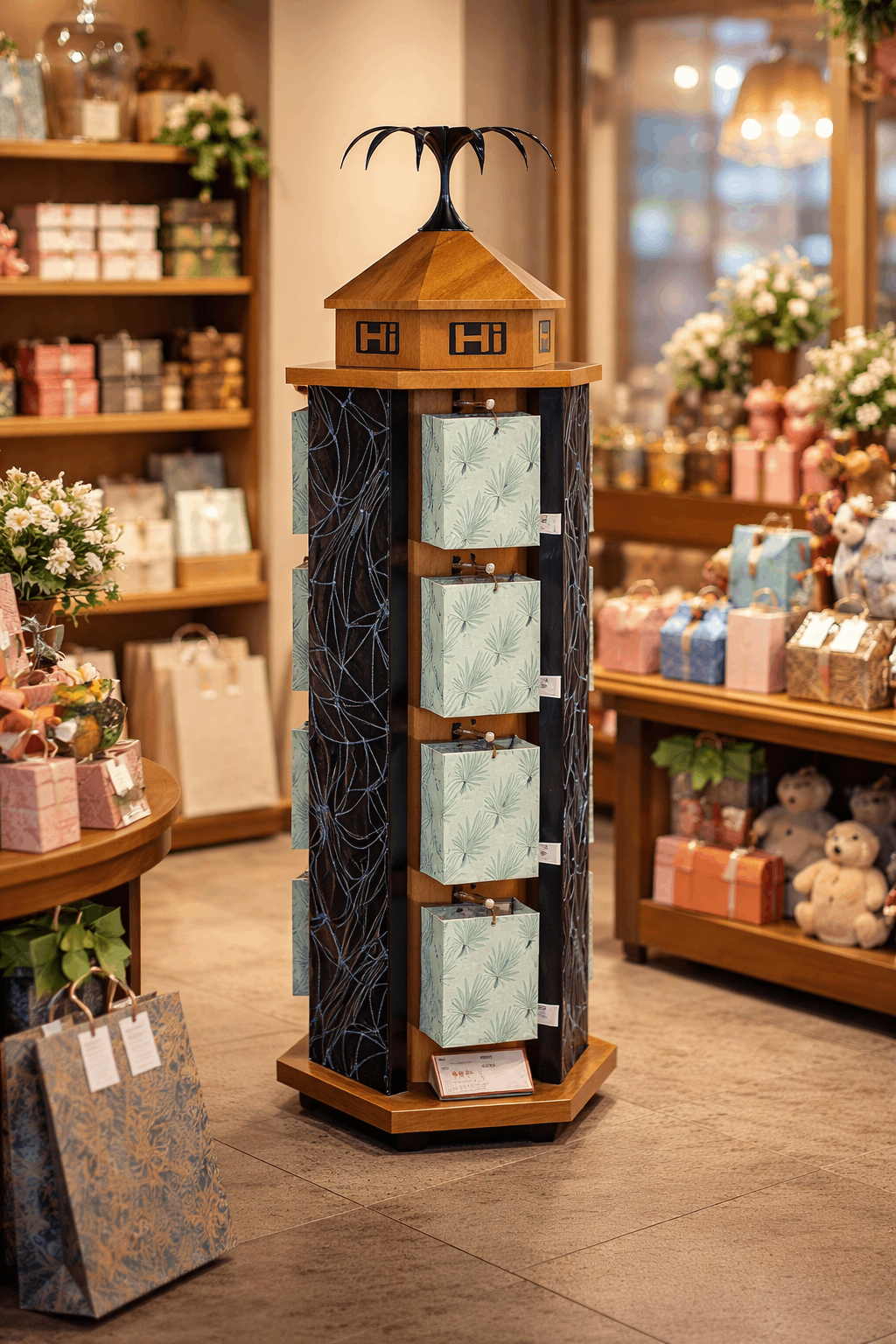
If you are sourcing OEM or ODM metal display racks for retail chains, shopfitting contractors or wholesale programs, you likely evaluate fixtures based on structural reliability, customization scope, MOQ and sample approval procedures, assembly workflow, export packaging and long-term merchandising performance. In that context, the custom 6-way wood-metal hook bag display rack engineered by Yishang Display is designed as a repeatable fixture platform rather than a decorative one-off item. Consequently, it fits the procurement mindset that prioritizes consistency, efficiency and risk control.
The model features a six-sided rotating metal structure, a hexagonal base footprint, a steel hook hanging system and a wood-top decorative cap suitable for premium retail interiors. Therefore, it functions well as a gift bag display rack, golf shop bag display, coffee bag display or light handbag display rack in golf pro shops, stationery chains, bookstores, duty-free stores and lifestyle retailers. As a result, suppliers and retailers can formalize bag packaging as a managed category instead of an informal bin or shelf assortment.
Buyers working in professional procurement prefer fixtures engineered for OEM or ODM production, wholesale distribution and chain roll-outs. For that reason, they often request:
A repeatable structural design
Defined material specifications
Reliable load performance
Customizable dimensions and finishes
Clear MOQ and sampling procedures
Flat-pack export packaging
Consistent QC across batches
Container-efficient packing density
This rack satisfies those criteria. For example, overseas buyers such as fixture wholesalers, packaging manufacturers, shopfitting companies and importers of retail equipment use bag display stands as standardized SKUs that must align with planograms, budget cycles, lead times and replenishment routines. Moreover, visual merchandising teams value fixtures that match brand identity rather than temporary cardboard POP solutions.
The defining feature of this model is its six-face radial layout, arranged around a central vertical axis that enables full rotation. Customers rotate the rack instead of walking around it. Consequently, stores benefit from improved traffic flow in tight layouts, particularly near checkout counters or narrow aisle intersections.
We use a hexagonal base geometry because it offers structural stability and visual compactness. In addition, the six-sided footprint supports flexible placement in:
Mid-floor merchandising positions
End-cap junctions
Checkout waiting zones
Store entrances
Gift wrapping stations
Unlike circular bases, hexagonal bases reduce wasted footprint area and improve tipping resistance. As a result, retailers can integrate the rack into tight layouts without sacrificing safety or stability.
We design the rotational system with a shaft and bearing or bushing assembly located between the base frame and the central column. This allows us to balance:
Torque level (easy to rotate yet stable)
Wobble control
Lateral rigidity
Noise reduction under load
Rotation is critical for multi-face fixtures. If rotation is poorly engineered, fixtures develop tilt, looseness or excessive friction. In contrast, a metal-engineered rotational hub withstands repeated customer interaction in high-traffic retail environments. Additionally, rotation can be disabled for clients who prefer a fixed six-face stand.
The top portion features a metal decorative crown and a wood-style cap. We laser-cut and powder coat the metal crown for durability and visual contrast, while the wood cap hides the structural connection points. Since the combination balances industrial strength with warm aesthetics, it suits golf shops, coffee stores and premium gift retailers. Logos displayed on sample images are demonstrations only; OEM branding is fully supported through custom caps and printed panels.
Professional buyers examine material thickness, hook diameter, welding quality and coating performance to evaluate fixture longevity. Because of that, we specify engineering data during prototyping so buyers can assess performance accurately.
We manufacture the frame from steel tubing and plate due to its tensile strength, dimensional stability and weldability. Furthermore, we produce hooks from steel wire or rod to prevent deformation under repeated loading.
For referencing purposes, typical engineering parameters include:
Tubing thickness: 1.0–1.5 mm for vertical supports
Hook wire diameter: 4–6 mm
Base plate thickness: 2.0–3.0 mm
Buyers can lock specifications during the PP sample stage to ensure consistent mass production.
In actual stores, stress occurs through pulling force, bundled stacking and daily handling. During testing, we evaluate hooks with:
Roughly 2–3 kg evenly distributed load per hook
Angle pull simulations
Rotation cycles under full load
These procedures confirm that the rack holds its shape, maintains rotation quality and resists structural fatigue. Consequently, chain retailers reduce fixture maintenance, store downtime and unplanned replacements.
We weld critical stress joints for rigidity and use bolting schemes for export-friendly flat-pack assembly. This dual strategy provides structural strength while minimizing shipping volume. During QC, we inspect weld penetration, continuity, grinding quality and surface finish before coating. Because welding consistency affects reorder stability, we document parameters for recurring batches.
We apply powder coating to steel components to improve scratch resistance, color uniformity and corrosion protection. Using RAL or Pantone references ensures color consistency across store networks. Meanwhile, we may electroplate hooks to improve sliding performance and wear resistance. Consequently, the rack maintains its appearance even under heavy daily use.
The wood-related sections include the top cap, base trim and optional side panels. Depending on the project, we manufacture these parts from MDF or plywood and finish them with veneers, laminates, paint or digital prints. Because finishes influence store ambiance, buyers often match wood tones to interior packages in golf pro shops, museum stores and gift boutiques.
We mechanically attach wood elements using screws or brackets. As a result, damaged parts can be replaced without discarding the entire fixture, which is valuable in multi-year fixture programs.
Functional merchandising advantages influence buyer decisions just as strongly as structural and aesthetic factors.
Since bags hang vertically, customers immediately see:
Size progression
Artwork or branding
Seasonal themes
Price tags and labels
Therefore, shoppers make faster decisions and require less staff assistance. Additionally, vertical presentation prevents bending and crushing common with stacked bags.
Because the rack uses vertical elevation and six faces, it achieves a high SKU-per-square-meter value. This efficiency is important in:
Airport concession retail
Duty-free environments
Boutique gift stores
Coffee and gourmet shops
Buyers can estimate required quantities per store by calculating SKUs per face, per hook and per rack footprint.
Store staff can identify low-stock hooks instantly. In addition, replenishing takes minimal time because staff avoid folding or separating merchandise. Although packaging is typically a low-margin category, efficient fixtures protect contribution margins by lowering labor cost per sale. Moreover, in chain environments, standardized fixtures streamline planogram compliance and simplify staff training.
We adapt this rack to multiple segments because the six-way format supports theme segmentation, size sorting and brand separation.
Golf shops frequently sell branded bags alongside apparel and accessories. As a result, the golf shop bag display format helps segment event, club and neutral packaging. The wood-metal design also complements golf retail interiors.
Customers choose gift packaging quickly at checkout. Consequently, a dedicated gift bag display stand reduces decision friction and increases add-on purchases.
Coffee beans, chocolate and premium snacks often use small handle or hang-tab bags. After adjusting hook spacing, the rack becomes a coffee bag display, offering a premium look absent in wire racks.
Book and museum shops use branded packaging for souvenirs and books. Wood tones support a curated aesthetic that fits these environments.
When configured for moderate hook loads, the stand also functions as a handbag display rack for lightweight handbags, clutches and soft goods.
We design the rack as a flexible platform for customization instead of a fixed SKU. Customization options include:
Height and base diameter
Hook count, length and spacing
Rotation vs fixed geometry
Metal thickness and coating type
Wood tone, veneer and print
Header panel shapes and logos
Packaging and assembly format
Since wholesalers often serve multiple brands, they benefit from using a shared structure while changing only printed components for each client. Consequently, tooling and prototyping costs stay manageable.
Procurement professionals analyze workflows as much as physical fixtures.
MOQ varies with customization level. Near-standard configurations support lower MOQ, whereas heavier customization may require higher MOQ to offset set-up costs.
Buyers request PP samples to verify bag fit, rotation behavior, surface finishes and branding components. After feedback, we refine the sample and confirm it as the reference standard for mass production.
We implement QC checkpoints for:
Incoming raw materials
Weld joints and structural integrity
Coating adhesion and thickness
Branding accuracy
Assembly tolerances
We maintain sample archives and inspection records to guarantee reorder consistency across multiple production cycles.
Lead time depends on engineering complexity, batch size, finishing queue and export scheduling. Therefore, buyers executing chain roll-outs may schedule phased deliveries to match store construction timelines.
Even though the sample images show a fully assembled rack, we design the structure to support flat-pack export packaging. Components include:
Hexagonal base frame
Central column and rotation hardware
Six vertical supports or side faces
Steel hook assemblies
Wood cap and trim
Brackets and fasteners
Therefore, buyers benefit from:
Reduced ocean freight cost
Higher container utilization
Improved warehousing and distribution
Lower transit damage rates
Assembly requires standard hand tools and minimal training. Installers can assemble a unit in minutes once familiar with the sequence.
Fixture evaluation frequently includes material comparisons.
Metal offers superior structural strength and humidity resistance. While wood provides warmth and visual presence, it is better suited for decorative rather than load-bearing functions.
Acrylic delivers a clean look but suffers from brittleness and surface scratching. Consequently, retailers with high customer traffic prefer metal.
Cardboard fixtures are cost-effective for temporary promotions. However, permanent categories like gift bags or coffee packaging require long-lived metal structures.
The hybrid wood-metal rack bridges durability and aesthetic appeal, making it suitable for long-term deployment in premium retail segments.
The custom 6-way wood-metal hook bag display rack provides a platform built for OEM and ODM supply, wholesale distribution and chain deployment. Specifically, it offers:
Six-sided rotational or fixed display
Hexagonal base for stability
Steel frame and hook system
Wood elements for premium interiors
Enhanced SKU visibility
High SKU-per-square-meter density
Efficient replenishment
Extensive customization scope
Flat-pack export packaging
Short assembly time
Because it functions as a bag display rack, gift bag display stand, golf shop bag display, coffee bag display or handbag display rack, buyers can adapt it to multiple retail categories.
If you are evaluating bag display rack manufacturers in China for wholesale or chain projects, you may provide bag dimensions, store layouts, desired quantities and branding requirements. Based on that, Yishang Display prepares engineering drawings, prototypes and quotations to support your retail fixture program.


Yishang Display specializes in crafting bespoke display solutions. From initial concept and prototyping through to full-scale production, our in-house team manages every phase—delivering a seamless, one-stop experience for your brand.
If you have any questions or need a quote, please send us a message. One of our specialists will get back to you within 24 hours and help you select the correct valve for your needs.
All of our products are available for sampling