For overseas procurement teams, early clarity matters. Before moving deeper into design details, buyers usually want to confirm whether a display fits their sourcing framework. The following reference information reflects typical wholesale programs and can be adjusted based on design complexity and order volume.
This information allows buyers to quickly assess sourcing feasibility before proceeding to detailed specification discussions.
Overseas wholesale buyers do not evaluate a camera display stand as a finished retail product. They assess it as a repeatable supply item that must perform consistently across stores, shipments, and sales cycles. When procurement teams review a product page, their focus is not visual appeal alone. They look for signals of production stability, controllable customization, and predictable retail execution.
Search behavior reflects this mindset. Buyers typically search for phrases such as camera display stand, counter top camera display, or display stand with screen to confirm early fit. They want to understand whether the structure matches counter constraints, whether screen integration is practical in daily use, and whether small qty or trial orders are feasible before committing to larger volumes. Clear, technically grounded explanations reduce sourcing friction and help buyers decide whether to proceed to RFQ.
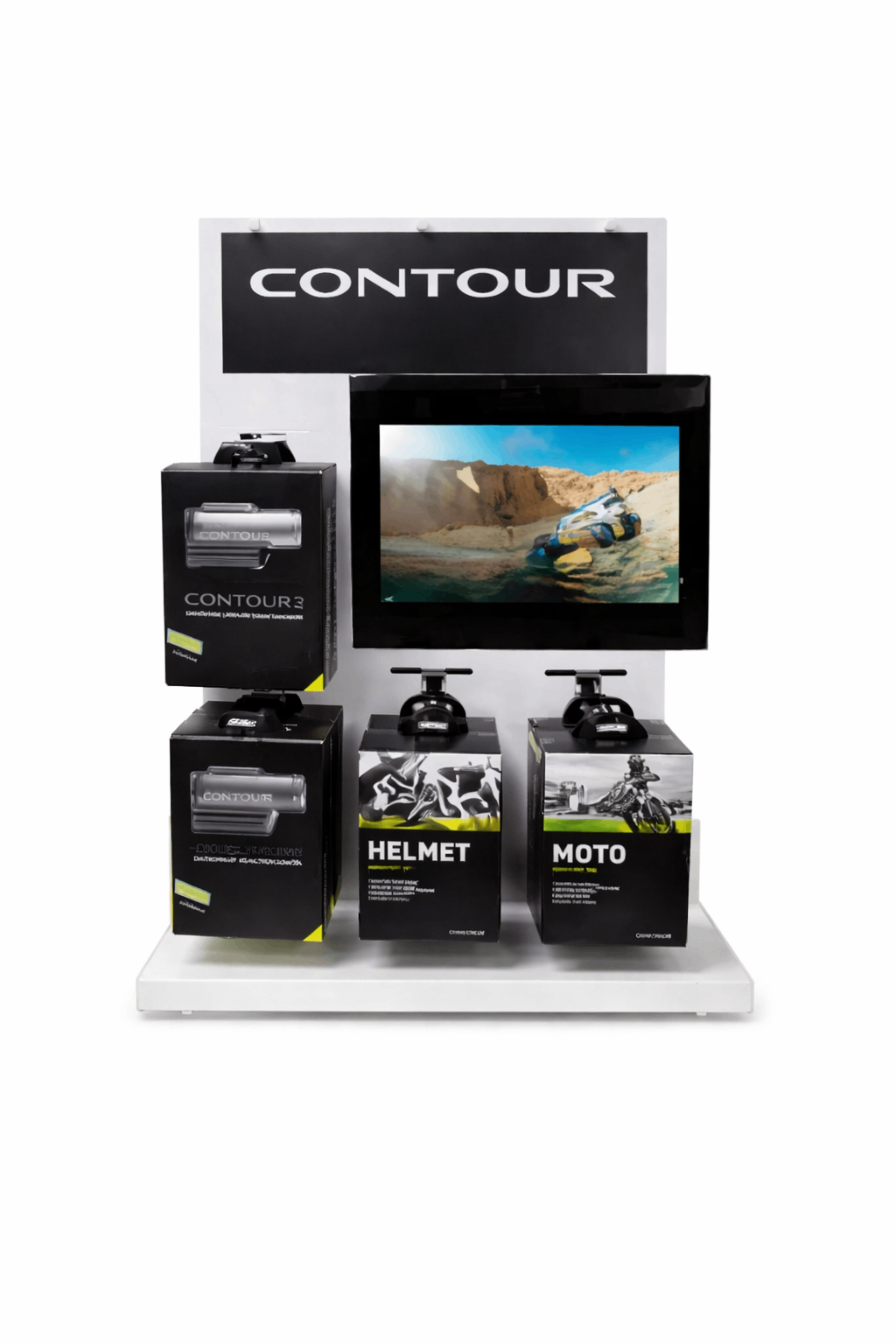
This page follows that logic. It explains how a white customized metal counter top camera display stand with screen functions in wholesale programs, how design choices affect in-store performance, and how the display supports both trial validation and scalable production. The focus remains on the product itself rather than on company promotion.
At the counter top, camera products compete within a short decision window. Customers pause briefly, compare options quickly, and expect clarity without long explanations. Many counter top displays underperform because they act only as holders. They present the product physically but fail to communicate why one model differs from another or why a specific price point makes sense. For wholesale buyers, this often results in uneven sell-through and inconsistent store performance.
A counter top camera display with screen addresses this gap by combining physical presentation with immediate visual explanation. The screen delivers context that packaging and printed cards cannot provide, while the metal counter top structure ensures stability during frequent customer interaction. Together, these elements help standardize how products are understood at the point of sale, reducing reliance on staff explanation and improving consistency across locations.
From a sourcing perspective, the display also functions as a control element. A stable, well-aligned counter top display protects the camera, maintains presentation quality, and supports a uniform brand image across markets. These factors determine whether a display is suitable for wholesale rollout rather than limited or temporary use.
In camera retail, many purchase-driving features are visual rather than textual. Image stabilization, video clarity, mounting scenarios, and interface responsiveness are difficult to communicate through static signage. A display stand with screen allows these elements to be demonstrated directly at the moment when customers are most receptive.
In a counter top camera display stand with screen, proximity is critical. When the screen is positioned close to the physical product, customers can connect what they see with what they touch. This shortens decision time and increases confidence without requiring extended explanation. For retailers, it enables a more self-guided interaction and reduces interruptions during peak traffic.
For wholesale buyers managing multiple stores, screens also support message consistency. Screen content can be standardized and updated across locations, reducing variation caused by printed materials or staff turnover. This makes the display easier to manage at scale and better suited to pilot programs that may expand into wider rollouts.
Once a screen is integrated, the display must be treated as a structural system rather than a simple fixture. Screens add weight, alter the center of gravity, and increase interaction frequency. If these factors are not addressed during design, the display may look acceptable in images but fail under daily retail use.
Counter top displays are particularly sensitive because of their limited footprint. Even small imbalances or vibrations are immediately noticeable. A metal counter top camera display therefore needs to be engineered around load distribution, internal reinforcement, and anti-tilt stability. These structural decisions directly affect how the display feels to customers and how well it maintains alignment over time.
Serviceability is another factor wholesale buyers evaluate quickly. Displays with screens require access for cleaning, cable checks, and content updates. Integrated routing that conceals wiring while allowing maintenance without disassembly reduces store labor time and helps preserve a clean presentation throughout the display lifecycle.
Metal is widely used in counter top camera displays because it offers predictable strength and durability. In wholesale programs, predictability matters. A metal camera display stand maintains its shape under load, resists deformation during shipping, and tolerates frequent handling in retail environments.
Compared with plastic or acrylic structures, metal is less prone to long-term creep and joint loosening. This is especially important for displays that support screens, where rigidity affects alignment and perceived quality. For buyers planning repeat orders or regional expansion, metal construction supports consistent performance across batches.
In some projects, mixed materials are introduced for secondary elements such as protective panels or visual accents. However, the load-bearing frame and connection points remain metal-based to ensure stability. This approach balances design flexibility with structural reliability, which is a common procurement consideration.
White finishes are commonly specified in camera and electronics displays because they improve visual clarity. Camera products often feature dark housings and fine detailing that can be lost against busy or colored backgrounds. A white customized metal counter top surface increases contrast and keeps attention on the product.
Operationally, white finishes also support consistency across different store environments. Lighting conditions vary widely, and white remains visually stable under both warm and cool lighting. This helps maintain a uniform presentation across regions, which is important for brand-controlled wholesale programs.
From a production standpoint, finish control is equally important. Consistent coating processes help maintain uniform color tone and surface quality across small qty trials and larger orders, reducing the risk of visible variation between shipments.
The following specifications represent common configurations for a metal counter top camera display stand with screen. Final parameters are confirmed during sampling.
| Specification Item | Typical Range |
|---|---|
| Overall size | Customized to counter top dimensions |
| Screen | Optional, size and orientation customizable |
| Screen input | USB / SD / internal media player (project dependent) |
| Power | Regional adapter options available |
| Camera mounting | Brackets, holders, or security mounts |
| Cable management | Internal routing with concealed exits |
| Structure | Metal-based, reinforced for stability |
| Packaging | Knock-down or assembled for export shipping |
Customization is often requested by wholesale buyers, but not all customization adds value. The most effective customization focuses on function rather than decoration. A camera display stand must support specific camera models, packaging layouts, and interaction patterns without introducing unnecessary production complexity.
Functional customization typically includes adjusting the counter top footprint, camera holding method, and screen mounting position. These decisions affect stability, viewing comfort, and product protection. Cable routing and access points are also tailored to match store maintenance practices, helping the display remain orderly over time.
For procurement teams, this approach keeps customization within controllable parameters. It allows suppliers to accept small qty or trial orders at an early stage, then scale to larger quantities without redesign. This reduces sourcing risk and supports long-term cooperation.
For buyers planning multi-store deployment, screen integration raises practical questions beyond appearance. Content is typically delivered through simple media formats that loop automatically, reducing the need for on-site configuration. Depending on the project, screen modules can be designed for quick replacement to minimize downtime.
Cable routing and access points are planned during the design stage so routine maintenance does not require dismantling the display. This approach reduces store labor time and helps ensure the screen remains an asset rather than an operational burden during rollout.
Wholesale buyers often begin with a small qty or trial order to validate performance. This stage determines whether the display can transition into regular procurement. Differences between trial samples and mass production are a common sourcing risk.
A production-ready camera display stand is designed with repeatability in mind. Key dimensions are controlled, structural joints are standardized, and surface finishes are monitored to ensure that trial units and subsequent orders perform the same in store. Packaging is also designed to protect alignment and finish during export shipping.
For overseas wholesale buyers, quality management and material compliance are baseline requirements. Controlled production systems such as ISO 9001 and material compliance like RoHS indicate that processes are documented and repeatable.
Beyond formal standards, buyers focus on practical consistency. Aligned panels, stable mounting points, and uniform surface finishes reduce store-level issues and help maintain brand presentation over time.
Do you accept small qty or trial orders?
Trial orders or small qty production can be discussed for new programs, depending on design scope and materials.
Can the screen size or orientation be customized?
Yes. Screen size, mounting position, and orientation are adjusted based on display layout and content requirements.
How is the display packaged for export shipping?
Packaging can be knock-down or assembled, with protective materials designed to prevent damage during transport.
Can the display support different camera models?
Mounting structures are customized to match camera dimensions and security requirements.
What is the typical production process?
Projects generally move from sample approval to trial order and then to mass production, with quality checks throughout the production process.
If you are evaluating a customized metal counter top camera display stand with screen for wholesale use, defining your camera models, counter space, and rollout plan will help streamline the process. A focused inquiry allows specifications, trial options, and production timing to be aligned efficiently.
Yishang Display specializes in crafting bespoke display solutions. From initial concept and prototyping through to full-scale production, our in-house team manages every phase—delivering a seamless, one-stop experience for your brand.
If you have any questions or need a quote, please send us a message. One of our specialists will get back to you within 24 hours and help you select the correct valve for your needs.
All of our products are available for sampling