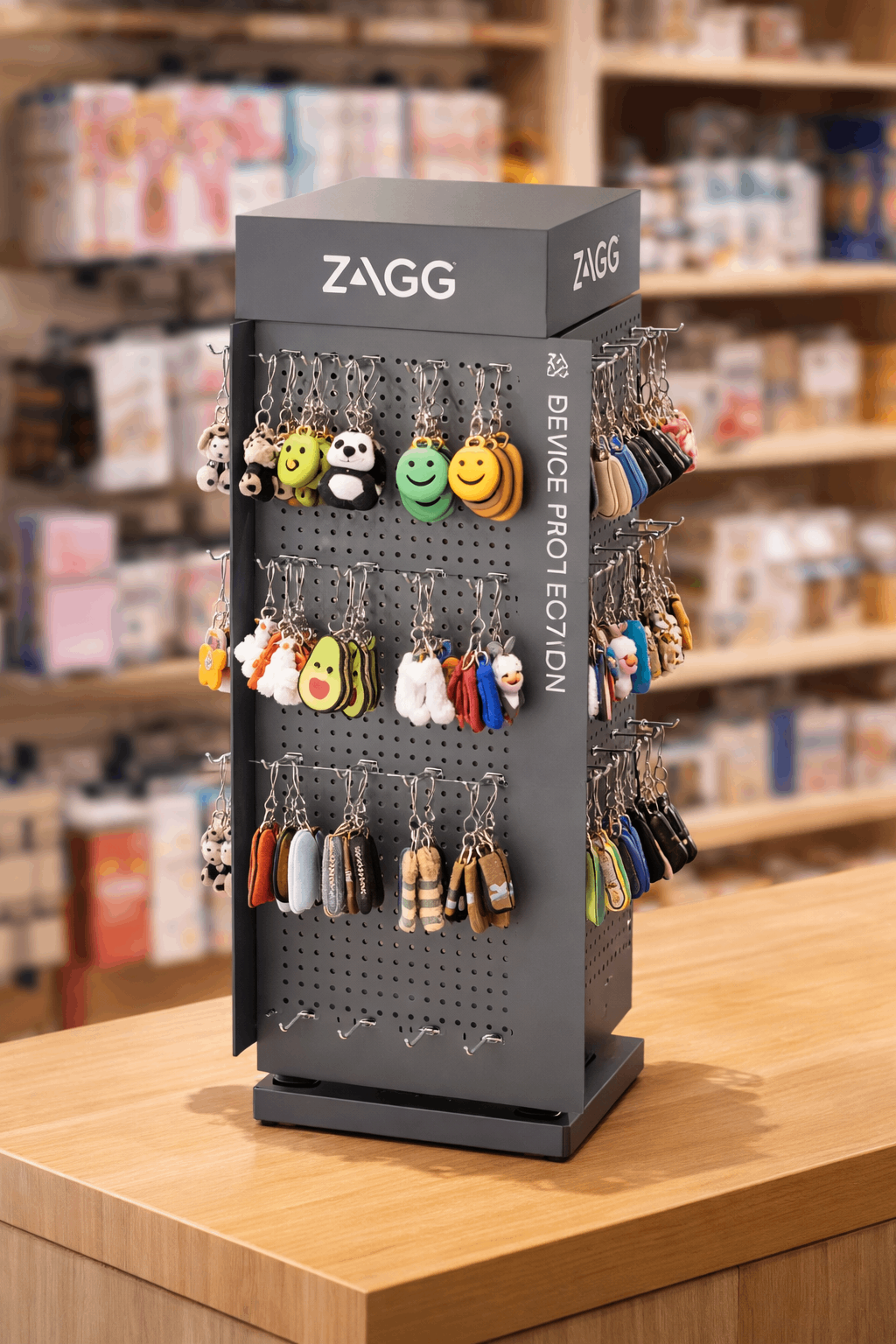
A countertop program succeeds when store teams can keep it neat, shoppers can browse quickly, and every unit performs the same after shipping and daily handling. This rotating countertop keychain display is built around that reality: compact footprint, multi-face exposure, and a hook layout that stays organized under high turnover.
If you are sourcing for wholesale rollout, the useful questions are practical ones. Can the fixture hold your SKU mix without tangling. Does it rotate smoothly when one side is loaded. Can you refresh a seasonal assortment without replacing the whole stand. This page focuses on those procurement decisions rather than consumer-style hype.
Keychains sell on variety and quick recognition, but their small size makes them easy to lose visually on a busy counter. When the category is presented in trays or bins, products overlap, styles blend together, and the display becomes hard to shop in a few seconds.
For wholesale buyers, the bigger risk is execution. A display may look fine in a single photo, then fail at store level because staff cannot maintain order or restock fast enough. A reliable countertop keychain display should reduce that risk by making the category easy to keep tidy even during peak hours.
Rotation is a space-efficiency strategy, not a gimmick. A rotating countertop keychain display turns multiple panels into active selling surfaces while keeping the same footprint, which helps when counter space is limited and closely managed.
It also supports clearer assortment planning. Instead of compressing everything onto one face, buyers can allocate panels by theme, license, campaign, or price tier. That improves readability and reduces the “crowded front row” effect that quietly lowers conversion.
Keychains behave like classic add-on items. They perform best where customers pause briefly, such as checkout counters and service points, because browsing happens in short bursts and decisions are fast.
For multi-store programs, countertop placement is also easier to standardize. Floor space varies widely by store format, while counters and service desks tend to be more consistent. Standardization matters to procurement because it reduces rollout friction and improves planogram compliance.
Hooks keep each product separated, visible, and easy to grab, which matters when buyers carry dozens or hundreds of SKUs. A keychain display with hooks reduces tangling, prevents overlapping packaging, and helps customers compare designs quickly.
Hooks also simplify replenishment. Staff can replace individual SKUs without rebuilding the display, keeping the presentation clean throughout the day. In wholesale terms, that means lower store labor and a higher chance the fixture is maintained as intended.
The pegboard-style panel behind the hooks enables flexible hook spacing and layout changes as your assortment evolves. That matters when you run seasonal programs, limited editions, or region-specific SKU sets.
Because the structure is modular, the same format can be adapted for other small accessories. Buyers sourcing sunglass display racks or a countertop sunglass display often face the same constraints: limited space, high SKU density, and frequent refresh. The exact configuration changes, but the merchandising logic stays consistent.
A rotating countertop stand is touched frequently. Customers spin it from the edge, remove items unevenly, and sometimes bump it while browsing. That is why stability must be evaluated in the loaded condition, not only when the display is empty.
A well-built rotating countertop keychain stand should rotate smoothly without wobble and remain stable when one panel is full and another is partially empty. Manual rotation is typically preferred for wholesale deployments because it avoids power requirements and reduces maintenance risk across markets.
Material choice directly affects lifecycle cost. Metal is commonly used for a display rack display structure because it stays rigid under load and tolerates high-touch use. For wholesale buyers, that means fewer replacements, fewer store complaints, and more predictable long-term performance.
Acrylic can be integrated where it adds functional value, such as clean branding surfaces or header elements. Many countertop accessory programs combine metal structure with acrylic signage to balance durability and brand visibility without making the fixture fragile.
In busy retail environments, finishes need to resist wear, scratching, and discoloration. Powder coating is a common choice for metal fixtures because it supports consistent appearance across batches.
Compliance language should stay practical. Where required, materials can be specified to meet RoHS expectations. If your deployment environment is demanding, buyers may also specify durability benchmarks such as coating adhesion checks or corrosion resistance testing. These are options to align on in the RFQ, not claims to exaggerate.
Wholesale teams typically quote faster when the spec is framed around rollout constraints. The parameters below are intentionally presented as buyer-defined inputs rather than a fixed catalog spec.
| Parameter | What Buyers Define | Why It Matters |
|---|---|---|
| Footprint and height | Counter limits, sightline targets | Reduces store pushback and improves compliance |
| Panel count | 3–6 faces depending on SKU volume | Controls capacity and category clarity |
| Hook specification | Length, gauge, spacing strategy | Fits packaging formats and reduces tangling |
| Load strategy | Items per hook, uneven-load behavior | Protects stability and rotation feel |
| Branding parts | Header, side panels, removable signage | Supports campaign refresh without new tooling |
| Pack-out | Knock-down or assembled shipment | Impacts freight and store setup effort |
If you share a simple SKU list with packaging type and target facings, panel allocation and hook spacing can be optimized to match your planogram rather than forcing your assortment to fit a generic layout.
Customization works best when it starts with product data. A countertop keychain display with hooks should be designed around your SKU dimensions, packaging style, and target capacity. Those inputs drive hook geometry, spacing, and panel layout.
Branding should support shoppability. Headers and side panels are most effective when they reinforce brand identity without blocking sightlines or interfering with rotation. For programs that refresh frequently, interchangeable branding components can extend the fixture’s useful life and improve ROI.
This format performs best in environments where customers pause briefly and browse casually, such as gift stores, convenience counters, tourist shops, accessory corners, and service desks. Rotation encourages exploration while hooks keep the assortment readable.
Fit matters. Oversized or heavy items may require reinforced hooks, a different base strategy, or an alternative fixture type. Matching product weight and packaging to the design early prevents stability issues later.
For wholesale rollouts, consistency across units is a primary quality metric. Buyers care about rotation feel, hook alignment, surface finish consistency, and stability under uneven loading, because variation at scale creates store-level problems.
Logistics planning influences total landed cost. Knock-down packing can reduce volume, while clear assembly steps reduce store labor. These are procurement factors worth confirming early, alongside MOQ, lead time, and packaging protection for the rotation mechanism.
Many global buyers source fixtures from mature manufacturing hubs such as Guangdong Province, China because supply chains for metal fabrication and finishing are well established. What matters most is not geography, but how clearly the specification is confirmed, sampled when necessary, and controlled through batch production.
When you need OEM/ODM support, Yishang Display typically works from your SKU information and rollout constraints to define a buildable specification, then aligns sample and approval checkpoints before mass production. The goal is predictable execution, not unnecessary complexity.
If your category relies on variety, frequent refresh, and fast browsing, this rotating hook-based stand is a practical choice. It improves exposure per square inch and keeps the assortment organized without demanding extra counter space.
To quote accurately, share product dimensions or packaging type, approximate SKU count, target footprint, branding needs, and expected order quantity. If you would like a fast feasibility check, send a short inquiry with those details and we will recommend a configuration that fits your program.
For procurement teams, a quick specification reference helps determine fit before moving into detailed RFQ discussion. The values below describe typical wholesale configurations for a rotating countertop keychain display. They are not fixed limits and can be adjusted based on assortment, packaging, and rollout requirements.
These ranges are intended to help buyers quickly assess whether the format aligns with their counter space, SKU count, and operational constraints.
Quoting accuracy and lead time improve significantly when the display is defined around real product data rather than generic assumptions. For a countertop keychain program, buyers typically prepare a short set of inputs before requesting pricing.
Useful information includes packaging type (header card, blister pack, ring-only), approximate product weight range, target number of SKUs and facings, preferred counter placement, branding expectations, and estimated order quantity. When these factors are clear early, panel layout, hook geometry, and packing method can be aligned quickly, reducing revision cycles and shortening the path from concept to production.
Can hook spacing be adjusted for different packaging cards?
Yes. Hook spacing and length are commonly adjusted to match card width and hang-hole position so products remain readable and easy to restock.
How is tipping prevented when one side is heavily loaded?
Stability is evaluated under uneven-load conditions. Base balance and weight distribution are designed to keep the display stable even when one panel carries more items than others.
Is knock-down packing recommended for international shipments?
Knock-down packing can reduce freight volume and landed cost. The choice depends on order size, destination, and store assembly capability.
What lead time is typical for a branded header update?
For most wholesale programs, branded header changes are managed within standard production timelines once artwork and dimensions are confirmed.
Which materials perform better in humid or coastal markets?
Metal structures with appropriate surface finishes are commonly specified. Finish selection can be aligned with environmental exposure during RFQ discussion.
Can this structure be adapted for other small accessories?
Yes. With adjustments to hook geometry and spacing, the same rotating countertop format can support sunglasses, packaged accessories, or similar small items.


Yishang Display specializes in crafting bespoke display solutions. From initial concept and prototyping through to full-scale production, our in-house team manages every phase—delivering a seamless, one-stop experience for your brand.
If you have any questions or need a quote, please send us a message. One of our specialists will get back to you within 24 hours and help you select the correct valve for your needs.
All of our products are available for sampling