
A procurement‑focused, structure‑driven guide from retail display engineering
Quick note for wholesale buyers
When you search “how to make your product stand out,” most articles talk to end consumers. This one is written for overseas wholesale procurement teams, brand owners, and retail planners who need a display solution that works across stores, seasons, and replenishment cycles.
Standing out, in your world, means fewer unknowns. It means a presentation system that protects sell‑through, protects labor efficiency, and protects rollout consistency.
Introduction: Why “standing out” is a procurement decision, not a design trick
If you buy for multiple stores or multiple markets, you already know this: products rarely win because they are the loudest. They win when choosing them feels operationally safe.
That safety is usually created by the display environment. A product that is well engineered but poorly presented can look unreliable. A product presented with structural clarity can look premium even before a shopper reads the label.
For procurement teams, “standing out” ultimately means predictable behavior over time. Displays that protect alignment, load capacity, and replenishment flow reduce downstream risk and simplify rollout decisions.
In the sections below, we translate “make your product stand out” into procurement language: consistency, load behavior, lifecycle cost, modularity, and decision efficiency.
Where “standing out” actually happens in retail environments
Buyer reality checkpoint: If you manage multiple stores or regions, the first failures rarely come from branding. They come from uneven displays, unclear grouping, slow replenishment, and fixtures that behave differently from store to store.
Products don’t compete alone — they compete inside display structures
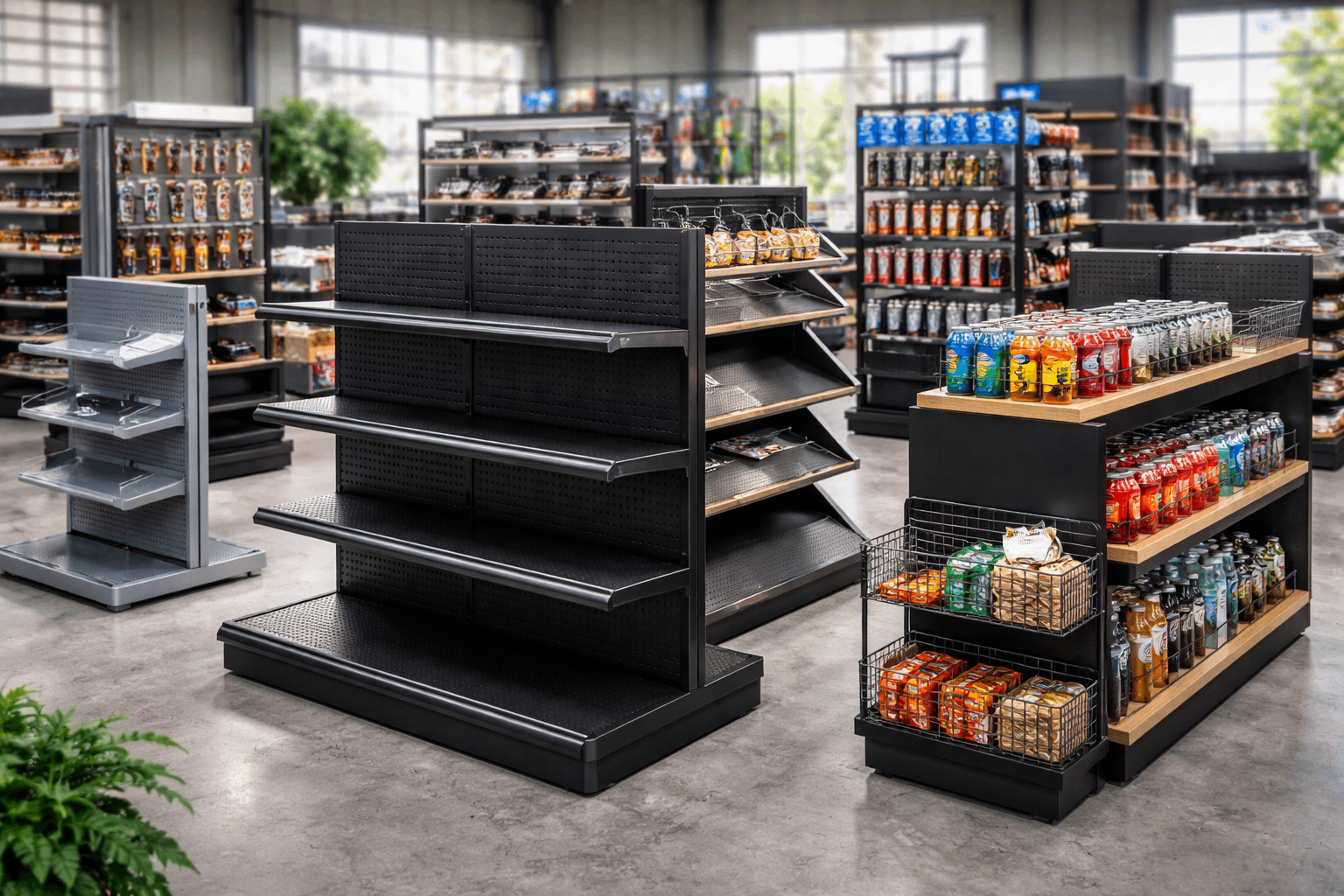
Products are experienced inside shelving systems, floor racks, gondolas, and modular fixtures that define grouping, reach, and replenishment. Wholesale buyers don’t separate the product from the product display.
The display structure sets the first decision frame: what belongs together, what is primary vs secondary, and what is easy to take. When that frame is weak, buyers expect hidden cost later.
This is why procurement teams pay attention to things that look “non‑marketing”: joint layout, hook density, shelf pitch, and the stability of the base. These are rollout signals.
A strong retail display structure also creates repeatability. If the same fixture can be deployed in different stores with minimal adjustment, the product looks consistent everywhere.
Visibility is not about bright colors — it’s about controlled exposure
Wholesale buyers rarely care whether a display is “creative” in the social‑media sense. They care whether the display reduces noise and increases product clarity.
Controlled exposure is achieved through geometry: consistent shelf heights, clean vertical alignment, stable facing counts, and enough spacing to prevent overlap.
Metal display systems support this because they hold geometry under load. In real store conditions, alignment that stays true after weeks of replenishment matters more than day‑one aesthetics.
If your audience searches for product display ideas, the best answer is rarely “use more graphics.” It’s “design the structure so the right SKU is the easiest to see and the easiest to choose.”
Why predictable structure creates trust before branding does
Brand trust helps, but procurement trust is earned differently. Buyers infer trust from consistency and observable control.
If a display behaves like engineered equipment—stable under load, predictable after transport, consistent across batches—buyers assume the supplier can support scale.
Stability, load, and finish as operational proof
Structural stability is a silent proof point. A display that remains rigid under full load signals real‑world readiness.
In beverage, hardware, automotive, and packaged‑goods categories, minor shelf deflection and joint movement become early warning signs. Buyers know that small movements become big issues at store scale.
Load behavior is also a planning signal. When load‑bearing performance is predictable, teams can standardize planograms and replenishment without constant exceptions.
Finish quality reinforces the same message. Uniform coatings, clean weld transitions, and consistent surface treatment suggest controlled manufacturing, not one‑off fabrication.
Cohesive systems reduce evaluation friction
Cohesive display design is not primarily visual. For procurement teams, cohesion is logistical.
When fixtures share dimensions, materials, and a consistent structural logic, it is easier to forecast deployment, maintenance, and replacement. That reduces internal debate.
Inconsistent systems introduce friction. Buyers worry about spare‑part compatibility, future expansion, and store‑to‑store variation.
A cohesive metal display system signals that the supplier designed for lifecycle, not just for a sample.
Fit beats flexibility in real wholesale programs
Many suppliers sell “universal” displays. Procurement teams know universal often means compromised.
A fixture that tries to fit everything can create uneven presentation, poor load efficiency, and higher adjustment cost across stores.
Why over‑flexibility increases hidden cost
Over‑flexible designs often trade away shelf depth, spacing efficiency, or load rating. The result is ongoing adjustment.
At scale, those small adjustments turn into real cost: more labor, more maintenance, more exceptions in rollout instructions.
Custom retail displays align structure with SKU reality. When shelf spacing, depth, and capacity match the product, the display communicates order.
That order is not cosmetic. It reduces operational variance and makes performance more predictable.
Making selection easier for customers — and approval easier for buyers
Displays that reduce customer decision fatigue also reduce procurement friction.
Clear grouping, consistent spacing, and logical progression make range comparison easier on the shop floor.
That same clarity makes internal approval easier. Buyers can justify why the assortment is presented a certain way without writing long explanations.
If your goal is that your product stand out from competitors, clarity is often the fastest path.
Immersion without distraction in B2B retail (where many programs go wrong)
Many articles recommend immersive displays. In wholesale programs, immersion is valuable only when it reduces uncertainty.
A display should help buyers and retailers understand how the product behaves in real use, not how creative the display looks in a photo.
Functional immersion supports procurement confidence
Functional immersion means showing scale, access, and load in a way that matches real store conditions.
For tools, it can mean an honest working angle and clear hand access. For beverages, it can mean realistic facing density and safe weight distribution. For auto parts, it can mean clear labeling zones and durable hooks.
Metal display systems support this because they provide structural realism. Products can be presented exactly as they will appear in‑store.
That reduces “imagination cost” for the buyer. It becomes easier to approve.
Refreshing presentation without resetting the system
Wholesale programs evolve. Promotions change. Seasonal graphics rotate.
Procurement teams prefer modular display systems that allow updates without altering the core framework.
Adjustable shelves, interchangeable accessories, and replaceable panels enable refresh cycles without adding new variables.
The system stays familiar. The presentation stays fresh.
Sustainability and materials as procurement signals (lifecycle, not messaging)
Sustainability is increasingly part of procurement conversations, but buyers evaluate it through durability and lifecycle economics.
A display that lasts longer and needs fewer replacements reduces waste and reduces cost.
Metal displays often perform well in this assessment. Higher initial material input can be offset by longer service life and lower maintenance requirements.
For wholesale programs, “sustainable” is often another way of saying “predictable over time.”
Why buyers trust displays that look engineered, not decorated
Retailers and wholesale buyers respond to engineered simplicity. Not because they dislike creativity, but because they dislike uncertainty.
A display that looks engineered signals control. A display that looks over‑decorated can signal short‑term promotion.
When simplicity signals professionalism
Clean structural lines, visible load logic, and restrained finishes suggest a fixture designed for function.
That perception aligns with procurement priorities: reliability, repeatability, and maintainability.
In store execution, simple systems also train staff faster. Fewer parts and clearer logic reduce errors.
Explaining design decisions builds more trust than storytelling
Wholesale buyers rarely need brand stories on supplier websites. They need reasoning.
When it is clear why shelves are spaced a certain way, why a base is weighted, or why a hook gauge was chosen, buyers infer competence.
This is also a strong E‑E‑A‑T signal. It demonstrates experience and expertise without claiming authority.
What procurement teams look for on supplier pages (and what to publish to stand out)
This section addresses a common browsing habit: wholesale buyers skim first, then read only what proves suitability.
If your blog post is informative but missing procurement‑grade details, it may attract traffic but not convert.
Make specifications easy to find without turning the page into an ad
Buyers want proof that your product display is designed for real conditions. They often search using phrases like metal retail display rack, custom gondola shelving, retail fixture design, or durable display materials.
To match that search intent, publish the technical essentials in a way that feels neutral and useful.
A short technical table does more for trust than paragraphs of claims.
Example: display engineering signals buyers recognize
| Buyer question | What to show | Why it matters in procurement |
|---|---|---|
| Will it hold up under load? | Rated load per shelf / hook, and test method | Reduces operational risk and warranty disputes |
| Will it stay aligned over time? | Material thickness ranges and reinforcement logic | Supports repeatability across stores |
| Will it survive store reality? | Finish type and durability tests (see below) | Predicts wear, corrosion, and appearance stability |
| Can we scale it? | Modular parts, standard sizes, spares strategy | Lowers rollout and maintenance friction |
| Can staff restock fast? | Replenishment access and facing logic | Reduces labor cost and execution errors |
Keep the numbers realistic. Procurement teams prefer honest constraints to inflated promises.
Use recognized tests and standards as credibility anchors
You do not need to flood a blog with standards. A few well‑placed references make the page feel mature.
Common examples for metal fixtures and finishes include:
| What you’re proving | Example standard / method | What it signals |
|---|---|---|
| Corrosion resistance | ISO 9227 / ASTM B117 (salt spray) | Finish durability in humid or coastal markets |
| Coating adhesion | ASTM D3359 (cross‑hatch) | Coating stability under handling |
| Impact resistance | ASTM D2794 | Resistance to knocks during replenishment |
| Gloss / thickness control | Simple QC reporting (microns, gloss units) | Process consistency and repeatability |
Standards are not marketing. They are a language procurement teams understand.
POP vs POS displays, packaging, and what procurement teams actually evaluate
Some buyers search POP vs POS displays because they are trying to align marketing intent with operational execution.
In practice, the difference is less important than whether the system matches the rollout goal.
If the goal is speed and promotion, a short‑term POP approach may be fine. If the goal is repeatability and lifecycle value, a more durable POS‑style fixture is usually preferred.
For wholesale programs, the most useful discussion is not definitions. It is trade‑offs: durability vs cost, modularity vs complexity, and how the display interacts with packaging design.
A good display and packaging design relationship is simple: packaging communicates, the display organizes. When both are clear, products are easier to choose.
How to keep the page conversion‑friendly without sounding like hard advertising
Wholesale buyers dislike pages that feel like a sales pitch disguised as education. They also dislike pages that never explain what happens next.
The balance is practical: focus on buyer problems, show decision logic, and offer a low‑pressure next step that mirrors how evaluations already happen internally.
In most real projects, buyers start by sharing a few basics: approximate product weight range, target store format, and required facing count. Those inputs are usually enough to assess whether a display structure is suitable or not.
Conclusion: Products stand out when the display structure reduces risk
For wholesale buyers, standing out is not about attraction. It is about assurance.
Products stand out when the display environment communicates predictable behavior over time: stable load performance, consistent alignment, and clear replenishment logic. Engineered retail display systems reduce uncertainty, support consistent execution, and make evaluation more efficient.
When structure supports predictability, products require less explanation and fewer assumptions. In competitive wholesale environments, that quiet competence often becomes the deciding factor.
If you’re evaluating scalable, durable display solutions, Yishang Display can help translate rollout requirements into a practical metal display system. A short message is enough to confirm fit for load, store format, and lifecycle expectations.
For wholesale buyers, standing out is not about attraction. It is about assurance.
Products stand out when the display environment communicates stability, clarity, and operational fit. Engineered retail display systems reduce uncertainty, support consistent execution, and make evaluation more efficient.
When structure supports predictability, products require less explanation and fewer assumptions. In competitive wholesale environments, that quiet competence often becomes the deciding factor.
If you’re evaluating scalable, durable display solutions, Yishang Display can help translate your rollout requirements into a practical metal display system. One short message is enough to confirm fit for load, store format, and lifecycle expectations.