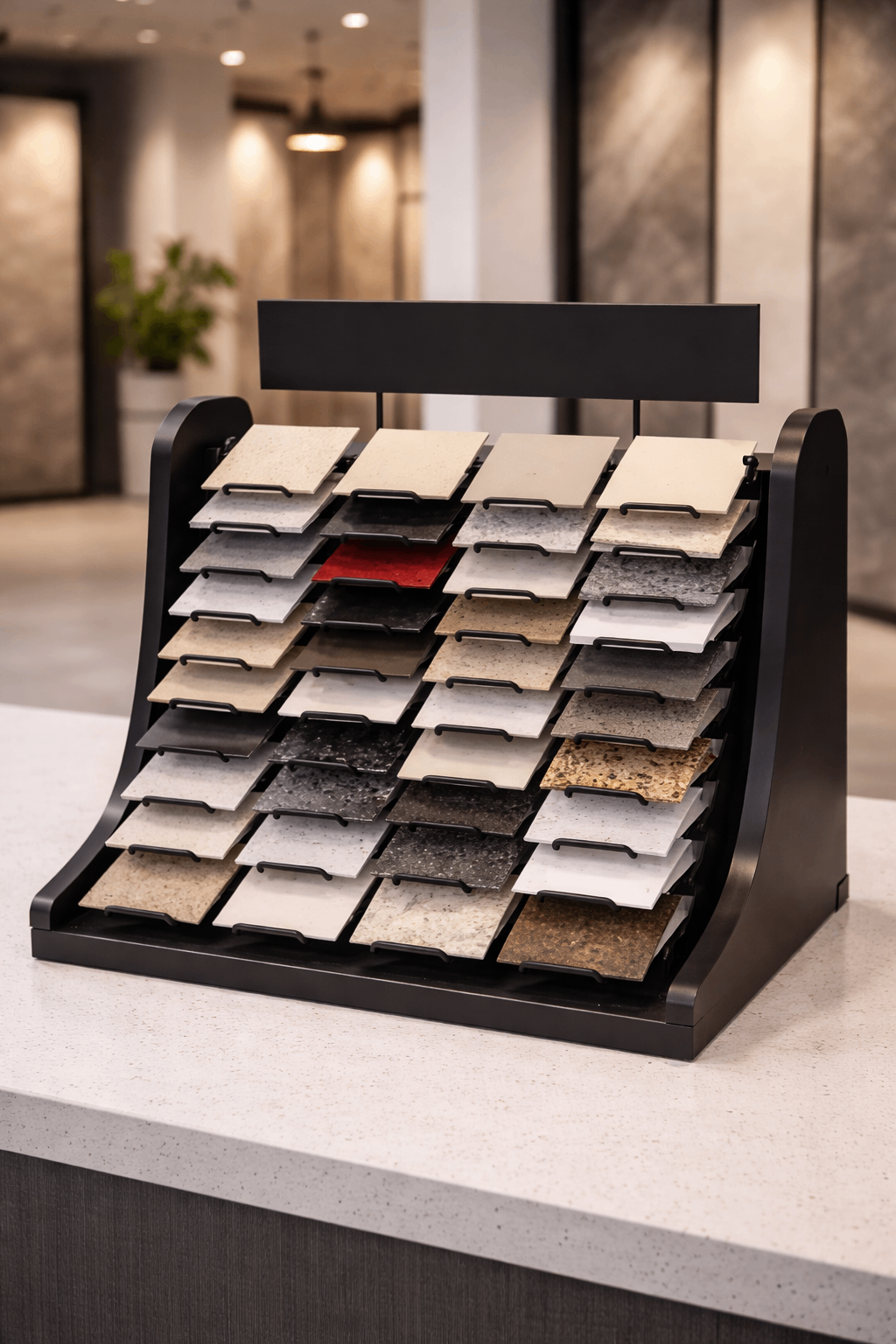
The fastest tile decisions happen when samples stay organized and easy to compare. The Functional Black Metal Slide Tile Holder Showroom Display Rack is a floor-standing tile display rack built around a guided slide tile holder system, so each sample board can be pulled out for inspection and returned without disturbing the rest of the set.
Designed for commercial showrooms and distributor sample areas, this showroom tile display focuses on load stability, smooth daily operation, and protection of tile samples over time—not decorative styling.
Many top-ranking supplier pages include a fast “RFQ snapshot” because B2B buyers skim first, then read details. For a tile holder showroom display rack, these are the items procurement teams usually confirm early (MOQ, lead time, shipping port, and packaging approach). )
For Yishang Display, final terms depend on configuration and quantity, but the structure below helps you send a clean request and get an accurate quote quickly.
| Item | What Buyers Usually Confirm | What to Share in Your Inquiry |
|---|---|---|
| Quantity / trial | Whether small qty or trial is possible | Target qty (trial or rollout) |
| Lead time | Production schedule planning | Required delivery window |
| Shipping | Port and delivery method | Destination country/port |
| Payment terms | Internal approval process | Your preferred term (EXW/FOB etc.) |
| Packaging | Damage prevention in transit | Any warehouse handling needs |
This section is intentionally short so buyers can locate key info in seconds, without turning the page into a company profile.
In a wholesale showroom, a display rack is part of a larger sample program: it must keep SKUs readable, reduce daily reset work, and support repeatable comparisons across finishes and series. This rack is built to keep tiles consistently positioned even when multiple visitors browse the same section in a short period.
The key difference versus fixed shelving is controlled interaction. Each tile sample has a defined holder and a predictable return position, which helps prevent gradual disorder and lowers the risk of edge-to-edge contact that leads to chips.
Each tile is mounted on an individual tile holder display panel that travels along a guided path. Pulling one sample forward brings it into a clear viewing position while keeping it fully supported during movement.
Because tiles are examined in place, the system reduces the need to lift heavy samples, stack boards temporarily, or lean tiles against other pieces. This is especially useful for porcelain and stone sample boards where uncontrolled handling can damage corners or surfaces.
Tile samples are heavy, and the rack must remain stable at full load. The frame uses a rigid metal structure designed to carry both static weight and the repeated push–pull forces created by daily sliding.
Stable geometry matters for long-term use. When a frame resists deformation, holder alignment stays consistent, sliding remains smoother, and the rack requires less adjustment over its service life.
The black powder-coated surface is chosen for durability and visual neutrality. In a busy tile showroom display, frequent contact and cleaning are normal; powder coating helps resist scratching and corrosion.
Black also works as a neutral background so tile color, texture, and sheen stand out more clearly during side-by-side comparison.
Different showrooms use different sample board sizes and thickness ranges. Instead of presenting one “fixed capacity,” this showroom display rack is typically configured around the sample format you already use.
| Item | What You Specify | Why It Matters |
|---|---|---|
| Sample board size (L × W) | Your standard tile sample format | Determines holder size and presentation area |
| Thickness range | Min–max thickness | Sets spacing and retention needs |
| Holder count per rack | Target SKUs per unit | Defines display capacity and grouping |
| Spacing preference | Dense vs easy access | Balances comparison comfort and footprint |
| Tile category | Ceramic / porcelain / stone | Guides reinforcement approach |
| Footprint limit | Available floor area | Affects traffic flow and layout planning |
When buyers search “display rack for tile showroom” or “tile holder showroom display rack,” the real question is usually fit: will the rack support existing sample formats without slowing down browsing? This rack supports common showroom boards used for ceramic, porcelain, and stone collections, with spacing and holder count defined around your program.
Good planning balances density with usability. Packing too tightly increases contact and slows comparison; spacing too widely wastes floor space. Many showrooms solve this by organizing holders by application (wall, floor, outdoor) or by series, so customers compare like-for-like without pulling every sample.
A slide-out system supports faster comparison because each sample can be pulled forward without moving adjacent boards. This helps visitors evaluate texture, finish, and thickness with less friction—important in project selection where decisions are often made in meetings, not casual browsing.
It also supports display control. Defined positions keep the set organized with less staff intervention, and controlled motion reduces uncontrolled stacking that often causes corner damage. Over time, fewer damaged boards can mean fewer replacements and a more consistent showroom appearance.
This rack is commonly used in distributor showrooms, building material centers, and sample libraries where collections are updated but comparison happens daily. It works especially well when visitors need hands-on inspection and the sample set must remain neat after repeated use.
For higher-traffic spaces, the stability of a metal frame helps the display stay aligned and usable, even when different people handle samples throughout the day.
Customization is most effective when it improves fit and daily usability. Common adjustments include rack height and width, holder count, and spacing tailored to thickness ranges—so both lighter ceramic boards and heavier stone samples remain supported.
Mixed-material elements can also be used selectively for labeling or visual organization. The structure remains metal-first for strength, while acrylic components may be added where they improve communication and navigation across categories.
Durability is proven over repeated cycles: pull out, compare, return—day after day. A reliable metal slide tile holder should maintain alignment so sliding stays consistent over months and years.
This rack is designed to reduce common long-term issues such as uneven motion, loosening, and visible surface wear. Predictable performance is especially valuable when the same display concept is used across multiple locations.
This functional black metal slide tile holder is a strong choice for medium to large sample programs where comparison is frequent and the display must stay organized with minimal daily reset work.
For short-term promotions, temporary events, or very small sample quantities, simpler stands may be more cost-effective. If the goal is high-density storage rather than frequent interaction, a rotating or library-style system may fit better.
Many showrooms combine systems. Fixed racks work for static presentations, rotating racks increase density in tight spaces, and storage-oriented racks suit back-of-house libraries.
For active comparison zones, pull-out / push-pull tile displays are commonly selected because they let visitors browse heavy tiles with less lifting and less re-stacking.
Many buyers start with a pilot. If you need small qty or trial order options to test in a showroom, those can be discussed based on configuration and production planning.
To keep sourcing efficient, confirm your sample board size, thickness range, target holder count, and quantity requirement early. This reduces quoting cycles and helps align lead time with showroom rollouts.
For overseas shipment, packaging must protect both the powder-coated surface and the sliding components. Reinforced export packaging with internal bracing is commonly used to reduce transit impact and help maintain alignment.
If the shipment includes partially assembled units, clear orientation labeling and protective edge treatment help simplify warehouse handling and installation planning.
What tile sizes does this rack support?
It is designed around common showroom sample formats. Holder size and spacing are configured to match your board dimensions and thickness range.
Is it suitable for heavy stone tiles?
Yes. The metal frame supports heavier categories when configured to the sample weight and spacing requirements.
Can the number of sliding holders be customized?
Yes. Holder count is defined based on the SKU capacity you want per rack and how you group collections.
Can you accept small qty or trial orders?
In many cases, small quantity or trial orders can be arranged depending on configuration and scheduling.
Is black powder coating standard?
Black is a common showroom choice for neutrality and durability. Alternative finishes can be discussed if needed.
If you’re sourcing a tile display rack for a showroom program, share your sample board size, thickness range, target capacity, and quantity. Yishang Display can then propose a configuration that fits your layout and browsing flow.
If you need small qty or trial first, say so. A one-paragraph inquiry is enough to start.


Yishang Display specializes in crafting bespoke display solutions. From initial concept and prototyping through to full-scale production, our in-house team manages every phase—delivering a seamless, one-stop experience for your brand.
If you have any questions or need a quote, please send us a message. One of our specialists will get back to you within 24 hours and help you select the correct valve for your needs.
All of our products are available for sampling