
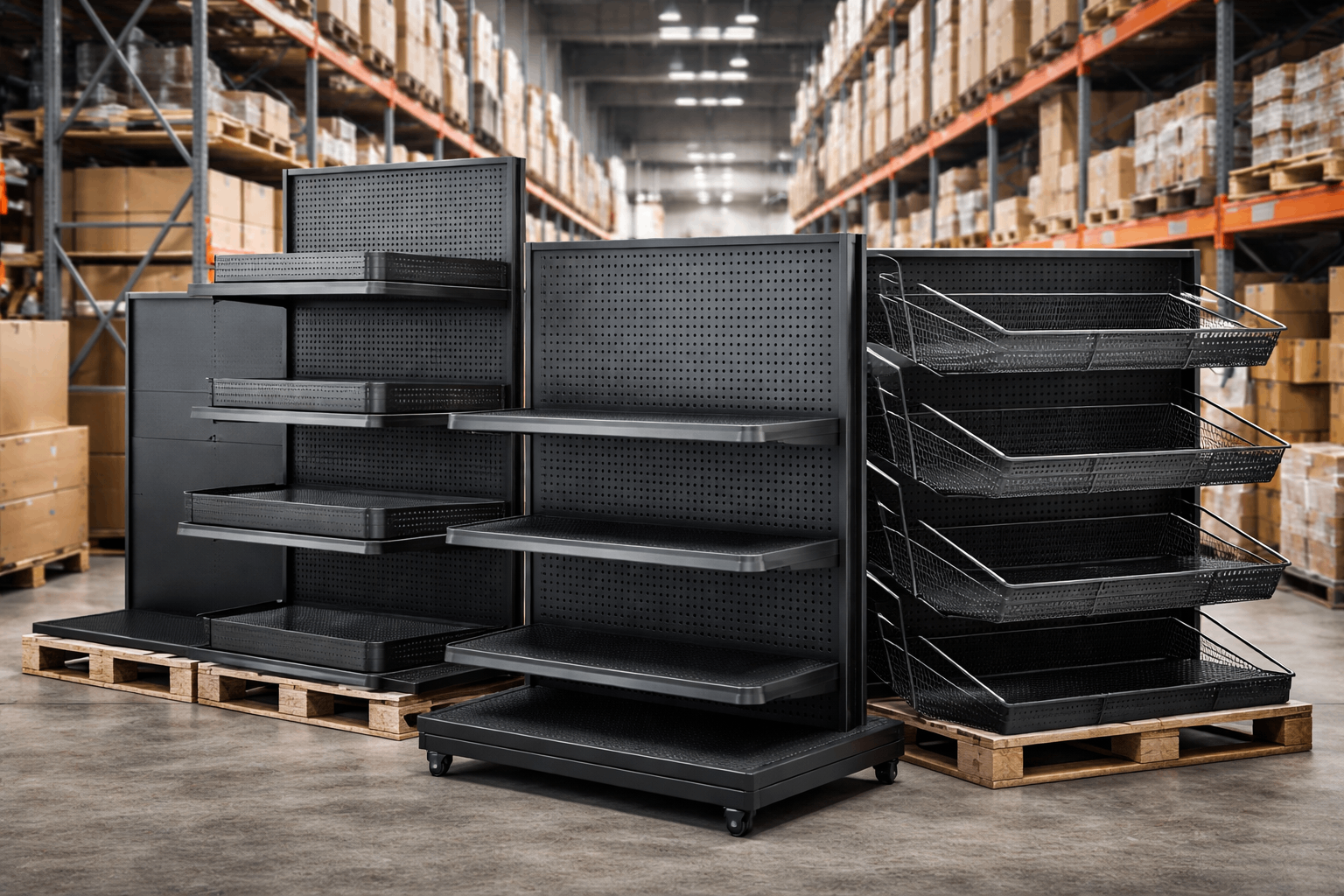
Why Retail Systems Trust Custom Metal Display Racks More Than You Think
For overseas wholesale buyers, a supplier’s blog is not brand storytelling. It is a screening document used early in the sourcing process. Importers, distributors, and category buyers skim with a specific goal: to judge whether a manufacturer can support retail execution at scale without creating downstream operational risk.
In practice, this means buyers scan less for inspiration and more for signals. They look for evidence of manufacturing maturity, batch consistency, export logistics awareness, and the ability to support multi-store rollouts across regions. If these signals are unclear or overly promotional, buyers move on quickly.
This article is written for that decision context. It explains how custom displays, particularly custom metal display racks, influence retail approval from an execution and sourcing perspective. The structure is deliberate and progressive, moving from retail entry logic, to buyer evaluation, to material behavior, and finally to manufacturing discipline. The aim is not persuasion, but practical clarity.
In retail sourcing, getting products into stores is less a marketing milestone than an operational checkpoint. Retailers approve products that integrate smoothly into their systems and reduce uncertainty at store level. The display is one of the clearest ways a supplier demonstrates that readiness.
Getting Products Into Stores Is a Structural Problem, Not a Sales One
Retail entry is often discussed as a commercial negotiation around price, margins, and promotional support. Wholesale buyers understand these factors well, but they also know that many retail programs fail for reasons unrelated to sales strategy.
Retail environments are designed to minimize variability. Every additional SKU introduces complexity unless it arrives with clear structural boundaries. Displays are central to this process because they define how a product occupies space, how it is replenished, and how it is handled by both customers and store staff.
From a procurement standpoint, retail store approval increasingly depends on predictability. Displays that enforce consistent placement and reduce handling errors lower operational risk. Displays that rely on ideal human behavior increase it. Buyers have repeatedly seen weak display programs lead to inconsistent setups, damaged units, missing parts, and rapid deterioration after rollout.
For this reason, “getting products into stores” is not only about securing a purchase order. It is about passing the retailer’s implicit test: can this product and its display be executed repeatedly across locations with minimal friction and minimal follow-up?
Where Most Brands Get Retail Displays Wrong
Most display problems are not caused by poor intent, but by misaligned priorities. A common mistake is optimizing appearance before optimizing behavior. Visual merchandising has value, but for wholesale buyers it is secondary to reliability.
Another misunderstanding is equating any display with being retail-ready. Many programs start with lightweight or short-term point-of-purchase units. These may perform well in controlled environments but often lack the structural tolerance required for large rollouts. Small weaknesses multiply quickly at scale. A shelf that flexes, a base that tips, or packaging that fails during transit can disrupt an entire program.
Wholesale buyers tend to avoid suppliers who treat displays as isolated design projects. They look for partners who consider material behavior, manufacturing repeatability, packaging engineering, and quality control as parts of one connected system. Displays that ignore these factors may look complete, but they rarely scale.
How Wholesale Buyers Evaluate Custom Retail Displays
Understanding buyer evaluation criteria clarifies why early display decisions matter. Retail and wholesale buyers assess display proposals primarily through a risk-management lens. Their responsibility is not to approve creative concepts, but to protect store operations and ensure consistency across locations.
In practice, evaluation centers on a small set of recurring concerns. Can store teams assemble the unit quickly using standard tools? Does it fit existing aisle widths and shelving standards? Will it survive export distribution from factory to regional warehouses and then to stores? And will it remain safe and stable under daily customer interaction?
Wholesale procurement teams share this mindset because they manage downstream consequences. If a display fails in the field, they are responsible for replacements, chargebacks, and retailer dissatisfaction. Suppliers who design displays that reduce variation rather than introduce it tend to progress further in the sourcing process.
Why Custom Metal Displays Behave Differently in Retail Environments
Once buyer expectations are clear, material choice becomes easier to evaluate. Custom metal display racks behave differently from cardboard-heavy or lightweight composite displays in ways that directly affect retail execution.
Metal structures provide predictable load-bearing capacity. In retail, load is not static. It includes repeated restocking, uneven product placement, customer interaction, and incidental impact from carts or cleaning equipment. Properly braced metal frames resist gradual deformation, preserving shelf alignment and presentation over time.
Metal also offers durability under frequent handling. Displays are moved, wiped, and adjusted daily. Structures that lack rigidity often become unstable, creating safety concerns and visual inconsistency. Durable retail displays built on metal frameworks maintain their geometry longer, reducing maintenance and replacement frequency.
From an assembly standpoint, metal enables precise and repeatable interfaces. Welded subassemblies, slotted connections, and standardized fasteners help store teams assemble units correctly. For chain programs, this repeatability is a strong indicator of retail readiness.
Many successful programs use hybrid constructions. Metal provides the structural backbone, while acrylic, wood, or printed panels deliver branding. The key is assigning each material a clear role rather than forcing one material to perform all functions.
Custom Displays as a Retail Stability System
At scale, displays function as systems rather than standalone fixtures. A retail display system is designed to reduce variability in placement, interaction, and replenishment across locations.
A stable system defines spatial logic. It limits how products can be arranged, guides customer access, and makes incorrect assembly difficult. This shifts control from people to structure, which is critical in environments with high staff turnover and limited training time.
Wholesale buyers value this approach because stability reduces field issues. Consistent displays lower chargebacks, replacement requests, and store-level complaints while protecting brand presentation without increasing labor. In sourcing terms, stability lowers total program risk.
Scalable Retail Display Types for Multi-Store Rollouts
Display categories are often discussed broadly, but scalability depends on behavior rather than form. For wholesale buyers managing chain-store programs, the key question is how a display performs once deployed across dozens or hundreds of locations.
Floor displays can drive visibility when they are stable, easy to reposition, and simple to replenish. Units that obstruct cleaning paths or tip under load are often removed by store staff, regardless of their visual design. End-cap displays offer premium exposure, but only when they align with standard dimensions, shelf heights, and replenishment routes.
Modular display systems tend to scale more effectively in chain environments. They adapt to different store footprints while maintaining consistent structure. For wholesale buyers, modularity reduces inventory risk, simplifies forecasting, and allows regional variation without full redesign.
In metal display programs, modular frameworks often enable broader rollouts. A consistent metal chassis carries structural load, while interchangeable components support seasonal or category-specific adjustments without disrupting the core system.
When Display Projects Fail After Approval
Many display programs fail after approval rather than before. Prototypes perform well because they are assembled carefully and monitored closely. Full rollouts expose real-world constraints.
Manufacturing tolerance is a common failure point. Minor dimensional variation that seems insignificant in a prototype can create assembly friction at scale. Misaligned holes, inconsistent welds, or slight deviations in bends lead to forced assembly and inconsistent results across stores.
Shipping stress is another factor. Displays move through palletization, container loading, distribution centers, and store receiving. Packaging that does not protect structural weak points can result in damage before the unit reaches the floor.
Repairability also matters. Retailers prefer systems that allow component replacement rather than full unit returns. Displays designed with replaceable shelves or panels extend program life and reduce friction for wholesale buyers managing after-sales support.
The Hidden Cost of Unstable or Short-Lived Displays
Wholesale buyers evaluate display programs using lifecycle cost rather than unit price. Initial savings often disappear if a display requires frequent replacement, repair, or store labor intervention.
Short-lived displays also affect credibility. Inconsistent or deteriorating fixtures signal weak program control to retailers. Buyers remember these outcomes, and future approvals become more difficult.
Many procurement teams apply a simple comparison. If a display costs more upfront but lasts significantly longer and reduces replacements, it often delivers lower total cost. Metal display systems frequently perform well under this lens because they maintain stability and presentation over extended periods.
Material choice should match program duration. Short promotions and long-term placements have different economic realities, and sourcing decisions should reflect that difference.
What Retail-Ready Manufacturing Really Means for Custom Displays
Retail-ready manufacturing focuses on predictable outcomes at volume. It is defined not by the ability to produce one good sample, but by the ability to produce thousands of units that behave the same.
From a wholesale buyer’s perspective, this involves stable material sourcing, controlled fabrication processes, and disciplined quality control. Certifications such as ISO 9001 provide a baseline framework, and RoHS compliance supports material safety requirements, but documentation alone is not sufficient.
Repeatability is the core requirement. Controlled bending and welding, fixtures that maintain geometry, and inspection methods that prioritize functional fit over cosmetic perfection all contribute to consistent performance.
Packaging engineering is part of this system. Export-ready packaging protects displays through long-distance transport and simplifies store receiving. Corner protection, foam placement, pallet patterns, and clear labeling reduce damage and confusion at scale.
The table below summarizes how common procurement concerns translate into manufacturing expectations.
| Buyer concern | Manufacturing implication | Typical evidence |
|---|---|---|
| Consistency at volume | Controlled tolerances and fixtures | Pre-production samples, inspection plans |
| Export survivability | Engineered packaging | Packaging specifications, pallet photos |
| In-store safety | Load-bearing and stability design | Load ratings, assembly validation |
| Assembly speed | Simplified interfaces | Assembly guides, time estimates |
| Compliance | Material control | RoHS declarations |
| Serviceability | Modular components | Spare parts lists |
A supplier who can address these areas clearly is easier for wholesale buyers to onboard and support.
Custom Displays as a Long-Term Retail Asset
For wholesale buyers, the strongest display programs are designed as assets rather than one-off projects. A durable structure can support multiple product launches, seasonal updates, and regional variations.
Metal frameworks support this approach by providing a stable base. Branding elements can change without rebuilding the structure, reducing tooling costs and lead times for future programs.
Retailers interpret this planning as professionalism. Brands that manage displays as systems are perceived as lower risk and are more likely to secure sustained shelf space in competitive categories.
Retail Systems Don’t Trust Ideas They Trust Structures
Wholesale procurement decisions are grounded in outcomes rather than concepts. Displays that enforce consistent placement, survive export logistics, and remain stable over time reduce operational friction for retailers and distributors alike.
Custom displays designed as systems rather than standalone concepts support predictable execution. When built on stable metal structures and manufactured with repeatability in mind, they reduce rollout risk and simplify long-term maintenance.
For overseas wholesale buyers evaluating suppliers, this mindset signals readiness. Displays that behave reliably are often the difference between a limited test program and a long-term retail rollout.
If you are assessing a display program for a multi-store rollout, working with an experienced manufacturer such as Yishang Display can help you evaluate structural feasibility early and avoid costly surprises later.