
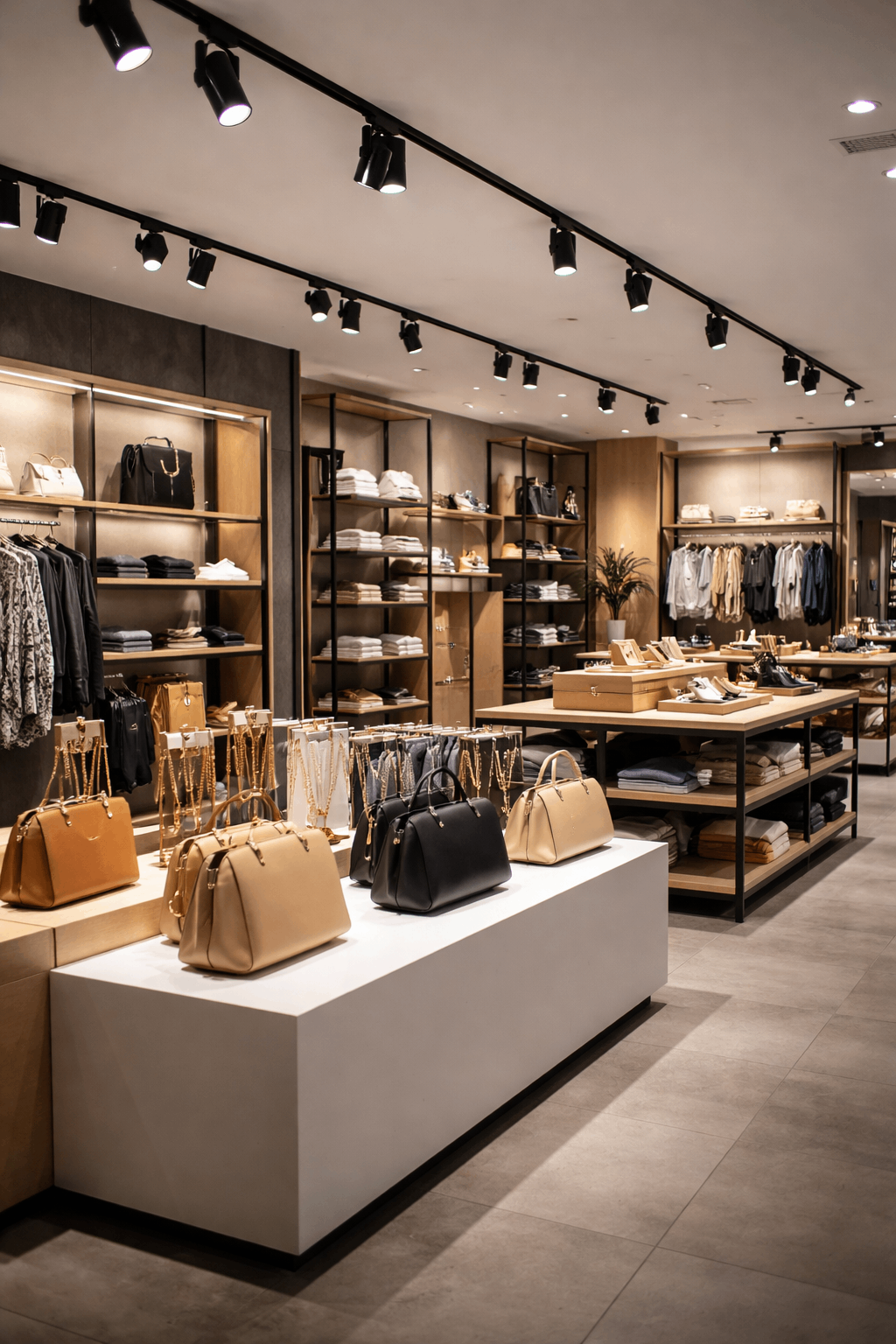
How Lighting Works With Retail Displays to Support Buyer Confidence, Consistent Rollouts, and Long-Term Store Performance
Retail store lighting ideas are often written for end consumers: ambience, mood, and a “premium feel.”
Overseas wholesale buyers read differently.
Importers, distributors, brand sourcing managers, and retail procurement teams usually care about repeatable store standards, fewer rollout surprises, and predictable operating cost.
They want lighting that makes products easy to evaluate on the shelf, keeps color consistent across locations, and integrates cleanly with modular fixtures—especially metal display racks and gondola shelving.
This article keeps the SEO promise behind retail store lighting ideas and best lighting for retail stores, but it frames the topic for procurement.
It explains how lighting must work with retail displays to reduce risk, protect brand presentation, and simplify multi-store execution.
If you are responsible for store rollouts, display sourcing, or merchandising standards, this guide focuses on lighting decisions that affect consistency, risk control, and long-term performance—not just visual appeal.
Why Many Retail Lighting Ideas Fail at the Display Level
Most retail lighting disappointments are not caused by the “wrong bulb.”
They happen when lighting is planned as a ceiling project, while displays are treated as separate furniture.
In real stores, light hits shelf lips, uprights, hooks, wire grids, price rails, packaging films, and metal frames.
Those surfaces create glare, shadows, and uneven contrast that can hide the product even in a bright store.
Procurement teams often notice the failure later, during rollout.
A pilot location looks acceptable, but store formats vary.
Deep shelves block downlight beams, tall racks self-shadow, and glossy packaging blooms under certain angles.
The same lighting specification then produces different results across regions and contractors.
Another common failure is “fixing” visibility by raising ambient brightness.
When everything is equally bright, visual hierarchy disappears.
Feature bays, promotions, and endcaps stop performing, because nothing visually earns attention.
For sourcing teams, a blanket-brightness approach usually signals a missing link between retail display lighting and display geometry.
How Shoppers See Products and Why Buyers Should Care
Even though buyers are not the end shopper, shopper perception still drives procurement outcomes.
If products look hard to evaluate, stores see lower conversion, higher returns, and more operational complaints.
Human vision is contrast-driven.
Shoppers notice edges, vertical planes, and “readable” structure before they notice uniform brightness.
That is why lighting in retail stores should prioritize product faces, not floors.
It also explains why in-store display tactics often succeed or fail based on light direction rather than light quantity.
Shoppers usually evaluate merchandise in two passes.
First, they scan from the aisle.
Then they confirm details up close: color, texture, and label information.
If the product face is underlit from the aisle, it gets skipped.
If close-range viewing causes glare or color shift, trust drops.
From a procurement angle, this becomes a specification problem: you need aisle-level readability and close-range comfort.
Display systems influence how easy this is.
Consistent shelf spacing, aligned facings, and clean vertical lines create a readable “merchandise wall.”
Lighting can reinforce that readability.
Irregular or overcrowded displays create visual noise that lighting cannot fully correct, which is why lighting ideas that ignore display structure can feel “correct” but perform poorly.
Why Lighting Performance Depends on Display Structure
Lighting and display structure form a single optical system.
The same fixture can perform very differently depending on shelf depth, rack height, and surface finish.
This interaction matters most with metal display racks because metal is durable, modular, and widely used in rollout programs.
Metal has a practical advantage: it defines edges crisply.
Under controlled illumination, metal frames and uprights make displays look engineered and stable.
That perceived stability matters in categories like hardware, automotive accessories, sports equipment, and premium packaged goods.
But metal also reflects light directionally.
If beam angles are not controlled, you can get hotspots on powder-coated or polished components.
Hotspots pull attention away from products and reduce label legibility.
This is not a “bad rack” problem or a “bad lamp” problem.
It is a coordination problem between lighting for retail displays and surface behavior.
Shelf depth and density also change outcomes.
Ceiling lighting alone often cannot reach product faces on deep shelves.
The store looks bright, but the merchandise reads dark.
In those cases, raising lumen output increases energy use while leaving the core visibility problem untouched.
A more reliable fix is to improve distribution: vertical lighting retail strategies, integrated shelf lighting, or display adjustments that reduce self-shadowing.
For buyers, the takeaway is simple.
Displays are not passive furniture.
They determine whether a lighting spec will deliver consistent results across locations.
Suppliers who can discuss display geometry, reflectivity, and vertical illuminance typically deliver fewer rollout surprises.
Rethinking the Best Lighting for Retail Stores From a Procurement View
Search results frequently promise “the best lighting for a retail store.”
Procurement reality is different.
There is no universal best lighting, because performance depends on merchandise type, display structure, ceiling height, and store density.
What buyers can standardize is a system-level performance target.
From a procurement view, “best” means three outcomes.
Products must be readable from normal browsing distances.
Color and material cues must stay trustworthy at close range.
And the solution must be repeatable across stores with minimal re-aiming or special labor.
This is where many store lighting ideas break.
A concept that looks good in a flagship can fail in a rollout because it relies on precise aiming by a single expert.
Buyers typically prefer lighting systems that are tolerant of installation variability.
That means consistent optics, clear aiming guidance, and a plan that still works when contractors are not perfect.
If you are not sure where to start, begin by separating aesthetic preference from performance requirement.
In early-stage planning, buyers typically define three things first: what must be readable from the aisle, where color accuracy directly affects returns, and how much visual variation is acceptable between stores. Once those points are clear, fixture styles and decorative choices become much easier to evaluate without locking the rollout into fragile solutions.
Aesthetic choices can vary by brand.
Performance requirements should be measurable and written into RFQs and rollout manuals.
A Buyer-Oriented Technical Reference
Wholesale procurement teams benefit from specifications that can be documented, compared, and verified.
Final targets depend on store type and brand intent, but the parameters below commonly appear in retail briefs focused on display performance.
| Parameter | Purpose | Typical consideration | Procurement value |
|---|---|---|---|
| Correlated Color Temperature (CCT) | Visual tone | Choose one range per concept (often 3000K–4000K) | Prevents mixed appearance between stores |
| Color Rendering Index (CRI / Ra) | Color fidelity | Ra ≥ 80 general; Ra ≥ 90 for color-critical areas | Reduces color-related complaints |
| ANSI/IES TM-30 | Detailed color rendition | Request TM-30 report where consistency matters | Improves cross-supplier comparison |
| Vertical Illuminance | Product visibility | Prioritize light on product faces and display walls | Avoids “bright floor, dark shelf” issues |
| Uniformity | Visual comfort | Define per zone (ambient vs feature) | Reduces rework and adjustments |
| Glare Control | Viewing comfort | Manage glare at evaluation points | Improves dwell time and confidence |
Numbers vary by category, but the principle stays stable.
If your goal is product readability on shelving, specify performance at the vertical plane.
That single shift—toward vertical illumination for retail shelves—often resolves the most common rollout complaints.
Procurement teams also benefit from defining what “acceptable variation” looks like.
If contractors aim lights differently, how much change in appearance is tolerable?
By defining tolerances, you reduce store-by-store drift and protect brand presentation.
Lighting Layers That Support Real Displays
Layered lighting is often explained as a design theory.
For buyers, it is more useful to think of layers as shopping tasks supported on the actual display system.
The base layer provides stable visibility.
Aisles feel comfortable, signage is readable, and displays are not lost in shadow.
This layer should not be so bright that nothing can stand out.
Overly strong base lighting makes later merchandising less effective.
The emphasis layer creates hierarchy.
It is how you turn standard shelving into a feature zone.
In many rollouts, emphasis is delivered through track heads, directional downlights, or header-mounted lighting aligned with the merchandising plan.
The key is controlled contrast, not random brightness.
The evaluation layer supports the decision moment.
Labels should be readable without squinting.
Packaging films should not glare.
Finishes should look consistent.
This is where shelf lighting retail solutions and controlled vertical illumination can materially improve outcomes, especially on modular metal shelving and high-SKU categories.
These layers also help buyers communicate intent.
Instead of saying “we want it brighter,” you can specify what must be readable and where.
That is more procurement-friendly and easier to verify during installation.
Why Vertical Lighting Deserves Priority
Many stores rely on ceiling lighting and then wonder why shelves feel dim.
The reason is structural.
Retail displays present products vertically, but ceiling lights often deliver illumination primarily onto horizontal planes.
That mismatch is one of the most frequent causes of disappointing upgrades.
Vertical lighting places light where buying decisions occur.
Wall washing on feature bays, shelf-integrated linear lights, and carefully aimed downlights can increase legibility without making the whole store feel harsh.
This is especially valuable for deep shelves and tall gondolas.
It also supports “clean merchandising.”
When product faces are evenly lit, shoppers can compare items faster.
That reduces decision friction and helps high-density displays perform.
For metal display racks, vertical lighting adds another benefit.
It emphasizes straight structural lines and reduces the cluttered look that occurs when bright hotspots appear on frames.
Done well, vertical lighting makes product displays that are dense still feel organized.
Color Quality and Buyer Risk
Color quality is not only a design topic.
It is a buyer-risk topic.
If color rendition differs between stores, shoppers perceive inconsistency.
If colors look different under store lights than under daylight or online photos, return rates can rise.
CRI (Ra) is a familiar reference point.
Many programs treat Ra ≥ 80 as a general baseline and Ra ≥ 90 in color-critical zones.
However, two LED products with the same CRI can still render certain colors differently.
That is why some procurement teams request TM-30 retail lighting reports or sample validation under real display conditions.
The most procurement-friendly approach is to validate on the intended display system.
A light source tested on a blank wall can behave differently over metallic shelving, glossy packaging, or acrylic lips.
A short sampling step reduces rollout surprises and protects brand consistency.
If you are sourcing across regions, color consistency also depends on supply continuity.
Buyers often specify acceptable color binning and require documentation to prevent “same model, different look” outcomes over time.
This is one of the easiest ways to protect brand presentation without increasing fixture count.
Decorative Lighting in a Scalable Context
Decorative lighting can strengthen brand tone.
But wholesale buyers tend to evaluate it through scalability.
If a decorative element requires frequent re-aiming, special parts, or complex maintenance, it becomes a flagship-only feature.
That can be fine, but it should be labeled as such.
The more scalable approach is decorative lighting that frames merchandise.
It adds rhythm and atmosphere while leaving product zones visually dominant.
If shoppers notice the fixture first and the product second, the hierarchy is reversed.
This is where decorative and ambient choices should be assessed against merchandising.
A good decorative element supports wayfinding and brand mood.
A poor decorative element creates glare, visual clutter, and inconsistent appearance across stores.
For rollout programs, restrained design tends to outperform “wow” design because it is easier to replicate consistently.
Durability, Sustainability, and Lifecycle Thinking
Wholesale procurement often runs on multi-year cycles.
Retail displays—particularly metal systems—are long-term assets.
Lighting should be specified with the same lifecycle discipline.
Energy efficiency matters, but buyers also care about maintenance predictability.
If a system drifts in brightness or shifts in color over time, stores start to look inconsistent.
That inconsistency triggers operational fixes, mixed replacements, and brand-standard erosion.
A lifecycle approach aligns lighting replacement with display replacement.
If the display program is expected to last five years, lighting specifications should target stable output and consistent color across that period.
This reduces disruption and keeps store presentation predictable.
For procurement teams, sustainability is not a slogan.
It is reduced total cost of ownership: fewer replacements, fewer service visits, and stable appearance.
This is also where documentation helps.
If the supplier can provide performance data and clear maintenance guidance, rollout teams work faster and store operations stay smoother.
Common Display and Lighting Mismatches
Many performance issues come from predictable mismatches rather than poor equipment.
In multi-store rollouts, these issues typically appear after the first few installations, not during the initial concept stage, which is why they are often underestimated during early planning.
The fixes are often faster than buyers expect.
A common mismatch is strong accent lighting aimed at reflective surfaces.
Metal uprights, acrylic edges, or glossy packaging create glare that hides product details.
The shopper’s eye is pulled to hotspots instead of information.
Another mismatch is ceiling-focused brightness over deep shelving.
The floor looks bright, but the merchandise reads dim.
This leads to store teams adding ad-hoc lamps or re-aiming fixtures, creating inconsistent outcomes across locations.
A third mismatch is inconsistency between zones.
If an endcap is lit cooler than an adjacent aisle, packaging can look like it changed.
This is subtle, but it affects perceived quality.
For rollout programs, these mismatches become expensive because they create rework, debates between teams, and gradual drift from the original standard.
The most reliable approach is to address mismatches through coordination.
Align lighting angles with display geometry.
Use vertical illumination where product faces need it.
Validate color behavior on actual displays.
These steps often improve performance without replacing the entire system.
Evaluating Lighting and Displays Together
A procurement-friendly assessment begins where shoppers browse.
Stand at normal aisle distance.
Key products should be readable without effort.
If definition disappears at that distance, lighting is not supporting the display.
Next, check reflections.
If shoppers need to shift position to avoid glare, the lighting is fighting the display.
On metal fixtures, pay attention to hotspots on uprights and shelf lips.
Hotspots can make a tidy display feel visually noisy.
Then review consistency across conditions.
Daylight can hide weaknesses.
Evening conditions often reveal them.
If the store looks acceptable at noon but inconsistent after sunset, the rollout standard is not robust.
This is also where buyer documentation matters.
If your rollout relies on “an expert on site,” it will be hard to scale.
If your standard is measurable and tolerant, it becomes repeatable.
That repeatability is what procurement teams buy.
Why This Lighting Approach Aligns With Overseas Wholesale Buyers
Wholesale buyers value clarity, risk reduction, and operational realism.
They scan for suppliers who can translate intent into measurable requirements and anticipate common rollout issues.
That is why this article emphasizes vertical illumination, glare control on real materials, color consistency, and display compatibility.
Those are the factors that most often separate a successful rollout from an expensive series of adjustments.
This approach also fits how B2B buyers search.
Instead of only searching “store lighting ideas,” they often search long-tail phrases like retail lighting specification for procurement, lighting for gondola shelving, glare control for retail displays, or CRI 90 retail lighting.
By addressing those concepts naturally within the topic, the page becomes more discoverable without becoming keyword-heavy.
Finally, this perspective aligns with how buyers compare partners.
A supplier who understands both the display system and the lighting behaviors around it reduces sourcing risk.
That is the practical value wholesale buyers look for when selecting display programs.
Conclusion
The most effective retail store lighting ideas treat lighting and displays as one coordinated system.
When lighting supports vertical product faces, manages glare on real materials, and maintains consistent color quality, it improves product readability and makes multi-store rollouts more predictable.
For overseas procurement teams, success is not defined by a single impressive store.
It is defined by a repeatable standard that performs consistently across locations and installation teams.
Yishang Display supports global buyers with durable retail display systems—especially metal display racks—that integrate cleanly with practical lighting strategies.
If you are planning a rollout or reviewing an existing standard, a short discussion can help clarify requirements and reduce sourcing risk.