
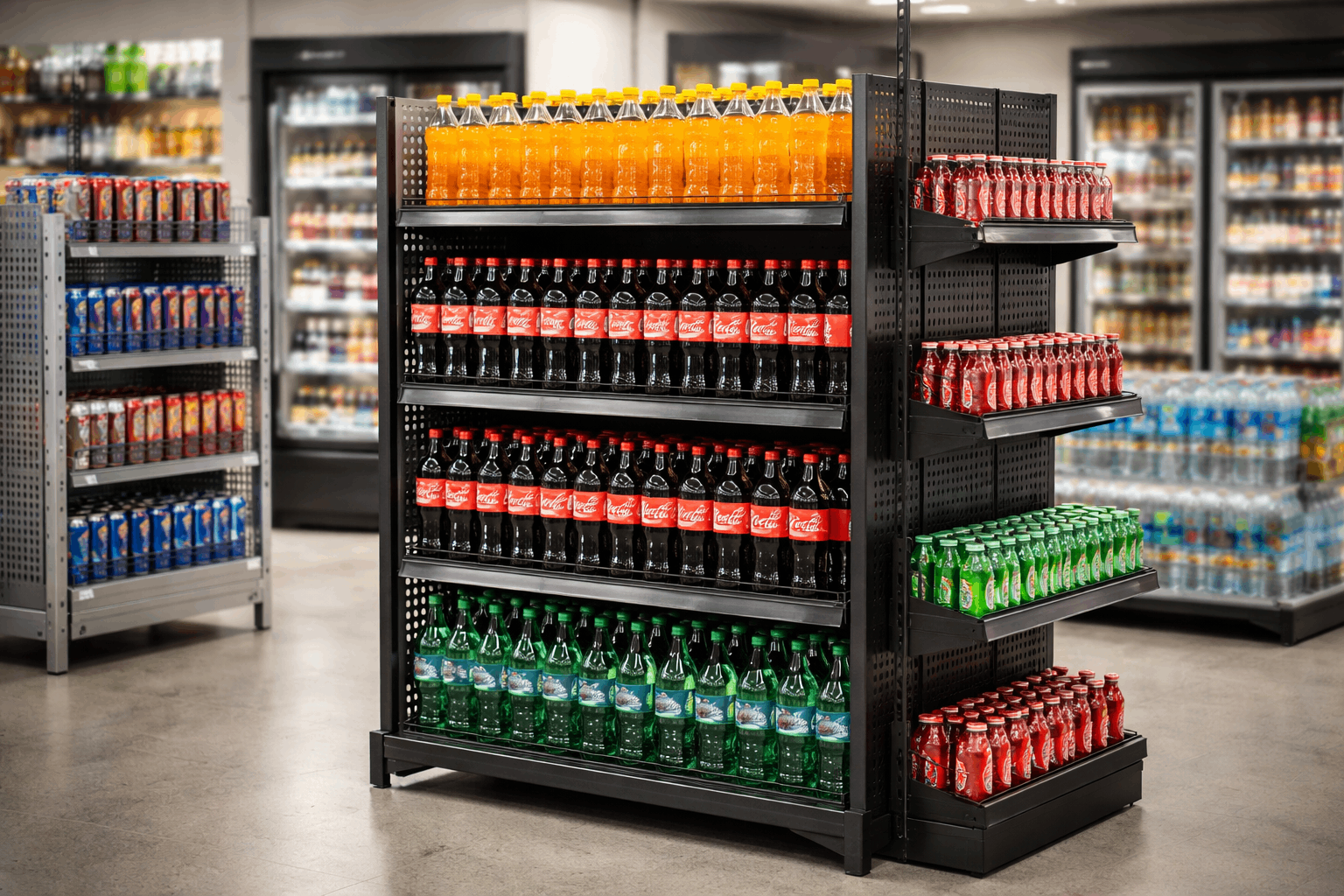
A Buyer‑Focused Guide for Wholesale Sourcing, Manufacturing Consistency, and Retail Rollouts
For overseas wholesalers and distributors, a beverage display is not a branding experiment. It is a procurement decision tied to batch consistency, replacement risk, and long‑term retailer satisfaction. Buyers visiting a supplier’s website are usually not looking for inspiration; they are screening risk. Typical questions include whether a display can survive repeated restocking, whether production quality is stable across hundreds of units, and which problems tend to appear after installation rather than on day one.
This guide addresses those questions directly. It focuses on design elements to consider for beverage displays from a manufacturing and wholesale sourcing perspective. Instead of visual trends or consumer psychology, the emphasis is on durability, repeatability, and decision clarity. The structure and language are intentionally aligned with how B2B buyers scan content, compare suppliers, and prepare RFQs.
1. Why Beverage Displays Carry Higher Procurement Risk
This section explains why beverage displays require more scrutiny than many other retail fixtures. Beverages are heavy, frequently handled, and usually merchandised in dense quantities. These conditions expose weaknesses that are not always visible during sample approval or initial installation.
From a wholesale perspective, the critical issue is timing. Structural problems often surface weeks or months after deployment. Shelf sag, joint loosening, and gradual misalignment lead to retailer complaints, replacement requests, and unplanned logistics costs. For buyers managing multi‑store rollouts, these issues quickly scale.
For sourcing teams, this means beverage display design should be evaluated as a risk‑control system rather than a purely visual fixture. The sections below break this risk into controllable design variables that directly affect long‑term performance.
2. Beverage Reality Comes Before Design Decisions
This section defines the physical constraints that shape every effective beverage display. Establishing these realities early prevents repetition later and keeps design discussions grounded.
2.1 Load Is a Scenario, Not a Single Rating
Shelf load is often presented as a fixed number, such as a maximum weight per shelf. In real retail environments, load behaves as a scenario. Full restocking, uneven placement, and one‑sided product removal create stress patterns that differ significantly from uniform laboratory loading.
For buyers, failures rarely occur at average load. They occur during peak or irregular events that repeat over time. Evaluating how a beverage display rack responds to these scenarios provides more insight than relying on a single load rating.
From a sourcing perspective, this is often where low‑cost designs reveal their limits after rollout.
2.2 Packaging Shapes Structural Requirements
Beverage packaging determines how weight enters the display system. Glass bottles concentrate mass and raise the center of gravity. Cans increase cumulative load through quantity. PET bottles introduce leverage due to height and grouping. Secondary packaging such as trays or cartons can create localized point loads.
Displays that ignore these realities tend to fail at predictable locations, including shelf edges and long unsupported spans. Effective beverage display design aligns shelf geometry and reinforcement with actual package footprints rather than abstract assumptions.
2.3 Turnover Speed as a Structural Multiplier
Turnover speed determines how quickly small weaknesses become visible. High‑velocity channels subject displays to frequent load cycling, accelerating fatigue in shelves and joints. Slower‑moving channels may tolerate lighter construction, but fast‑moving environments expose marginal designs quickly.
For wholesale buyers, recognizing turnover as a multiplier helps tailor specifications to different retail formats instead of assuming one design fits all.
3. Structural Design Elements That Determine Performance Over Time
This section explains how structural choices respond to the constraints defined above.
3.1 Frame Architecture and Load Paths
The frame defines how weight travels from shelves to the floor. In a well‑engineered metal beverage display, loads move vertically through uprights into the base, reducing bending stress. Lightly braced or heavily cantilevered structures are more susceptible to gradual drift under beverage loads.
Connection points are especially critical. Small movements at shelf‑to‑frame joints can alter load paths over time, concentrating stress where it was not intended. Buyers should evaluate whether joints are designed for repetition, not just initial assembly.
When comparing suppliers, this is typically where long‑term performance differences begin to appear.
3.2 Shelf Geometry Matters More Than Thickness
Thickness alone does not prevent sag. Shelf span, depth, edge returns, and reinforcement features have a greater impact on stiffness and long‑term stability. A flat shelf with a long unsupported span can deform even when made from thicker material.
Designs that use downturned edges or reinforcement ribs often achieve better stiffness‑to‑weight ratios. For buyers, this affects durability, shipping efficiency, and installation handling.
3.3 Stability Evolves, It Is Not Static
Stability is not a one‑time test result. As shelves deform slightly or products shift, the center of gravity of a display changes. Minor floor slopes can amplify this effect, especially on tall or narrow displays.
Designs that remain stable as conditions change reduce safety risk and protect perceived product quality. For wholesalers, this means fewer service issues after deployment.
4. How Shopper Interaction Influences Structural Wear
This section translates normal shopper behavior into structural consequences. Beverage displays are handled more aggressively than many other fixtures because products are often purchased in multiples.
One‑handed grabs, bulk lifting, and temporary resting of items on shelf edges introduce asymmetric and transient forces. Over time, these actions accelerate wear at shelf fronts and joints. Displays designed only for ideal use conditions are more likely to generate after‑sales issues.
Anticipating normal human behavior improves consistency across locations and reduces variability in field performance.
5. Visibility Within Structural Limits
Visibility matters in retail beverage display programs, but overloading shelves to create abundance often shortens display lifespan. Excessive density increases load, accelerates deformation, and reduces SKU clarity.
High‑performing displays balance visibility with discipline. Matching product quantity to shelf capacity preserves alignment and maintains a clean appearance months after installation. For distributors, this reduces replacement frequency and retailer complaints.
6. Material Selection Through a Lifecycle Lens
Material choice is a core design element because it defines load behavior and wear characteristics. Metal remains the preferred material for beverage displays due to predictable strength and compatibility with reinforcement strategies. Powder‑coated steel is widely used for its balance of durability, appearance, and cost.
Alternative materials have specific roles. Aluminum can reduce weight but may require different section design to achieve comparable stiffness. Wood and acrylic are better suited to non‑load‑bearing components such as branding panels or signage, particularly in environments with moisture or frequent cleaning.
For wholesale buyers, lifecycle performance is usually a stronger cost driver than initial unit price.
7. Customization Versus Repeatability in Wholesale Programs
Customization can support brand differentiation, but it also increases complexity. Unique components require dedicated tooling, packaging, and replacement inventory. At scale, these factors influence lead time, consistency, and serviceability.
Repeatable, modular systems allow visual elements to change while keeping structural components standardized. This approach improves manufacturing consistency and simplifies after‑sales support for distributors managing multiple accounts.
8. Manufacturing Consistency and Tolerance Management
Design intent must survive production. Welding distortion, forming tolerances, and assembly stack‑up introduce variation that can affect alignment and load distribution. Designs that do not account for these realities may perform inconsistently across batches.
Buyers benefit from suppliers who design joints and assemblies with realistic tolerances and clear assembly logic. Manufacturing consistency often has a greater impact on long‑term field performance than minor cosmetic differences.
9. Evaluating Performance After Six Months of Use
Initial appearance is a poor predictor of success. More meaningful indicators appear after several months: shelf alignment, fastener stability, coating wear, and overall rigidity.
A successful beverage display stand continues to function without frequent adjustment. It supports consistent merchandising and avoids drawing attention to itself. For wholesalers, this reduces service burden and protects margins.
10. Beverage Displays as Integrated Systems
Effective beverage displays treat structure, material, use, and manufacturing as a single system. When these elements are aligned, performance is predictable. When they are separated, small issues compound into visible failure.
This system‑level perspective helps buyers filter suppliers based on long‑term reliability rather than surface features.
Supplier Documentation That Supports Confident Sourcing
Professional buyers often evaluate suppliers remotely. Clear documentation supports faster approval and reduces uncertainty. Typical buyer‑requested materials include material specifications, surface finish definitions, assembly instructions, and evidence of quality management systems.
Suppliers that provide this information transparently make procurement decisions easier and reduce friction during rollout.
Closing: Using This Guide in Procurement Decisions
When sourcing beverage displays, focus on design elements that protect structure over time. Ask how shelves resist sag, how frames manage load paths, and how materials perform in beverage environments. These questions align evaluation with wholesale realities.
Yishang Display works with overseas wholesalers to translate these considerations into manufacturable, repeatable display solutions. If you are reviewing specifications or planning a rollout, a short discussion can help clarify options and constraints before commitments are made.