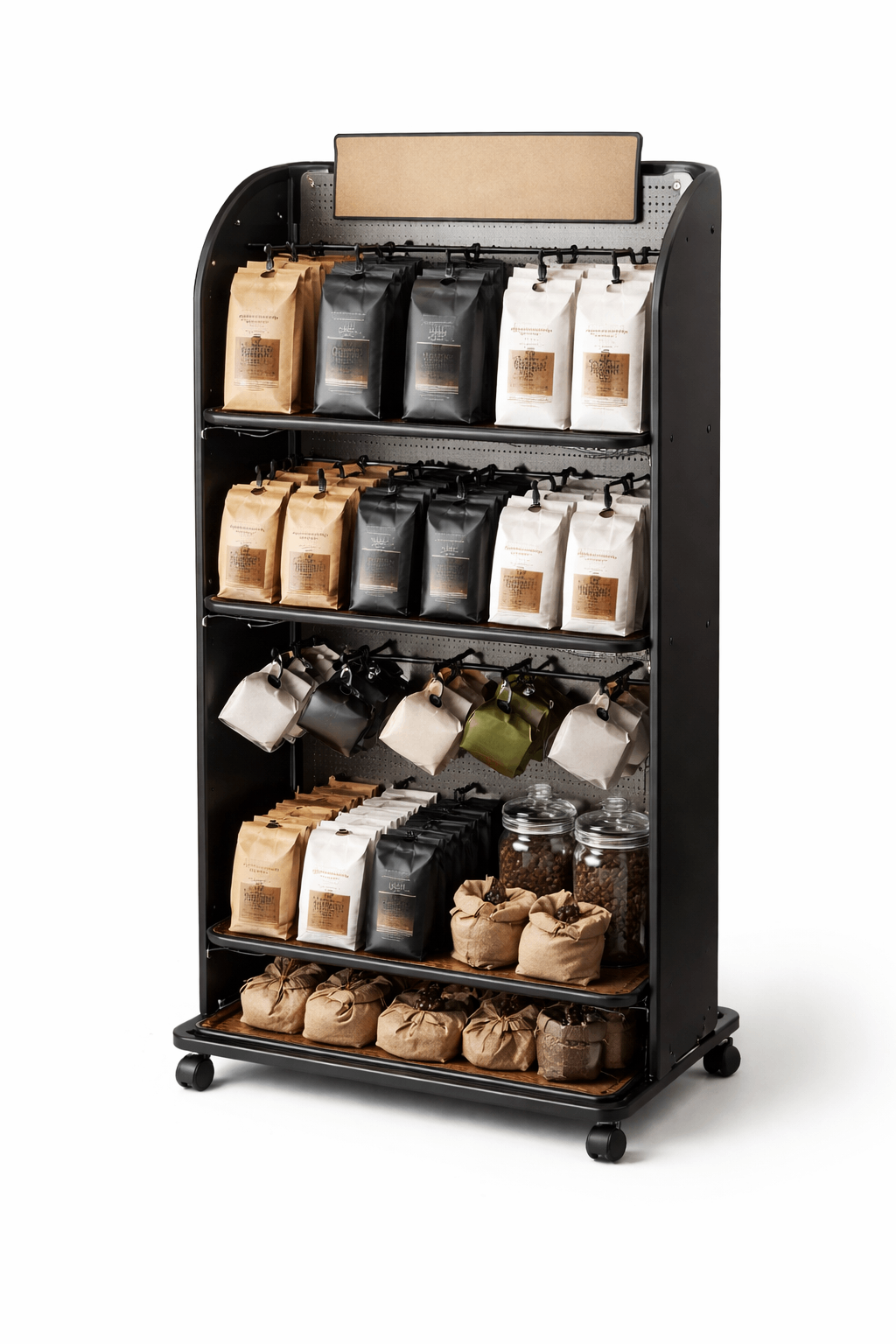
For overseas wholesale buyers, selecting a coffee display rack is primarily a commercial and operational decision. Buyers are not only evaluating how the display looks in a single store, but whether the same display concept can be supplied repeatedly, adapted for different retail spaces, and integrated into project-based or distribution-driven purchasing models.
When searching for terms such as coffee display rack, coffee mug display rack, or coffee shop display furniture, most buyers scan product pages quickly. They look for confirmation that the rack is suitable for commercial use, that key dimensions and finishes can be adjusted for different spaces, and that ordering conditions such as small qty or trial order are realistic. This page is structured to support that type of fast, procurement-oriented evaluation.
Rather than focusing on company storytelling, the following sections concentrate on the wire coffee bag and mug display rack itself—its structure, configuration logic, durability, and ordering considerations—so buyers can efficiently judge whether it fits their sourcing needs.
This snapshot is intended to help wholesale buyers quickly confirm baseline suitability before reviewing detailed information below.
Coffee retail environments commonly combine packaged products and reusable items within the same display area. Coffee bags are lightweight but vary in height and width depending on packaging style, while mugs and cups are heavier and handled frequently. A display rack that does not account for both product types often creates stability or layout issues in daily use.
Floor space is another limiting factor. Many coffee shops and food retail areas prefer vertical display racks that keep products visible without obstructing customer movement. Deep shelves or bulky food display racks may reduce browsing comfort, particularly in smaller cafés. Wholesale buyers therefore tend to favor display racks that balance footprint efficiency with adequate display capacity.
Wire coffee display racks address these constraints by combining vertical merchandising with an open structure. Products remain visible from multiple angles, while the rack itself maintains a relatively compact footprint, making it suitable for a wide range of coffee and food display applications.
In retail practice, coffee bags are typically displayed to support visual comparison. Customers scan branding, roast type, and origin information quickly, which makes eye-level placement and clear alignment especially important. Vertical presentation allows multiple SKUs to be displayed without overwhelming the shopper.
Mugs and coffee cups require a different approach. Customers often pick them up, check weight, and examine details such as handles and finishes. This repeated interaction introduces lateral forces that a display rack must withstand. A coffee mug display rack designed only for lightweight products may feel unstable under this type of use.
A wire coffee bag and mug display rack separates these functions logically. Upper and middle tiers are commonly used for packaged coffee, while lower or reinforced tiers support mugs and heavier items. This layout reflects real customer behavior and reduces the risk of damage or instability during daily operation.
Wire construction is widely used in coffee display racks because it combines strength with visual neutrality. For wholesale buyers, this means a structure that performs consistently across different retail formats without drawing attention away from the products themselves.
Open wire shelves improve visibility by allowing packaging graphics to remain unobstructed. This is particularly valuable when multiple coffee brands or blends are displayed together. Compared with solid wood or acrylic fixtures, wire display furniture places emphasis on the merchandise rather than the rack.
From a structural standpoint, metal wire racks distribute weight evenly when designed with appropriate wire gauge and reinforcement. This makes them suitable for mixed displays that include both coffee bags and mugs, reducing the need for separate fixtures and simplifying procurement.
The structural layout of a wire coffee bag and mug display rack determines how effectively it performs in commercial environments. Multi-tier designs allow products to be organized by category and interaction type, rather than by arbitrary shelf placement.
Upper tiers are typically positioned at eye level and used for coffee bags and premium packaged products. Middle tiers may hold complementary items such as filters or accessories. Lower tiers are designed to carry heavier mugs and cups, improving stability and reducing strain on the frame.
Side frames and back supports play an important role in overall balance. In high-traffic retail spaces, customers often remove products unevenly across tiers. A well-balanced structure helps the rack remain stable under these conditions.
For wholesale buyers, configuration flexibility often matters more than fixed specifications. Shelf spacing is a key variable, as coffee packaging formats vary widely. Adjustable or semi-custom spacing allows one rack design to serve multiple product lines.
Load capacity is another important factor. While coffee bags are light, mugs add significant weight. A coffee mug display rack must be designed to handle mixed loads over time without bending or loosening. Proper material thickness and reinforcement help ensure long-term performance.
Footprint size also affects purchasing decisions. Narrow, vertical coffee display racks are often preferred because they maximize visibility while minimizing floor space usage. Optional mobility features, such as casters, can further increase flexibility for promotions or layout changes.
Coffee products are not standardized, which makes layout adaptability important for wholesale distribution. Bag sizes, packaging materials, and branding styles differ between suppliers. Drinkware also varies in weight and shape.
Custom layout options allow tier height, shelf depth, and support structure to be adjusted based on the intended product mix. For example, a display focused on coffee bags may prioritize vertical alignment, while a bag and mug display rack may allocate more space to reinforced lower tiers.
This adaptability allows wholesale buyers to offer one display concept that can be configured differently for various customers, reducing the need to manage multiple display models.
The same wire coffee display rack concept can be adapted for different retail formats. Compact versions suit small cafés or point-of-sale areas where space is limited. Larger formats support broader assortments in specialty retail or food display rack zones.
Double-sided display racks are often used in open layouts, allowing products to be accessed from multiple directions. Additional options such as sign holders or branding panels can be added without changing the core structure.
These variations make the rack suitable for coffee-focused retail as well as mixed food and beverage display programs.
Durability is a primary concern for wholesale buyers supplying display racks to commercial environments. Coffee shop fixtures are exposed to frequent handling, temperature changes, and regular cleaning. Over time, poorly designed racks may loosen or deform.
Common failure points include unstable bases, insufficient reinforcement at welded joints, and uneven load distribution. A well-designed wire coffee display rack addresses these issues through balanced structure, appropriate wire gauge, and reinforced connections.
Surface treatment also affects longevity. Proper finishing helps the rack resist corrosion and wear, supporting consistent performance across different climates and markets.
Clear ordering conditions are essential for wholesale procurement. Buyers typically review minimum order quantities, lead times, and customization scope early in the decision process. Display racks that can be produced consistently within predictable timelines are easier to integrate into distribution plans.
In some cases, buyers request a small qty or trial order to test the display in specific markets or projects. Understanding whether such arrangements are possible helps reduce risk during initial cooperation.
Is this display rack suitable for wholesale supply across different markets?
Yes. The wire coffee bag and mug display rack is designed to adapt to varied retail formats and product assortments, which makes it suitable for wholesale distribution across different regions and market requirements.
Can shelf spacing be adjusted for different coffee bag and mug sizes?
Shelf spacing and tier configuration can be adjusted based on packaging dimensions and drinkware size, allowing the same rack structure to support different product mixes.
Is the structure stable enough for heavy mugs and frequent handling?
The rack is designed to support mixed product loads and repeated commercial use. Reinforced joints and balanced load distribution help maintain stability in daily retail environments.
Are black or custom colors available?
Common finish options include black or custom colors, depending on project needs and visual requirements.
This wire coffee bag and mug display rack fits wholesale procurement models where consistency, adaptability, and commercial durability are priorities. Its structure supports repeated deployment across different retail spaces while maintaining clear product presentation.
If you are evaluating coffee display racks for wholesale supply, sharing your space dimensions and target product mix can help determine the most suitable configuration and ordering approach.


Yishang Display specializes in crafting bespoke display solutions. From initial concept and prototyping through to full-scale production, our in-house team manages every phase—delivering a seamless, one-stop experience for your brand.
If you have any questions or need a quote, please send us a message. One of our specialists will get back to you within 24 hours and help you select the correct valve for your needs.
All of our products are available for sampling