Optical retail environments place continuous mechanical and visual demands on display fixtures. Sunglasses and eyeglasses are high‑interaction products. Shoppers pick them up, try them on, compare lens colors under store lighting, and return them to the rack repeatedly throughout the day. Over time, this behavior exposes weaknesses in display stands that are not designed for commercial optical use.
For overseas wholesale buyers supplying optical stores, the evaluation criteria go beyond first‑day appearance. Procurement teams focus on whether a display stand maintains stability, alignment, and a professional look after months of daily handling. This is why buyers search specifically for an optical store fixtures eyeglass rack display stand for sunglasses sale instead of a lightweight or decorative rack. The intent is to source a product engineered for real retail conditions, not short‑term presentation.
This floor standing eyeglass rack display stand is designed around that expectation. Its role is to support optical merchandising over time by keeping sunglasses and eyeglasses organized, accessible, and visually consistent through seasonal product changes and repeated replenishment cycles.
Optical stores face a combination of challenges that directly influence fixture selection. First is product density. Sunglasses collections typically include many styles, lens treatments, and price levels, all of which must be displayed clearly within limited floor space. Second is customer handling. Unlike static displays, eyewear racks experience constant product removal and replacement, which shifts weight distribution throughout the day. Third is operating time. Optical stores often run long business hours, meaning fixtures must remain stable and aligned without frequent adjustment.
A commercial grade eyeglass display stand is designed with these realities in mind. Stability is achieved through structural balance rather than visual bulk. Joints, fasteners, and contact points are engineered to stay tight under repeated movement. Layout is planned so shoppers can browse quickly and return products easily, reducing accidental contact between frames.
For wholesale buyers and distributors, commercial grade also means consistency. When supplying multiple retail locations, the display stand must deliver the same geometry, finish quality, and assembly result from batch to batch. This predictability lowers project risk, simplifies rollouts, and ensures that visual merchandising remains uniform across different optical stores.
| Aspect | What Wholesale Buyers Look For |
|---|---|
| Use case | Optical stores, eyewear retailers, sunglass zones |
| Structure | Metal‑based floor standing display stand |
| Function | Sunglasses and eyeglasses merchandising |
| Ordering | Project‑based wholesale procurement |
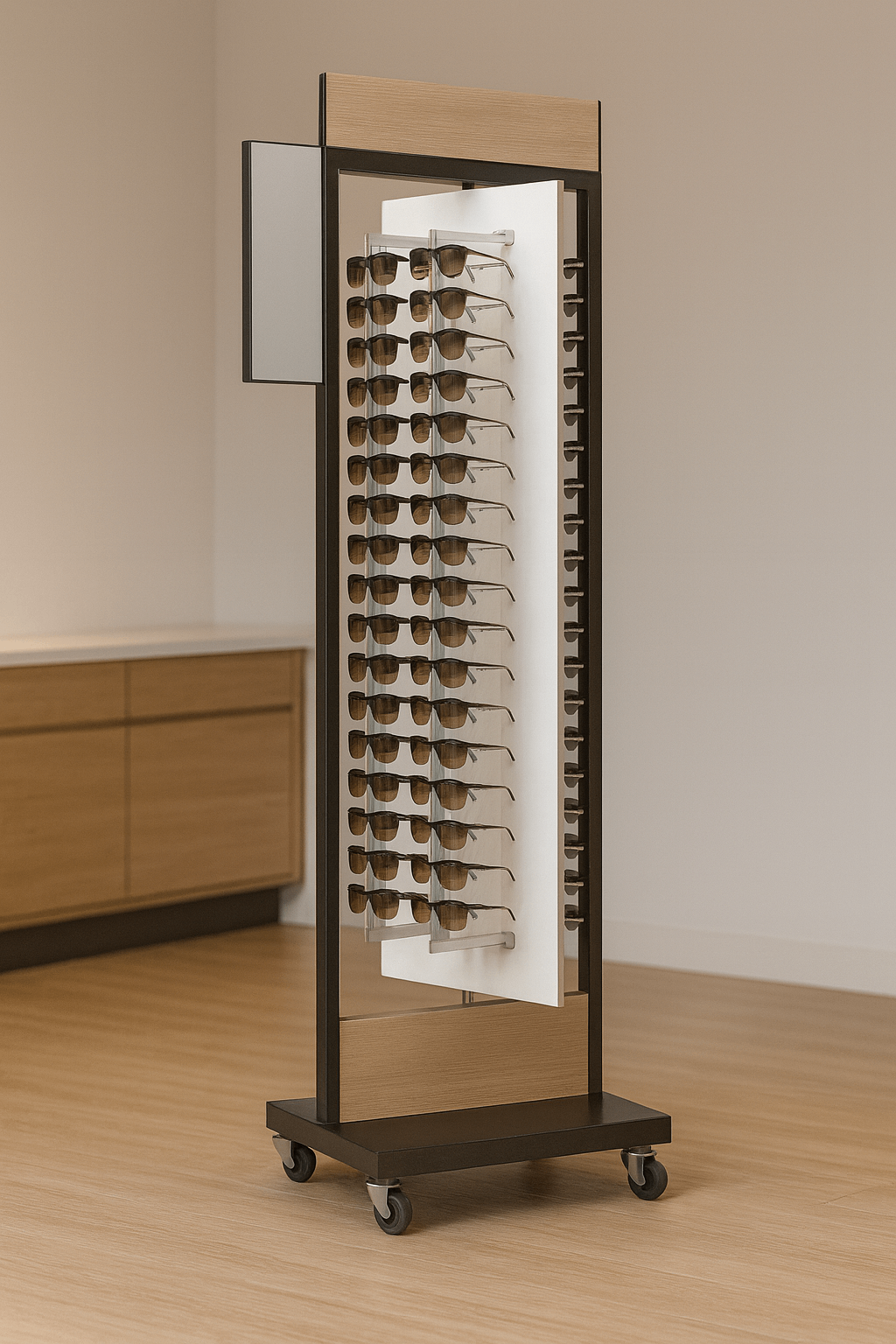
This product is a floor standing eyeglass rack display stand designed specifically as an optical store fixture for sunglasses and eyeglasses. The vertical structure allows a high number of products to be displayed while keeping the footprint compact, which is essential for maintaining aisle space and customer flow in retail stores.
The rack is suitable for use as a dedicated sunglass display or as part of a broader optical merchandising display. In many retail stores, sunglasses are highlighted seasonally, then integrated back into the main eyewear offering. A movable or semi‑mobile rack display stand provides flexibility to support both approaches without requiring permanent installation changes.
From a visual standpoint, the design remains product focused. Clean lines, balanced proportions, and controlled surfaces keep attention on the eyewear rather than the fixture.
Because many optical stores want shoppers to try on frames without leaving the display area, this product platform can be configured with a side mirror panel mounted on the frame (optional, depending on store concept and budget). The central display area is a fixed, single‑sided display panel, designed to keep merchandising focused and structurally stable while maintaining a slim footprint.
For wholesale buyers, this means the same rack display stand concept can be adapted to different store tiers: a standard version for cost‑controlled rollouts, and a mirror‑equipped version for stores that want to improve in‑store try‑on efficiency without changing the core structure.
The core of this eyeglass rack display stand is a metal based structure engineered for long term retail use. In optical merchandising, metal is widely preferred because it provides strength, dimensional stability, and resistance to gradual deformation. Compared with lightweight alternatives, a metal frame maintains alignment even after prolonged exposure to frequent handling and cleaning.
The metal framework supports the entire display from base to top, ensuring balanced weight distribution as products are removed and replaced. This is particularly important in optical stores, where customers often browse unevenly across different rows. A stable metal structure minimizes wobble and preserves a professional appearance throughout the business day.
Other materials such as acrylic or wood can be incorporated for visual or branding purposes, but they are treated as complementary elements rather than structural supports. Acrylic panels may be used for signage or decorative sections, while wood or laminated boards may be selected to match interior finishes. In every configuration, the metal frame remains the primary load‑bearing component to protect durability and service life.
While final specifications are project dependent, wholesale buyers often request a baseline reference when evaluating a display stand. The following table outlines typical parameters used in commercial optical store fixtures.
| Item | Reference Range | Procurement Relevance |
|---|---|---|
| Frame material | Steel or aluminum | Determines load capacity and long‑term stability |
| Surface finish | Powder coating, paint, plating | Affects corrosion resistance and appearance consistency |
| Fasteners | Commercial grade hardware | Reduces loosening under frequent handling |
| Edge treatment | Smooth, deburred edges | Protects eyewear frames and improves safety |
| Decorative panels | Acrylic, wood, composite | Supports optical merchandising and brand tone |
These factors influence not only appearance but also maintenance cost and replacement cycles, which are key considerations for bulk procurement projects.
Display capacity must be evaluated together with layout efficiency. Simply increasing the number of sunglasses on a rack can reduce usability if spacing becomes too tight. This eyeglass rack display stand is designed to balance capacity with clear visibility, allowing retailers to present a wide range of products without creating visual clutter.
The vertical layout maximizes the use of floor space, which is especially valuable in optical stores where fixtures must coexist with examination areas, seating, and service counters. Adequate spacing between display positions ensures that individual sunglasses remain easy to view, remove, and replace, supporting smooth shopper interaction.
For wholesale buyers managing multiple retail locations, standardized layout efficiency is a practical advantage. When each rack follows the same spacing and row configuration, store staff can follow consistent planograms. This reduces training time and helps maintain uniform presentation across different stores.
Actual capacity depends on size and configuration, but the following reference points help buyers define requirements during inquiry.
| Parameter | Typical Options | Buyer Consideration |
|---|---|---|
| Display orientation | Single‑sided | Focused merchandising with a slim footprint |
| Row quantity | Adjustable | Must align with comfortable reach height |
| Spacing | Optimized for eyewear | Prevents frame collision during browsing |
| Footprint size | Customizable | Smaller bases save space; larger bases add stability |
An effective optical merchandising display should make selection feel effortless for shoppers while remaining practical for restocking and maintenance.
The long‑term performance of a display stand is determined by its structural details. This eyeglass rack display stand is designed for daily store operation where products are handled repeatedly and the fixture must remain orderly. Each holding position supports sunglasses securely, reducing the chance of slipping or misalignment during customer use.
Consistent spacing protects product condition. When frames touch or overlap frequently, surface wear and scratches accumulate over time, particularly on premium finishes or coated lenses. By maintaining controlled distances between display points, the rack helps preserve product quality and reduces loss caused by damage.
Ease of maintenance is another practical factor. Optical stores typically clean fixtures frequently to maintain a professional environment. Smooth surfaces and stable joints make cleaning easier and help the display retain a neat appearance after restocking, reinforcing positive brand perception at the point of sale.
For seasonal resets and store layout changes, many wholesalers prefer a stand that can be repositioned without unloading all eyewear. A mobile base with casters is often selected for that reason. For higher‑value assortments, locking casters or additional security options can be specified to reduce shrink risk.
Safety details matter in optical retail. Smooth edge treatment and stable base geometry reduce accidental knocks in tight aisles. When you are supplying retail stores across regions, specifying these details upfront helps prevent field issues and reduces after‑sales friction.
The long‑term performance of a display stand is determined by its structural details. This eyeglass rack display stand is designed for daily store operation where products are handled repeatedly and the fixture must remain orderly. Each holding position supports sunglasses securely, reducing the chance of slipping or misalignment during customer use.
Consistent spacing protects product condition. When frames touch or overlap frequently, surface wear and scratches accumulate over time, particularly on premium finishes or coated lenses. By maintaining controlled distances between display points, the rack helps preserve product quality and reduces loss caused by damage.
Ease of maintenance is another practical factor. Optical stores typically clean fixtures frequently to maintain a professional environment. Smooth surfaces and stable joints make cleaning easier and help the display retain a neat appearance after restocking, reinforcing positive brand perception at the point of sale.
Wholesale buyers rarely require a one‑size‑fits‑all solution. Store formats, merchandising strategies, and brand guidelines vary widely. Customization for this eyeglass rack display stand focuses on practical adjustments that influence store fit, display performance, and brand presentation rather than unnecessary complexity.
Dimensions and capacity can be adjusted to suit available floor space and product quantity. Boutique optical stores may prefer a narrower footprint with curated selection, while larger retail chains often prioritize standardized dimensions for consistent rollout. In both cases, structural stability remains the priority.
Finish options allow the metal structure to align with store fixtures and interior design. Color selection, surface texture, and optional acrylic or wood panels help integrate the rack into different retail environments. Brand logo elements can be added in a restrained manner, supporting brand visibility without overwhelming the merchandise.
If you want faster, more accurate pricing for bulk procurement, it helps to send a short RFQ checklist with your inquiry. This reduces revision cycles and helps align sample expectations.
| RFQ item | What to provide | Why it helps wholesale procurement |
|---|---|---|
| Target capacity | Approx. number of sunglasses / frames | Confirms row count and spacing |
| Footprint limit | Max width × depth | Ensures aisle clearance and base stability |
| Preferred function | Fixed or rotating core; mirror yes/no | Controls cost and user experience |
| Finish direction | Black / white / metallic / custom | Matches store fixtures and brand tone |
| Deployment | Single store or multi‑store rollout | Supports standardization and batch consistency |
This optical store display rack performs effectively across several common retail scenarios. In space‑limited optical shops, the vertical rack provides increased sunglasses exposure without expanding floor area. It can be positioned along walls, near checkout zones, or in designated feature areas while maintaining shopper circulation.
In multi‑brand eyewear stores, the rack is often used as a seasonal sunglass display. During peak demand periods, retailers can bring sunglasses forward using a dedicated rack display stand rather than modifying permanent fixtures. This flexibility supports faster merchandising changes.
For brand‑focused zones, the clean structure and balanced layout help reinforce brand identity. When products are displayed with clear spacing and stable support, shoppers tend to associate the presentation with higher product quality.
For overseas procurement teams, performance during transport and installation is as important as in‑store use. This optical store fixture is designed with bulk shipping in mind. Packaging protects metal surfaces and structural components, reducing the risk of damage during international transport.
Knock down packing is commonly used for wholesale projects to improve container utilization and manage freight cost. When properly designed, KD packaging allows efficient shipping while keeping on‑site assembly straightforward. Clear part organization and reliable fit reduce installation time and error rates.
Consistency across production batches is another key concern for wholesalers. Stable dimensions and repeatable finishes help maintain visual consistency across different retail locations, which simplifies long‑term merchandising management.
The following reference points are commonly reviewed during procurement discussions.
| Topic | Reference | Buyer Focus |
|---|---|---|
| MOQ | Project dependent | Alignment with rollout scale |
| Lead time | Approximately several weeks | Store opening and replenishment planning |
| Shipping terms | EXW, FOB, CIF, DDP | Landed cost and responsibility clarity |
| Packing method | KD or partial assembly | Freight efficiency versus assembly time |
Clear communication of these factors helps buyers evaluate feasibility and reduces delays during ordering.
If you are sourcing a stand for sunglasses as part of an optical merchandising project, the most effective next step is to match the rack display stand to your store layout and product quantity. Share your available space, target capacity, and finish preference, and the configuration can be adjusted to support your retail plan.
This optical store fixtures eyeglass rack display stand for sunglasses sale is designed to support wholesale procurement needs by combining durability, efficient display, and adaptable presentation. It helps retail stores showcase eyewear consistently while reducing operational friction.
Yishang Display specializes in crafting bespoke display solutions. From initial concept and prototyping through to full-scale production, our in-house team manages every phase—delivering a seamless, one-stop experience for your brand.
If you have any questions or need a quote, please send us a message. One of our specialists will get back to you within 24 hours and help you select the correct valve for your needs.
All of our products are available for sampling