
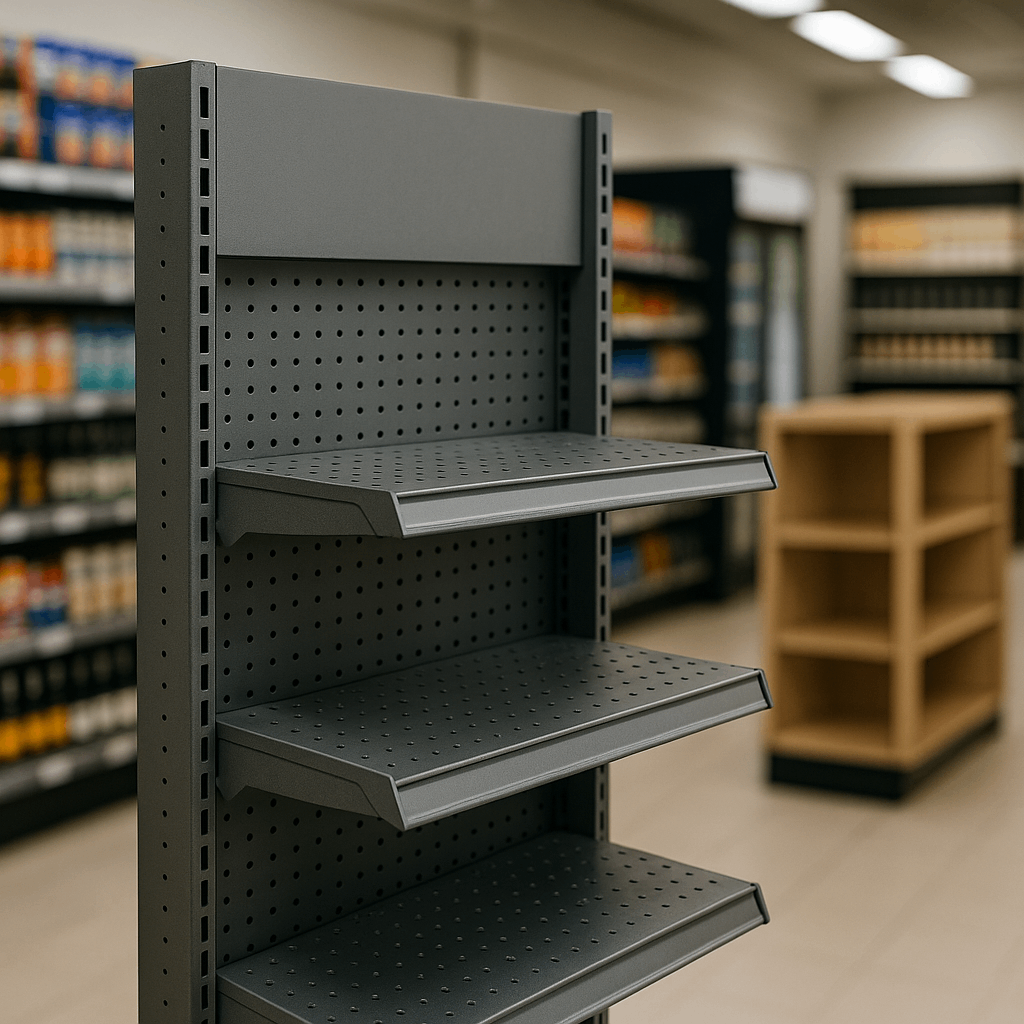
I. Introduction: Why Metal Displays Have Become a Procurement Priority
For international wholesale buyers, retail fixtures are not decorative marketing pieces—they are operational assets that affect category performance, logistics efficiency, retailer satisfaction, and long-term programme cost. A well‑engineered metal display is far more than a stand for products: it protects heavy SKUs, supports multi‑market rollouts, reduces field failures, and strengthens negotiations with retailers.
This article is written specifically for overseas procurement teams sourcing engineered metal displays—not for end consumers. Every section reflects real challenges faced by importers, distributors, private‑label brands, and category managers working with hardware, automotive, beverage, sports, pet supplies, FMCG and convenience retail. The goal is to help buyers make confident decisions using measurable criteria: structural reliability, freight optimisation, compliance alignment, and multi‑year ROI.
Yishang Display manufactures custom metal fixtures for global brands and suppliers, with a focus on export-ready engineering. The insights here are built on practical collaboration with B2B customers—not theory.
II. What Custom Metal Displays Mean in Professional Procurement
In global sourcing, “custom displays” must go far beyond cosmetic adjustments. A procurement‑ready metal fixture requires four layers of engineering clarity:
1. Structural engineering
Load calculations, tube gauge selection, reinforcement strategy, weld quality control, and defined safety factors based on SKU weight and customer handling frequency.
2. Merchandising configuration
SKU spacing, peg layout, shelf angles, header integration, and category segmentation designed around planograms and regional assortment differences.
3. Environmental and usage durability
Coating thickness, corrosion resistance, scratch resistance, and tolerance to common store cleaning agents—critical for beverages, convenience, and refrigerated zones.
4. Export logistics design
Flat‑pack structure, carton optimisation, container utilisation, and simplified assembly for global deployment.
Only when all four dimensions are addressed can buyers expect consistent performance across multi‑market retail environments.
III. Why Generic Displays Increase Long-Term Procurement Costs
Procurement teams often evaluate initial unit price, but generic displays introduce compounding risks across the supply chain.
Structural instability
Lightweight MDF, low‑gauge metal, or plastic fixtures deform under heavy loads. In hardware, beverages, automotive accessories, and household tools, this leads to safety concerns and store‑level removal.
Brand inconsistency
Generic racks lack controlled finishes, precise colour matching, or durable signage areas. After several weeks in-store, branding deteriorates—reducing perceived product value and weakening buyer–retailer negotiations.
Operational inefficiencies
Bulky packaging increases ocean freight. Tools and brackets vary unpredictably across batches. Assembly takes longer than retailers expect. Replacement cycles accelerate. These inefficiencies often exceed the savings of a lower upfront cost.
IV. Key Benefits of Custom Metal Displays for B2B Procurement Programmes
A. Structural Reliability for Heavy-Duty Retail Conditions
Metal displays engineered for defined load cases provide predictable stability. Reinforced supports, controlled weld penetration, and structural bracing prevent twisting, bowing, or collapse—even under continuous customer interaction.
For procurement teams operating multi‑SKU categories, this greatly reduces service tickets, emergency replacements, and retailer complaints. Powder coating and anti‑corrosion treatments extend usable lifespan across humid, high‑traffic, or refrigerated environments.
B. Optimised Merchandising and SKU Organisation
A well‑designed metal display improves category navigation, reduces shopper hesitation, and keeps assortments orderly despite frequent handling. Adjustable shelves, pegboards, wire baskets, and dividers support regional SKU differences without re‑engineering.
These capabilities give buyers flexibility to supply big‑box, convenience, DIY, and specialty retail formats using a unified base design—lowering tooling cost and simplifying procurement cycles.
C. Durable and Consistent Branding Across Markets
Metal fixtures provide stable surfaces for laser‑cut logos, durable sign frames, LED headers, and colour‑matched powder coatings. Unlike MDF or plastic, metal does not fade, warp, or degrade quickly.
For procurement teams managing distributor networks or multi-country rollouts, this consistency strengthens brand presence and reduces the cost of reprinting graphics or replacing damaged fixtures.
D. Better Operational Efficiency: Warehousing, Shipping, and Store Handling
Custom metal displays can be engineered for flat‑pack shipping, reducing container volume and ocean freight cost. Standardised fasteners and clear assembly logic cut installation time—an important factor for retailers operating under strict labour constraints.
During day‑to‑day use, metal withstands impacts, chemical cleaners, moisture, and constant planogram resets. Procurement teams benefit from fewer damaged units, fewer retailer claims, and smoother long-term relationships.
E. Lower Total Cost of Ownership (TCO) and Higher Multi-Year ROI
When analysed using cost‑per‑store‑per‑year models, metal displays consistently outperform alternatives. A steel fixture deployed for 3–5 years delivers stable ROI even when global freight costs fluctuate.
For long‑term assortments or evergreen product lines, metal fixtures reduce replacement cycles, simplify forecasting, and support predictable budgeting across regions.
F. Sustainability and ESG-Driven Procurement
Metal displays are inherently recyclable and generate less waste than single‑use or mixed‑material fixtures. Their long lifespan helps procurement teams meet retailer sustainability frameworks and respond to ESG reporting requirements.
Steel and aluminium retain structural integrity through repeated recycling, supporting circular economy goals without compromising retail performance.
V. Why Metal Outperforms Other Materials in Heavy-Duty Retail Settings
A direct comparison helps procurement teams justify material choices:
| Material | Durability | Load Capacity | Environmental Resistance | Reusability | Recommended Use |
|---|---|---|---|---|---|
| Cardboard | Low | Very Low | Low | One Time | Short promotions |
| Wood | Medium | Medium | Sensitive to humidity | Moderate | Lifestyle branding |
| Acrylic | Medium | Low | Prone to scratches | Moderate | Premium accents |
| Metal | High | High | High | Excellent | Multi-year, heavy-duty retail |
Metal is the only material that simultaneously supports heavy SKUs, multi-year deployment, flat‑pack shipping, and cross‑market consistency.
VI. How Procurement Teams Should Plan Custom Metal Display Projects
Effective sourcing requires alignment between commercial goals and engineering criteria. Buyers should define:
- SKU weight and high‑frequency handling patterns
- Required shelf count and category segmentation
- Retailer‑specific compliance or planogram rules
- Flat‑pack or pre‑assembled shipping requirements
- Regional variations across export markets
Collaborating early with manufacturers such as Yishang Display provides access to engineering drawings, structural validation, sample testing, and controlled production processes—reducing approval delays and ensuring batch consistency.
Modularity is especially useful for global rollouts. A single core metal system can support pegboard layouts in the U.S., shelf-driven layouts in Europe, and compact footprints in Asia—without new tooling.
VII. Future Trends: Why Metal Will Remain the Foundation for Retail Fixtures
Retail compliance requirements are tightening. Major chains now request clear load ratings, stability tests, coating certifications, and recyclability information. Metal structures meet these requirements with predictable performance.
Digital integration is increasing. More displays incorporate QR frames, small screens, LED strips, or motion sensors. Metal frames support wiring, heat dissipation, and impact protection better than other substrates.
Sustainability expectations will continue to rise. Long-life, recyclable fixtures help procurement teams align with retailer ESG goals while reducing waste from short-term MDF or cardboard units.
VIII. Conclusion: A Stable, Scalable Foundation for Multi-Market Retail Execution
For global wholesale buyers, custom metal displays provide the structural reliability, branding consistency, operational efficiency, and long-term cost control that generic fixtures cannot deliver. They are not simply merchandising tools—they are strategic procurement assets.
Yishang Display supports distributors, brands, and importers with engineered metal fixtures designed for heavy-duty global retail environments. If you would like to explore specifications or request technical guidance for your next programme, our team is ready to assist.