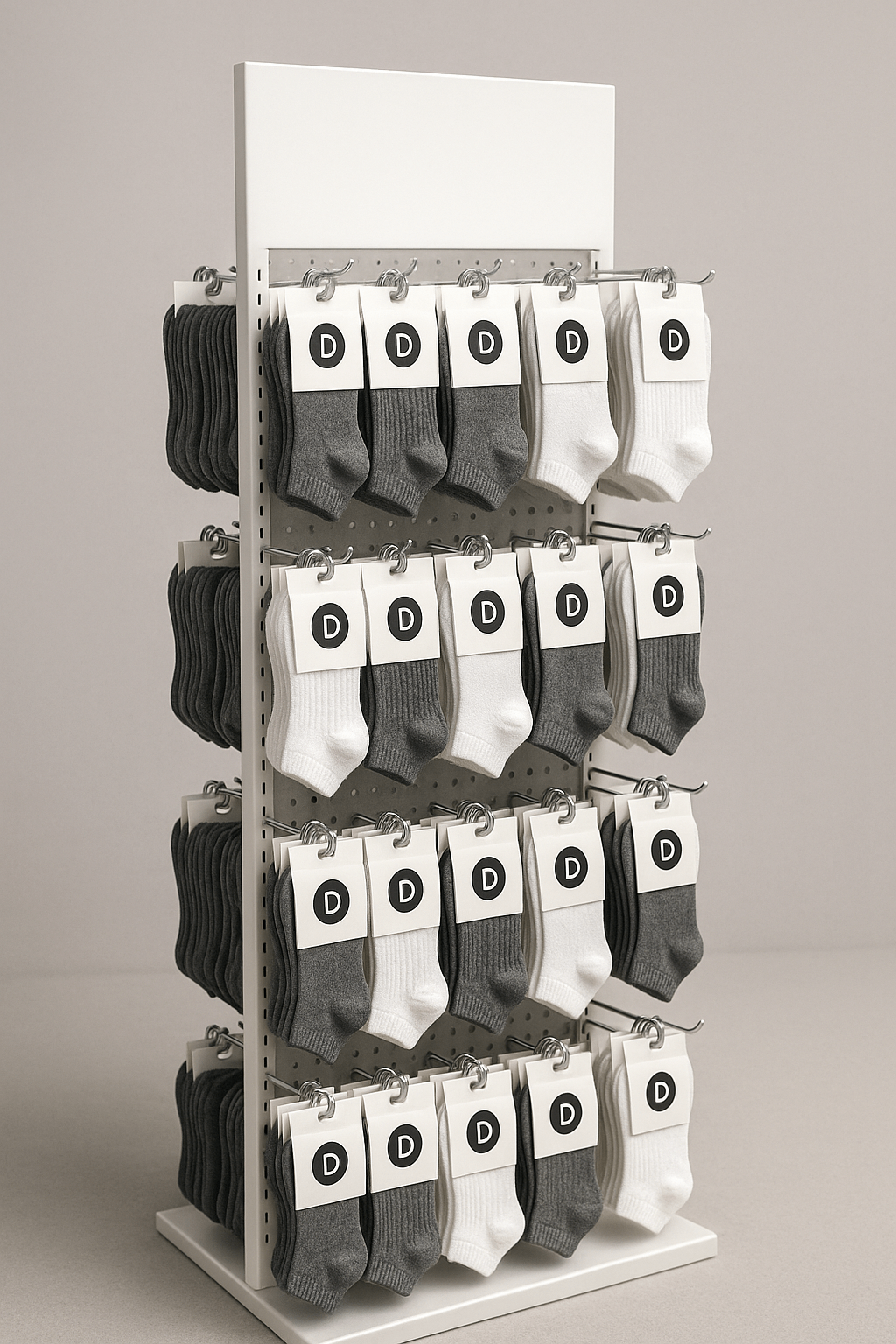
The double-sided custom retail sock display rack hanging stand with hooks is engineered to meet the operational demands of modern retail chains, distributors, and procurement managers responsible for multi-store deployments. In categories like socks, where assortments shift frequently and SKU counts remain high, retailers rely on fixtures that provide clear visibility, stable long-term performance, and effortless restocking. This freestanding metal rack is developed specifically for these requirements, providing durable structure, high merchandising capacity, and consistent presentation across diverse store formats.
For wholesale purchasers, a display system must deliver more than visual appeal. It must support varied packaging sizes, withstand consistent customer interaction, and maintain uniform performance in different international environments. This double-sided metal fixture addresses these needs with a vertical merchandising format that maximizes space efficiency while presenting products in a well-structured layout. Each hook maintains a defined spacing to keep packaging aligned, preventing the visual clutter that typically occurs with folded shelf displays or dump bins.
Designed for bulk distribution programs, the rack ensures predictable performance across large order quantities. Its metal construction enhances structural integrity, making the fixture suitable for heavy daily use in supermarkets, apparel chains, sports retailers, and convenience formats. For buyers managing rollouts across multiple regions, this uniformity is instrumental in maintaining consistent store standards and reducing fixture-related maintenance costs.
The compact footprint supports flexible placement in tight floor plans while delivering a surprisingly high SKU density. By elevating merchandise vertically and offering two complete display faces, the stand increases the number of sellable facings without restricting customer flow. This level of efficiency is especially useful in stores handling seasonal rotations or promotional cycles, where fixtures must support fast changes without compromising stability or product accessibility.
The double-sided configuration enhances SKU exposure by presenting merchandise from two opposing panels, allowing customers to approach the display from multiple directions without encountering blind spots. For purchasing teams planning layouts in compact spaces, this design reduces the number of fixtures required to achieve desired presentation volumes. The result is better inventory visibility with fewer units occupying floor space.
From a planning standpoint, double-sided fixtures contribute to improved store traffic efficiency. When placed in central aisles or promotional zones, they create viewing opportunities for customers moving in both directions. Retailers consistently report that dual-facing displays generate higher engagement for small packaged items like socks, where selection decisions are made quickly. The vertical sightline further supports consumer recognition of color variations, size distinctions, and packaging styles, improving turnover speed for fast-moving SKUs.
In large-scale procurement scenarios, double-sided metal racks minimize the need for fixture diversification because a single model can serve footwear sections, promotional islands, or accessory zones. This simplifies procurement logistics and ensures standardized fixture sets across different store formats. It also increases installation efficiency, reducing labor requirements during setup.
Hook-based presentation plays a critical role in product protection and display consistency. Unlike shelf stacking, which compresses packaging and requires frequent reshuffling, hook display keeps each sock pack suspended in its intended shape. This prevents damage to branding elements, maintains barcode visibility, and reduces product deformation — all important considerations for procurement teams aiming to deliver a clean, professional presentation in every store.
Operational efficiency is a major factor for retailers working with reduced staff. The hook system minimizes the time required for replenishment: staff can simply replace sold items by hanging new stock onto predefined positions. Because the hooks maintain alignment across rows, the store team avoids the time-consuming process of reorganizing products after customer browsing. Over large retail networks, these incremental time savings translate into measurable reductions in labor cost.
For wholesale buyers sourcing fixtures for multi-brand or multi-category sock assortments, hook spacing is a key parameter. This double-sided metal rack supports adjustable spacing that accommodates various packaging widths, allowing retailers to mix standard hooks, long multi-pack hooks, or specialty hooks for premium items. This adaptability ensures that a single fixture model remains compatible with evolving packaging trends, reducing the need for fixture replacement when product designs change.
The vertical merchandising strategy behind this socks hanging stand prioritizes SKU density without compromising accessibility. By projecting merchandise upward rather than outward, the rack frees valuable floor real estate for customer movement or additional displays. For procurement officers managing multiple store sizes, a vertical structure enables logical placement in narrow aisles, compact corner sections, or front-of-store promotional bays.
In international retail settings, footprints must comply with varied store layouts. The rack’s compact base supports placement in high-traffic zones without causing obstruction, while its tall, slim body ensures adequate product volume for stores with different stocking strategies. This flexibility helps wholesale buyers reduce the need for different fixture types across markets.
The fixture’s modular nature also benefits retail operators who update planograms seasonally. Whether promoting holiday socks, sports collections, or school-season assortments, the rack supports quick repositioning without requiring new hardware. For multi-store networks, this adaptability is especially valuable because it allows coordinated merchandising while respecting localized store constraints.
The primary structure of this double-sided custom retail sock display rack hanging stand with hooks is manufactured using high-strength steel engineered to maintain rigidity under continuous load. For procurement managers purchasing fixtures for multi-store rollouts, structural consistency is essential. The steel used in this rack offers predictable stability compared to mixed-material displays, ensuring each unit performs identically across different store environments.
Metal is selected for its superior resistance to deformation, impact stress, and long-term fatigue. When customers interact repeatedly with hooks — removing and replacing sock packs — the frame must remain stable without developing looseness or vibration. Steel tubing with controlled wall thickness ensures that vertical and horizontal supports remain aligned over years of commercial use. This reliability reduces maintenance requirements and prevents variations in store presentation across locations.
Surface treatment is an equally important component of durability. The powder-coated finish provides protection against corrosion, abrasion, and environmental humidity. Powder coating undergoes high-temperature curing, creating a dense, uniform surface resistant to chipping. For premium retail settings or fixtures exposed to constant handling, chrome-plated finishes are available. Chrome adds a reflective, clean look while providing enhanced defense against scratching and chemical exposure.
A professionally treated metal surface ensures that the rack retains its visual quality throughout seasonal rotations and frequent product changes. For wholesalers shipping to regions with diverse climates, a corrosion-resistant finish helps maintain fixture stability during transport and long-term use, minimizing post-installation issues.
Hooks are the operational core of a hanging stand with hooks, and their engineering determines the rack’s merchandising stability. Precision-manufactured metal hooks with diameters between 4 and 6 millimeters support uniform load distribution. This capacity allows retailers to stock multi-pack bundles, winter-weight socks, or heavy promotional assortments without bending or distortion.
For bulk procurement, predictable performance is essential. Hooks undergo anti-bend reinforcement at the contact point where they anchor into the pegboard or slatwall panel. This reinforcement resists lateral pressure from customers pulling products at different angles. Over thousands of interactions, the hook remains straight, maintaining the clean horizontal alignment that buyers expect across store networks.
Load testing indicates that each hook supports between 3 and 5 kilograms depending on its thickness and length. For procurement teams working with packaging variations across markets, this load tolerance provides broad compatibility. Whether stocking lightweight low-cut socks or thick thermal pairs, the fixture delivers consistent performance.
The hook geometry also ensures natural product balance. Packages remain front-facing without excessive tilt or overlap, preventing visual clutter and improving customer scanning efficiency. This level of engineering helps reduce product-handling errors and supports fast restocking routines.
Pegboard or slatwall panels form the core of the display area. These metal panels incorporate evenly spaced perforations created through precision stamping, ensuring that holes remain uniform for consistent hook placement. Accurate spacing preserves symmetry across rows and columns, which is a key factor in maintaining a clean, professional presentation in large retail formats.
Reinforced metal panels resist flexing under load. When hooks are fully stocked, lower-quality fixtures often sag or bend, creating uneven levels across the display. This double-sided rack uses structured reinforcement behind the perforated panel to enhance load distribution and maintain flatness. For procurement teams scaling up for multi-store deployment, this stability ensures that store layouts retain uniform visual factors.
The selected steel thickness — typically between 0.7 and 1.2 millimeters — is determined by expected stocking requirements and the need to balance weight with mobility. A thicker panel offers higher load tolerance, suitable for stores with high-volume merchandising. Thinner panels support lightweight configurations without compromising stability.
Surface finishing of the panel matches that of the rack frame. Powder-coated or chrome-plated finishes create a cohesive appearance and provide protection against moisture, fingerprints, and daily friction. Over time, this ensures that the metal panels retain their color and structural clarity despite constant interaction.
The double-sided panels allow buyers to maximize display capacity without increasing store footprint. Each panel functions independently, supporting flexible hook configurations that accommodate different product assortments. For procurement teams supplying stores across regions with varied planogram rules, this modular approach reduces the need for different fixture models.
The precise perforation pattern ensures that hooks can be repositioned to support seasonal changes, brand promotions, or category restructuring. This capability adds long-term value, allowing buyers to deploy the same fixture for years without replacement. For retailers using diverse packaging styles, the panel spacing supports consistent alignment whether using short hooks, long hooks, or specialty hooks for promotional formats.
Because the panels remain rigid even when fully stocked, the rack maintains structure during high shopping volume. This is particularly important in supermarkets or sports retailers where customers frequently interact with products. Stable panel alignment reduces visual noise and ensures that the display maintains a professional appearance across daily operations.
The base of the display rack is engineered with center-of-gravity calculation to prevent tipping in busy stores. As customers remove products from upper rows, a poorly weighted rack may lean or lose balance. This double-sided unit incorporates reinforced weight distribution to sustain stability whether the load is balanced or concentrated on one side.
Base dimensions typically range from 350×350 to 450×450 millimeters. This ensures a stable foundation while still supporting compact placement in narrow aisles or promotional zones. For procurement teams evaluating fixtures for global rollouts, these size ranges match common international retail spacing guidelines, making integration into various store formats straightforward.
Mobile base options include high-quality casters with locking mechanisms. These allow staff to reposition the rack quickly during layout changes while maintaining safety once the fixture is locked in place. Retailers running frequent promotional updates benefit from this mobility because it simplifies transitions between campaigns without requiring additional equipment.
In high-traffic environments, a stable base is essential not only for safety but also for protecting merchandise. A fixture that remains firmly in place reduces accidental knocks and product drops, minimizing shrink and improving overall operational efficiency.
Customization plays a central role in aligning fixtures with store concepts. Yishang Display supports tailored specifications to help procurement teams adapt the display stand to regional branding, assortment size, or operational requirements. Buyers can specify rack height, panel width, hook count, finish color, and branding elements for the header display zone.
Retailers with multi-brand assortments may require neutral finishes, while fashion-focused stores might prefer bold colors or materials that align with visual merchandising themes. Accessory modules — such as lighting strips, side panels, or brand header boards — can be integrated to enhance product segmentation or promotional storytelling.
Customization also helps ensure compatibility with existing display hardware in large retail networks. Procurement teams can request specific dimensions to match current fixtures, ensuring cohesive arrangement across store chains without redesigning planograms.
For procurement teams managing fixture rollouts across multiple markets, technical clarity is essential. This double-sided custom retail sock display rack hanging stand with hooks is engineered with specifications aligned to global retail fixture norms, allowing consistent deployment regardless of store format or region. The data below provides a framework for evaluating compatibility with SKU assortment, load expectations, and spatial constraints.
| Specification Category | Options / Data |
|---|---|
| Height Range | 1500–2000 mm standard, customizable for regional planograms |
| Display Faces | 2 (double-sided vertical panels) |
| Panel Type | Metal pegboard (25 mm perforation spacing) or metal slatwall |
| Steel Thickness | 0.7–1.2 mm based on load requirement |
| Hook Length Options | 150 mm, 200 mm, 250 mm |
| Hook Diameter | 4–6 mm depending on product weight |
| Load Capacity per Hook | 3–5 kg validated under dynamic pull testing |
| Base Dimensions | 350×350, 380×380, or 450×450 mm |
| Surface Treatment | Powder coating (matte or semi-gloss) or chrome plating |
| Optional Accessories | Header signage board, caster base, side panels |
| Material Origin | High-strength steel sourced from Guangdong Province, China |
These specifications are structured to support procurement decisions based on fixture longevity, stocking capacity, and compatibility with international retail guidelines. The ability to modify dimensions or finishes ensures that buyers can tailor the rack to specific branding or operational needs without deviating from core structural stability.
In sporting goods stores, socks are frequently cross-merchandised with footwear. This double-sided metal sock display rack allows performance socks to be categorized by activity type such as running, hiking, training, or outdoor use. Hooks enable clear segmentation, helping customers identify features like cushioning, compression, or moisture-control technology. From a buyer’s perspective, the fixture’s structure supports consistent product zoning across locations, enabling stores to mirror standardized layouts without requiring separate fixture types for different sports categories.
Procurement teams distributing products to chains with high restocking cycles benefit from the rack’s ease of maintenance. Staff can perform rapid replenishment due to the clear hook alignment, improving operational efficiency during high traffic periods. The metal frame maintains consistency despite repeated interactions common in sports retail environments.
Fashion retailers require a flexible fixture that can adapt to seasonal color rotations, promotional capsules, and themed displays. The double-sided format supports dual merchandising strategies—for instance, presenting essential everyday socks on one side while showcasing seasonal designs on the other. This arrangement increases SKU visibility while enabling stores to shift themes without adding new fixtures.
For procurement managers coordinating multi-store seasonal rollouts, consistency across locations is crucial. The standardized hook spacing and panel configuration allow unified presentation of collections regardless of store size, ensuring that branding and merchandising strategy remain cohesive in each market. The metal construction maintains alignment throughout frequent seasonal changes.
In mass retail formats, sock sales are driven primarily by impulse purchasing. The rack’s vertical structure and narrow base support placement in corridors, endcaps, or promotional islands where customer flow is highest. Because the display does not rely on shelves, products remain consistently visible and accessible even when stock levels fluctuate.
For procurement teams responsible for fixtures across hypermarket chains, durability and low maintenance requirements are major considerations. This metal socks hanging stand maintains its structure over extended operating hours, minimizing store staff involvement in maintaining fixture alignment. Its high load capacity allows retailers to maximize inventory per unit, supporting weekly promotional volumes without compromising stability.
Airports, stations, and transit retail environments demand displays that provide maximum exposure with minimal footprint. The narrow profile and double-sided visibility make this rack well-suited for these compact spaces. Customers navigating quickly through travel zones benefit from a clear, front-facing product layout.
Procurement teams maintaining travel retail networks prioritize fixtures that can withstand heavy foot traffic while supporting frequent restocking cycles. This rack addresses these needs with reinforced hooks and stable base engineering. The vertically oriented design ensures merchandise remains visible from a distance, increasing the likelihood of impulse purchases in fast-paced environments.
Retailers operating in compact floorplans or specialty stores often require fixtures that support full circular browsing. A rotating variant of the double-sided metal display rack allows customers to spin the unit for easier access to all hooks. This is especially beneficial when stores offer extensive SKU assortments in limited space.
From a procurement standpoint, rotating fixtures reduce the need for multiple stands placed side by side. This improves space efficiency while still offering high product exposure. Heavy-duty bearings ensure smooth rotation without compromising the fixture’s load capacity or stability.
Stores that update merchandising plans frequently—such as supermarkets, sporting chains, or hypermarkets—benefit from a caster-equipped version of the rack. Lockable industrial-grade casters allow staff to reposition the display easily during seasonal resets or promotional campaigns.
Procurement teams appreciate mobile variants because they reduce labor costs associated with fixture movement. One fixture can support multiple layout strategies over its lifecycle, enhancing long-term value and reducing the need to purchase multiple fixed units.
For retailers managing high SKU density or operating in regions with larger store footprints, extended-height variants provide greater vertical merchandising space. A multi-tier version supports additional hook rows, enabling stores to display more product lines without increasing floor usage.
Buyers coordinating global rollouts benefit from the ability to match fixture height to regional ceiling standards or visual merchandising requirements. Taller variants conform to the same structural integrity standards, ensuring stability despite increased load.
To maintain cohesive branding in multi-store networks, procurement teams can specify customization options including panel colors, powder-coated finishes, store identity signage, or branded header boards. Because the core structure remains unchanged, retailers achieve brand alignment without affecting load capacity or fixture durability.
These customization options help ensure that the fixture integrates seamlessly into varied retail aesthetics, whether minimalist modern stores, lifestyle boutiques, or industrial-themed environments.
Yes. The metal pegboard or slatwall panel uses standardized perforation spacing, allowing hooks to be repositioned according to packaging width or SKU assortment. This is useful for buyers managing multiple sock suppliers or packaging updates across seasons. Adjustable spacing ensures compatibility with both lightweight single-pair packs and larger multi-pack bundles, keeping the fixture flexible for long-term use.
Heights between 1800 mm and 2000 mm provide strong vertical visibility while maintaining a safe center of gravity under typical stocking conditions. For regions with strict safety codes or narrow aisles, buyers can specify a shorter height to match local guidelines. Both standard and extended-height options undergo stability testing to ensure reliable performance in high-traffic environments.
Yes. Unless a custom panel pattern is requested, the hook connections follow widely used industry standards. This means buyers who already use pegboard or slatwall fixtures in other categories can integrate the same hooks or accessories with this metal sock display rack. Cross-compatibility reduces inventory of spare parts and simplifies long-term fixture management.
The structure supports a variety of products with similar weight profiles. Retailers commonly use it for gloves, headwear, packaged fashion accessories, or small sporting items. The hook system is designed to stabilize lightweight merchandise without causing sagging or overlap, making it suitable for multiple accessory categories.
Each hook is rated to support 3–5 kilograms depending on length and diameter. Metal reinforcement at the contact point prevents bending even when customers remove products repeatedly throughout the day. For buyers sourcing fixtures for chains with long operational hours, the predictable load performance helps ensure merchandise remains aligned and visually consistent.
Before ordering, buyers should assess the expected SKU range, packaging size variation, and turnover rates. Stores with high SKU density benefit from longer hooks or extended-height versions, while stores with frequent product changes may prefer shorter hooks for easier management. Understanding the merchandise flow helps select a configuration that minimizes labor during restocking and maximizes facings.
Evaluating store traffic flow ensures the rack is sized appropriately for aisles, promotional zones, or accessory departments. A compact base is advantageous for narrow aisles but should still match required stability standards. For multi-store deployment, consistent dimensions across locations reduce layout complexity and simplify installation.
Buyers should also confirm whether stores require mobile or fixed bases. Mobility is useful for promotional rotations, while fixed bases are preferred for high-density zones where stability takes priority.
Buyers can select powder coating for general use or chrome finishes for premium environments. If the stores are located in humid regions, corrosion-resistant coatings help preserve fixture longevity during daily cleaning and high customer contact. This consideration prevents finish degradation and ensures cohesive presentation across seasons.
Selecting a consistent finish also helps unify the visual identity across retail networks, maintaining alignment between stores and enhancing brand cohesion.
For overseas shipments, proper packaging is essential to avoid scratches, dents, or deformation during transit. Fixtures from Yishang Display are typically protected with corner guards, bubble wrap, and reinforced cartons suitable for container loading. Buyers coordinating large-volume imports should specify any additional packaging requirements, especially for long-distance sea freight.
Ensuring structured packaging reduces the need for post-delivery adjustments and keeps installation schedules on track during multi-store rollouts.
Buyers may provide detailed specifications for header signage, panel color, hook type, or display height. Clear instructions help ensure the final product aligns with corporate identity and existing fixture sets. For buyers managing large-scale deployments, consistent customization across stores enhances visual order and ensures seamless integration into current merchandising strategies.
If you are planning a bulk procurement program or multi-store rollout and need a display solution engineered for long-term stability, retail efficiency, and consistent performance, you may contact Yishang Display for detailed configurations or a quotation adapted to your project requirements.


Yishang Display specializes in crafting bespoke display solutions. From initial concept and prototyping through to full-scale production, our in-house team manages every phase—delivering a seamless, one-stop experience for your brand.
If you have any questions or need a quote, please send us a message. One of our specialists will get back to you within 24 hours and help you select the correct valve for your needs.
All of our products are available for sampling